Fair Oaks Gutter Guards and Downspouts: Leaf Loads, Fascia Rot, and Drainage Scope
The gutter problem usually looks small from the ground until the first contractor points out where the water has been going.
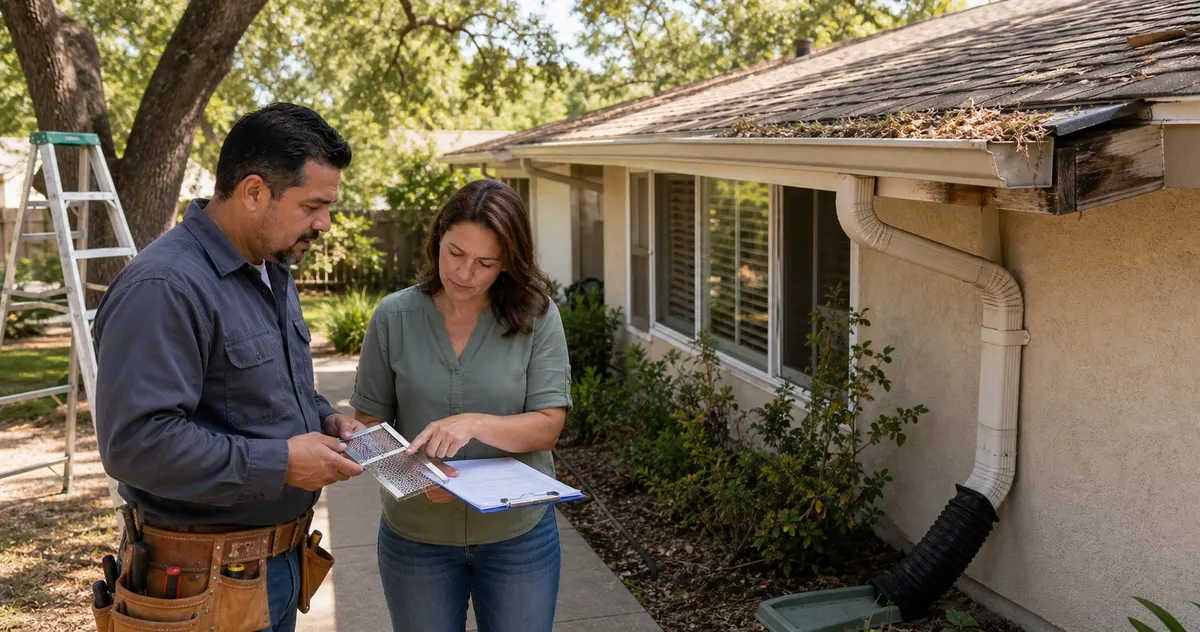
A Fair Oaks homeowner notices oak leaves packed along one roof edge, a dark stain on the fascia near the patio, and a downspout that drops roof water into the same planting bed every storm. The house is not leaking inside. The gutters are not falling off. It is tempting to call this a cleaning job and move on. Then the gutter contractor asks whether the guard system can handle oak leaves and fine debris, whether the fascia is soft behind the old hangers, whether the gutters are sized for the roof area, and where each downspout should discharge once the water leaves the house.
That is when a simple gutter question becomes a water-management project. In Fair Oaks, mature trees are part of the appeal. They also turn gutters into roof-edge filters, push debris into valleys, hide fascia damage, and make downspout routing matter more than the shiny guard sample on the sales table.
Use this chart before comparing gutter bids. In Fair Oaks, the cleanest scope usually separates guard type, fascia repair, gutter sizing, downspout routing, and tree maintenance instead of treating everything as one line item.
Start at the Roof Edge, Not the Guard Sample
Gutter guards are easy to sell because they solve a problem homeowners can see. The better first question is why the gutter is clogging, where the water goes when it overflows, and what condition the roof edge is in now.
On many Fair Oaks homes, gutters sit under valley oaks, liquidambars, pines, and mixed mature canopy. Large leaves are only part of the issue. Small seed pods, roof grit, pollen strings, pine needles, and decomposed leaf sludge can mat over a screen, collect behind a reverse-curve guard, or settle in inside corners. A guard that handles big leaves may still let fine debris build into a muddy line that slows water during the next storm.
Ask the contractor to walk the whole roof edge from the ground before recommending a product. Which roof planes dump into short gutter runs? Are there inside corners where debris piles up? Is the gutter pulling away because the fascia is soft, or because old spikes have loosened? Are there black streaks under the gutter, water marks behind the fascia, or soil washed out below the downspout?
Those answers decide whether you need cleaning, guards, new seamless gutters, fascia repair, additional downspouts, or a drainage fix after the downspout. The guard sample comes after that.
Fair Oaks Leaf Load Changes the Guard Choice
No gutter guard is maintenance-free in a neighborhood with mature trees. The useful question is which system reduces the right kind of maintenance for your house.
Basic screens can work on simple rooflines when the debris is mostly larger leaves and the homeowner is comfortable with periodic brushing or blowing. Micro-mesh systems can be better when fine debris and roof grit are the problem, but the edge detail, fastener method, and cleanout access still matter. Foam and brush inserts are cheap, but they can trap organic material and may become their own maintenance problem under heavy canopy.
Do not let a contractor sell "never clean your gutters again" as the whole pitch. Ask what happens in late fall, after a wind event, and after pollen season. Ask whether debris will shed off the guard or sit on top. Ask how the system is removed or opened if a section clogs. Ask whether the guard changes the roof warranty, touches shingles, or fastens through a part of the roof edge that should not be pierced.
The best answer may be different on the front of the house than the back. A low roofline under oaks may need premium guards and a maintenance plan. A clear garage run may only need standard seamless gutter and a better downspout.
Downspouts Are Not an Afterthought
Gutters collect water. Downspouts decide whether the job helped.
Fair Oaks has plenty of older ranch homes, sloped lots, tight side yards, patios near the foundation, and planting beds that were never designed to take concentrated roof runoff. If a downspout dumps next to the slab, into a low bed, against a crawl-space vent, or across a walkway, the new gutter system can move water faster to the wrong place.
A useful estimate should show downspout locations and discharge points. Sometimes the fix is simple: add a downspout, extend it several feet away from the foundation, use a splash block, or route it to a visible landscape area that can handle the water. Sometimes the job needs a landscaper or drainage contractor to connect downspouts to solid pipe, a pop-up emitter, a dry creek bed, or a larger drainage plan.
Be careful with underground drain tie-ins that sound neat but are not explained. You need slope, cleanouts, pipe size, outlet location, and a plan for leaves that get past the guard. A buried pipe with no cleanout can become a hidden clog that is harder to fix than the old open downspout.
What a Useful Estimate Should Separate
For a small single-story Fair Oaks home, gutter cleaning or a limited repair may be a few hundred dollars. New seamless aluminum gutters on a typical ranch home often land in the low-to-mid thousands. Gutter guards, extra downspouts, two-story access, fascia repair, wood replacement, paint touch-up, or drainage piping can move the project into the $4,000 to $12,000-plus range. Larger custom homes, steep rooflines, heavy wood repair, premium guard systems, copper, or broader drainage work can push higher.
Ask each bidder to separate:
- Existing condition. Which gutters are clogged, sagging, leaking, undersized, or pulling away from the fascia.
- Cleaning versus replacement. Whether the bid includes flushing, resealing corners, re-hanging sections, or full replacement.
- Gutter material and size. Seamless aluminum or another material, 5-inch versus 6-inch, color, gauge, and total linear footage.
- Guard system. Screen, micro-mesh, reverse-curve, foam, brush, or no guard, plus how it is fastened and maintained.
- Fascia and roof-edge repair. Who replaces soft wood, who paints it, and whether hidden rot is handled by allowance, unit price, or change order.
- Downspouts. Number, size, locations, elbows, straps, extensions, splash blocks, and whether more outlets are needed.
- Drainage. Where water goes after the downspout, whether underground pipe is included, cleanout locations, outlet location, and landscape repair.
- Access and safety. Ladder access, two-story sections, tight side yards, patio covers, pool areas, and overhead branches.
- Disposal and warranty. Old gutter removal, haul-off, workmanship warranty, guard warranty, and what maintenance keeps coverage valid.
Two bids can look far apart because one includes fascia repair and drainage while the other only installs guards on a failing gutter. Compare the assumptions before you compare the totals.
Which Contractor Should You Call?
Start with a licensed gutter or sheet-metal contractor for straightforward seamless gutters, downspouts, and guard installation. In California, gutter installation commonly fits a C-43 sheet metal contractor, though some roofing contractors and general contractors may handle gutters when they are part of a larger roof-edge or exterior repair scope. Verify the active CSLB license before signing.
Bring in a roofing contractor if the roof edge is failing, shingles are damaged, gutters tie into a reroof, or water has backed under the roof covering. Bring in a general contractor or qualified carpenter if fascia, rafter tails, soffits, siding, or trim need more than minor replacement. Bring in a landscaper or drainage contractor when downspouts need to connect to yard drainage, grading, dry creek beds, or underground pipe. Bring in a tree service when branches over the roof are causing the maintenance problem, but confirm protected-tree rules before major pruning or removal.
The right lead depends on the cause. If the gutter is sound but water exits in the wrong place, a gutter installer alone may not solve the problem. If the fascia is soft, a guard installer should not simply fasten new hardware into bad wood and leave.
Permits, Licensing, and Safe Roof Work
Straightforward gutter and downspout replacement is usually treated as maintenance and typically does not need a building permit in Sacramento County. That can change when the work includes significant fascia reconstruction, structural roof-edge repair, grading changes, underground stormwater drainage, or a larger reroof or remodel. Fair Oaks is unincorporated, so Sacramento County is the jurisdiction to check when the scope goes beyond normal gutter replacement.
Licensing matters because most real gutter projects exceed California's $1,000 contractor threshold once labor and materials are combined. Verify the CSLB license, bond, insurance, and workers' compensation status. If a crew will be on ladders or a roof, workers' compensation is not a minor detail.
Also ask how the contractor handles safety. Homeowners should not be expected to climb a ladder to inspect work or clear a test section. A professional should document conditions with photos, explain access limits, and use the right ladder and fall-protection practices for the roofline.
Red Flags in Gutter and Guard Bids
Slow down if you hear any of these:
- "These guards mean you will never clean gutters again" without a maintenance explanation.
- No one inspects or photographs the fascia before quoting.
- The bid omits gutter size, footage, guard type, downspout count, or old-gutter disposal.
- Downspouts end at the foundation, but the contractor says drainage is not their problem.
- Underground drains are included without pipe size, slope, cleanouts, or outlet location.
- The contractor wants to install guards on sagging, leaking, or undersized gutters without fixing the gutter first.
- There is no written plan for soft fascia, roof-edge damage, or hidden rot.
- The license number, insurance, or workers' compensation proof is vague.
Good contractors do not make gutters mysterious. They show you the roof-edge photos, explain what is failing, and make clear where their scope ends.
Questions to Ask Before You Sign
- What kind of debris is causing the clogging: leaves, needles, seeds, roof grit, or sludge?
- Do we need cleaning, repair, new gutters, guards, or all of those?
- Are the existing gutters correctly sized and sloped for this roof?
- What condition is the fascia in, and how will hidden rot be priced?
- How many downspouts are included, and where will each one discharge?
- If water needs to move farther from the house, is that in this bid or a separate drainage scope?
- How can the guards be cleaned or removed if a section clogs?
- Does the guard installation touch shingles or roof warranties?
- What license classification, insurance, bond, and workers' compensation coverage do you carry?
Those questions turn a product pitch into a real scope.
Internal Homework Before You Hire
For local context, start with our Fair Oaks contractor guide, compare licensed gutter installation contractors, roofing contractors, landscaping contractors, tree service contractors, foundation repair contractors, and general contractors. Use the contractor search when you are ready to build a shortlist.
For related planning, pair this with our Sacramento gutter installation cost guide, roof and gutter maintenance guide, roofing contractor guide, foundation drainage warning signs guide, Fair Oaks tree work planning guide, Sacramento County tree permit guide, California permit basics, and license verification guide.
The Bottom Line
A Fair Oaks gutter project should not start with the most expensive guard sample. Start with the roof edge, the trees above it, the wood behind it, and the water path below it. Hire the contractor who can explain all four, put the downspout plan in writing, and tell you when the job needs roofing, drainage, tree, or carpentry help instead of pretending a guard alone fixes everything.
Who to Hire for This Project
For the work covered in this guide, these are the contractor types to contact and the CSLB classification to verify before you take quotes:
Questions to Ask Before You Sign
- "Is your CSLB license active and bonded?" Verify it yourself at cslb.ca.gov the license number must appear on their bid.
- "Who pulls the permit, and is it included in the bid?" The contractor should handle any required permits a pro who suggests skipping one is a red flag.
- "Can you itemize labor, materials, and allowances?" Itemized bids are the only way to compare quotes on the same scope.
- "What's the payment schedule?" California caps the down payment at $1,000 or 10%, whichever is less payments should track completed work.
- "Who from this area can I call as a reference?" Ask for a recent local job of similar scope, not just photos.