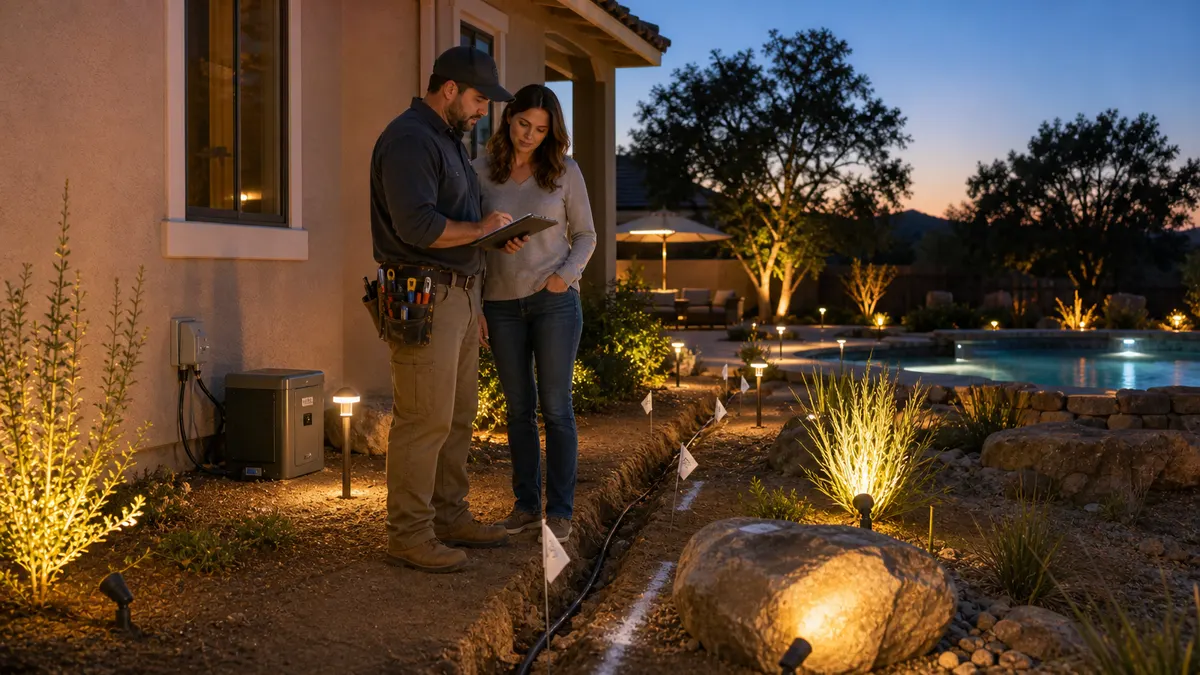
Granite Bay Landscape Lighting Planning: Trenching, Outdoor Power, and Pool-Side Safety
The prettiest landscape lighting problems usually show up after dark.
A Granite Bay homeowner adds a few path lights near the pool, then decides the oak canopy needs uplighting, the outdoor kitchen needs task lighting, the side gate needs a motion fixture, and the patio needs an outlet that does not trip every time the irrigation runs. By the second estimate, the project is no longer "just lights." It is trenching, voltage drop, GFCI protection, transformer placement, pool clearances, irrigation conflicts, and possibly a Placer County permit question.
That does not mean landscape lighting has to become a major remodel. It means the first contractor conversation should separate decorative lighting from electrical work. A good plan makes the yard safer and more usable. A rushed one leaves wires in bad soil, fixtures aimed into windows, overloaded transformers, damaged irrigation, or pool-side electrical details nobody wants to own.
Use this chart before comparing bids. A landscape lighting estimate is not ready to compare until power, trenching, water-area safety, fixture zones, controls, and service access are visible.
Start With the Yard You Actually Use at Night
Granite Bay yards often have several outdoor zones: the pool deck, a dining patio, side-yard access, mature trees, a driveway court, steps near grade changes, and planting beds that look good during the day but disappear after sunset. The lighting plan should start with how people move through the property, not with a fixture catalog.
Walk the yard after dark with a flashlight. Mark where guests step down, where the gate latch is hard to find, where the outdoor kitchen turns into a shadow, where pool glare hits the house, and where trees or boulders deserve accent lighting. Also note where you do not want light: bedroom windows, the neighbor's yard, reflective pool water, and dark-sky-sensitive open-space edges.
That walk changes the bid. Path lights for safe movement, uplights for trees, wall-wash fixtures, under-cap lights, step lights, and task lights all solve different problems. A contractor who cannot explain why each fixture belongs in that location may be selling parts, not designing a system.
Low Voltage Still Needs a Real Electrical Plan
Most residential landscape lighting is low voltage after the transformer, but the transformer still needs a suitable power source. If it plugs into an existing exterior GFCI-protected receptacle, the scope may be fairly contained. If the project needs a new outlet, a hardwired transformer, a new circuit, a timer, smart controls, conduit, a subpanel, or work near pool equipment, a licensed electrician should be part of the conversation.
Ask where the transformer will live. It should be accessible for service, protected from irrigation spray, sized for the fixture load, and close enough to reduce voltage drop. Large Granite Bay yards sometimes need multiple zones or transformers so fixtures at the far side of the property do not dim, flicker, or fail early.
The estimate should also say how wire connections are made. Direct-bury cable, waterproof connectors, conduit where needed, expansion room, and a labeled zone map make future maintenance much easier. The cheapest lighting job is rarely cheap if nobody can find the splice when a section goes dark.
Trenching: Call 811, Then Look for Private Lines
Any trenching around a Granite Bay yard deserves planning before a shovel hits the soil. California's 811 system is the starting point for public utility marking before digging. It is not the whole map of your backyard.
Landscape lighting routes often cross private irrigation lines, old low-voltage wires, pool equipment lines, gas to a fire feature or grill, drainage pipe, sleeve locations, abandoned sprinkler zones, and conduit installed during previous projects. Those private lines may not be marked by the 811 ticket. Ask the contractor how they will locate and protect them.
For homeowners, the practical homework is simple:
- Take photos of valve boxes, cleanouts, pool equipment, gas shutoffs, hose bibs, and exterior outlets.
- Tell the contractor about past pool, patio, irrigation, or outdoor kitchen work.
- Walk the proposed trench route before approval.
- Ask what happens if an irrigation or private utility line is found or damaged.
- Confirm whether digging crosses a driveway, retaining wall, pool deck, walkway, or drainage system.
Good contractors do not treat trenching as invisible labor. They show the route, explain the depth and protection method, and tell you how the yard will be restored.
Pool-Side Lighting Is Not Ordinary Yard Lighting
Granite Bay pool areas create a different risk profile. Fixtures, controls, outlets, junction boxes, transformers, bonding, and conduit near water should not be improvised by a general landscape crew. Even if the new lights are not underwater pool lights, work near a pool deck or equipment pad can touch electrical safety rules that need a qualified electrician.
Ask these questions before pool-adjacent work starts:
- Are any fixtures, outlets, transformers, or controls within the pool area?
- Is the work low voltage only, or does it add line-voltage power?
- Does the bid include GFCI protection where required?
- Will anything connect to pool equipment, automation, existing conduit, or bonding?
- Is a pool contractor or licensed electrician needed to inspect the setup?
- Are fixtures aimed to avoid glare across the water or into the house?
The right answer may be simple. The problem is when nobody asks.
What a Useful Estimate Should Separate
For Granite Bay homeowners, a small fixture refresh or repair may run around $1,500 to $4,500. A new low-voltage lighting system for paths, planting beds, and one or two trees often lands between $4,500 and $14,000 depending on fixture quality, zones, trenching, transformer size, and access. A larger property with pool-area coordination, outdoor kitchen lighting, new exterior outlets, smart controls, long wire runs, masonry or hardscape cuts, and multiple zones can move into the $12,000 to $35,000-plus range.
Ask each bidder to separate:
- Design and fixture plan. Fixture types, locations, beam spread, color temperature, glare control, and which night-use problems each light solves.
- Power source. Existing GFCI outlet, new exterior receptacle, hardwired transformer, new circuit, panel capacity, timers, and controls.
- Transformer and zones. Transformer size, spare capacity, voltage drop assumptions, zone layout, labeling, and service access.
- Trenching and restoration. 811 ticket responsibility, private-line locating, trench route, depth, conduit, boring, hardscape cuts, irrigation repair, soil replacement, and mulch or rock restoration.
- Pool and wet-area details. GFCI protection, pool equipment proximity, automation connections, bonding concerns, and whether a licensed electrician reviews the work.
- Permits and inspections. Whether Placer County permits are included, not required, or still to be confirmed.
- Maintenance. Warranty, bulb or integrated LED replacement, controller support, seasonal adjustments, and who fixes dead zones later.
If the bid only says "install landscape lights," it is not detailed enough for a property with a pool, outdoor kitchen, long runs, or new power.
Permits and Licensing in Granite Bay
Granite Bay is generally in unincorporated Placer County, so homeowners should start with Placer County Building Services when a project adds or changes regulated electrical work. The county's homeowner guidance says Placer County issues permits for projects in unincorporated areas, and its building permit guidance points homeowners to permit submittal paths for residential work and electrical-related projects. In 2026, new permit applications also need to follow the 2025 California Building Standards Code.
Plain-English rule: do not assume "outdoor lighting" is automatically permit-free. Replacing a few plug-in fixtures is different from adding a circuit, hardwiring a transformer, installing new exterior outlets, trenching conduit, touching pool equipment, or combining lighting with walls, patios, drainage, or an outdoor kitchen.
Licensing should match the work:
- C-10 electrical contractor. Use this when line-voltage wiring, exterior outlets, panels, circuits, hardwired transformers, pool-adjacent electrical work, or troubleshooting are in the scope.
- C-7 low-voltage systems contractor. This may fit communications and low-voltage system work, depending on the exact setup.
- C-27 landscaping contractor. This can fit broader landscape systems and improvements, especially when lighting is part of an overall landscape project.
- General contractor or specialty lead. Use a broader lead when the project also includes masonry, concrete cuts, retaining walls, outdoor kitchens, drainage, or several trades.
Ask the contractor to name the license classification that fits the work and to write down who is responsible for electrical permit questions.
Red Flags in Lighting Bids
Slow down if you see any of these:
- The contractor never visits after dark or asks how the yard is used at night.
- The bid ignores transformer location, wire routing, voltage drop, and service access.
- New outdoor outlets or circuits are included without a licensed electrician.
- Pool-adjacent work is treated like ordinary planting-bed lighting.
- The contractor says 811 is unnecessary because the trench is shallow.
- Private irrigation, gas, drainage, and pool lines are never discussed.
- The plan creates glare into windows, across the pool, or toward neighbors.
- The estimate has no fixture schedule, warranty terms, or zone map.
Good landscape lighting contractors can make a yard look better without making the electrical scope fuzzy.
Questions to Ask Before You Sign
- Which parts of the yard are we lighting for safety, task use, curb appeal, or accent?
- Will you demonstrate fixture placement before final installation?
- What power source are you using, and is it GFCI protected where needed?
- Is the transformer plug-in or hardwired, and who installs it?
- Who requests 811 marking, and how do you handle private lines?
- Does any part of the work require a Placer County permit or inspection?
- Are pool-area clearances, bonding, outlets, and controls reviewed by a licensed electrician?
- What happens if a wire, fixture, or zone fails after the job is complete?
If the written estimate cannot answer those questions, ask for a clearer scope before approving the project.
Internal Homework Before You Hire
For local context, start with our Granite Bay contractor guide, compare licensed electrical contractors, landscaping contractors, pool contractors, concrete contractors, and general contractors. Use the contractor search when you are ready to build a shortlist.
For related planning, pair this with our Granite Bay outdoor kitchen cost guide, pool remodel decision guide, pool equipment electrical planning guide, electrical panel upgrade guide, smart home wiring guide, and California permit basics.
The Bottom Line
A Granite Bay lighting project should make the yard safer, warmer, and easier to use after sunset. Start with nighttime movement, confirm the power source, respect the pool area, map the trench route, and hire the contractor who can explain both the pretty part and the electrical part before work starts.
Who to Hire for This Project
For the work covered in this guide, these are the contractor types to contact and the CSLB classification to verify before you take quotes:
Questions to Ask Before You Sign
- "Is your CSLB license active and bonded?" Verify it yourself at cslb.ca.gov the license number must appear on their bid.
- "Who pulls the permit, and is it included in the bid?" The contractor should handle any required permits a pro who suggests skipping one is a red flag.
- "Can you itemize labor, materials, and allowances?" Itemized bids are the only way to compare quotes on the same scope.
- "What's the payment schedule?" California caps the down payment at $1,000 or 10%, whichever is less payments should track completed work.
- "Who from this area can I call as a reference?" Ask for a recent local job of similar scope, not just photos.