Lincoln EV Charger Planning: Panel Capacity, Garage Layout, and Permit Questions
The charger is the easy part to picture. A clean white box on the garage wall, a cable wrapped neatly beside it, and the car plugged in every night instead of hunting for public charging.
The harder part is what happens before that box goes on the wall.
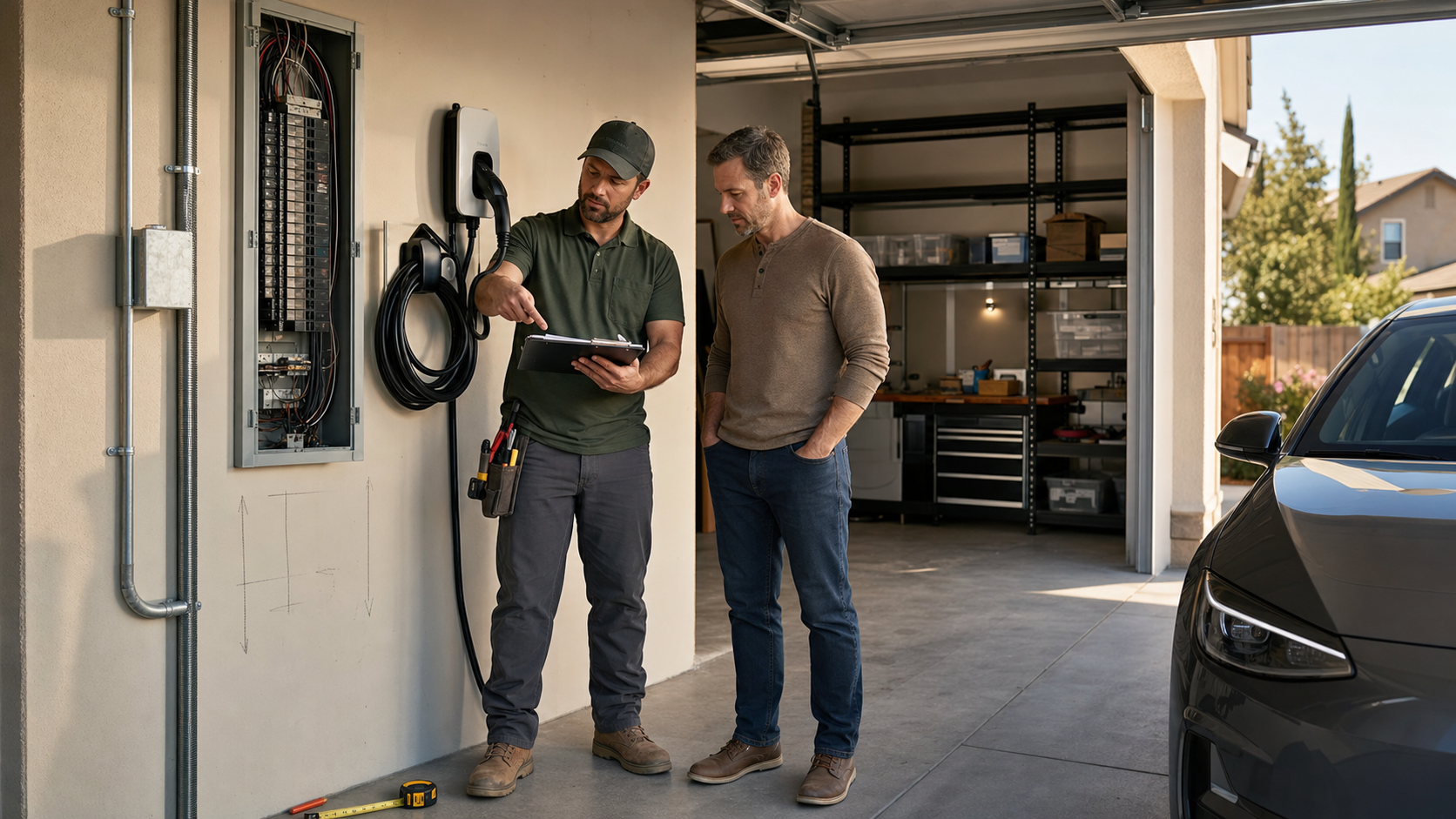
A Lincoln homeowner in Twelve Bridges or Lincoln Crossing may be planning garage cabinets, epoxy flooring, a freezer circuit, better lighting, solar later, and an EV charger now. The electrician walks in and asks a less exciting question: does the panel actually have capacity, where will the conduit run, and will the finished garage still leave the equipment accessible for inspection and service?
That is why EV charger installation should be planned like a small electrical project, not like hanging a gadget. The wrong location can create a long conduit run. A full panel can turn a simple install into load management or a service upgrade. A garage remodel can bury the best path behind cabinets. A future solar or battery project can get more expensive if no one thinks about it until after the drywall, storage wall, or driveway work is done.
| Decision | Why it matters | Best lead | Ask before signing |
|---|---|---|---|
| Panel capacity | A 40 to 60 amp charging circuit is a meaningful load. | C-10 electrician | Will you do a load calculation? |
| Charger location | Cable reach, parking habits, and cabinets all affect daily use. | Electrician plus homeowner | Can both current and future cars reach? |
| Conduit route | Distance, wall openings, attic access, and trenching drive cost. | Electrician or GC | What gets opened, patched, or left exposed? |
| Garage remodel timing | Cabinets, storage, paint, and flooring can block access later. | GC with electrician | Should conduit go in before finishes? |
| Future solar or battery | Load management and panel layout can affect the next project. | Electrician and solar contractor | Are we leaving a sensible path for later? |
Use this chart before comparing bids. A good EV charger estimate should explain panel capacity, charger placement, conduit route, permit documents, inspection access, and garage-finish coordination.
Start With Your Charging Habit
Before calling electricians, decide what problem the charger has to solve. Are you charging one commuter car overnight? Two EVs in alternating spaces? A plug-in hybrid that only needs a smaller circuit? A work vehicle that comes home nearly empty? A future teenager's car in the driveway?
Those answers matter more than the charger brand. A homeowner who drives 25 miles a day may not need the fastest charging setup the panel can support. A household with two EVs may care more about smart load sharing or where the cable reaches than about one oversized circuit. A detached garage, side driveway, or deep tandem bay changes the routing conversation completely.
Walk the garage before the first estimate. Photograph the main electrical panel, any subpanel, the meter area, the parking spot, the wall where you want the charger, garage cabinets, ceiling storage, water heater, solar equipment, and the route from panel to charger location. If the garage is about to be remodeled, include cabinet plans and flooring timing. The electrician needs to see the future garage, not only today's wall.
Why Lincoln Garages Need Layout-First Planning
Many Lincoln homes are newer than the older Sacramento repair stock, which helps. The garage may already have better framing, a cleaner panel, and a more predictable layout. But newer does not automatically mean "charger ready."
Builder garages are often optimized for parking, storage, and minimum code circuits, not for a high-load EV branch circuit plus cabinets, freezers, workbenches, holiday storage, smart openers, and future solar equipment. The main panel may be on an exterior wall that makes one charger location cheap and another surprisingly expensive. A neat storage wall can also become a problem if it blocks panel working clearance, conduit access, or the route an inspector needs to see.
If the garage remodel is already happening, install or reserve the electrical path early. It is usually cheaper to run conduit, set blocking, patch drywall, and paint once than to cut through finished cabinets or new wall panels later. If the charger is not being installed immediately, ask whether a capped conduit path or spare capacity plan makes sense.
What It Might Cost In 2026
These are planning ranges for Lincoln and nearby Placer and Sacramento Valley homes, not quotes:
- Electrical assessment, load calculation, and charger placement review: $250 to $900 when the electrician verifies panel capacity, parking layout, and basic permit assumptions.
- Simple Level 2 charger circuit near the panel: $800 to $2,800 when capacity exists, the run is short, and wall repair is minimal.
- Longer garage conduit run or attic route: $1,800 to $5,500 when the circuit crosses the garage, enters an attic, needs careful surface conduit, or requires drywall patching.
- Load management, subpanel changes, or panel cleanup: $2,500 to $9,500 when the existing panel needs breakers rearranged, a subpanel plan, or listed load-control equipment instead of a full service upgrade.
- Main panel or service upgrade tied to EV charging: $5,000 to $18,000-plus depending on equipment, utility coordination, meter work, trenching, stucco repair, inspection timing, and whether other electrification loads are being planned.
- Detached garage or driveway trenching: $4,000 to $25,000-plus when underground conduit, sawcut concrete, paver reset, landscape repair, or panel relocation enters the scope.
The cheapest bid is often cheap because it assumes the panel has room, the route is easy, and no finish work is included. A better bid may cost more because it includes load calculation, permit documents, listed equipment, inspection access, wall repair, and a charger location that works after the garage is finished.
Which Contractor Should Lead?
For a standard hardwired EV charger circuit, start with a licensed electrical contractor. In California, the CSLB's C-10 electrical classification covers installing and connecting electrical wires, fixtures, apparatus, raceways, conduits, and equipment that use electrical energy. That is the lane for a residential EV charger circuit, panel work, load calculations, disconnects, and conduit.
A general contractor may be useful when the charger is one part of a garage remodel with cabinets, drywall, insulation, lighting, epoxy flooring, wall storage, exterior stucco repair, or trenching through concrete. A solar contractor belongs in the conversation if the project is tied to panels, battery backup, critical-load planning, or future vehicle-to-home readiness. A concrete or landscape contractor may be needed if conduit crosses flatwork or a detached garage route tears up the yard.
Do not let the charger installer ignore finish details, and do not let a garage remodeler treat electrical as a casual add-on. The contract should say who designs the circuit, who pulls the electrical permit, who supplies the charger, who patches walls, who coordinates inspection, and who owns corrections if the inspector asks for changes.
Lincoln Permit And Inspection Questions
The City of Lincoln's residential permit page lists Solar, Energy Storage, and EV Charger among online eligible minor residential permit types. The same page lists an Electrical Load Calculation Worksheet and has a specific Electric Vehicle Charging Station section that says a building permit application is required.
Lincoln's EV charging station handout is useful because it shows what the city expects the permit package to make clear. It calls for floor plans, manufacturer installation instructions, and a single-line diagram with conductor sizes, breaker size, conduit size and location, charger model, and main panel or subpanel sizes. It also says the installation must follow the manufacturer's instructions, use listed equipment, and receive a final inspection after the work is complete.
That means homeowners should ask the electrician these questions before signing:
- Is the charger plug-in or hardwired, and why?
- What amperage are you proposing, and what charging speed does that realistically give us?
- Will you complete a load calculation using the city's worksheet or an equivalent method?
- Does the main panel need cleanup, load management, a subpanel, or replacement?
- Where will conduit be visible, and where will walls or ceilings be opened?
- If the garage remodel includes cabinets or wall systems, what must stay accessible?
- Who submits the Lincoln permit package and meets the inspector?
- If the service has to change, who coordinates with the electric utility and how long could that add?
Treat "no permit needed" as a claim that needs proof, not a selling point. A charger circuit is permanent electrical work, and skipped inspection can become a resale, insurance, safety, or warranty problem.
Charger Location Mistakes To Avoid
The best charger location is not always the closest wall to the panel. It is the place that works with how the household parks. Stand in the garage and run through a normal week: which side does the charging port sit on, which car parks outside, where do bikes go, can the cable cross a walkway, and will a future cabinet door hit the charger?
Avoid mounting the charger where the cable has to stretch across the hood, lie in a walking path, or wrap around storage every night. Avoid placing it behind a future workbench or water heater door. Keep panel access clear. If two cars may need charging later, ask about a location that can serve both stalls or a future second charger without tearing open the garage again.
Outdoor chargers add another set of questions: weather rating, bollard or wall protection, conduit exposure, parking clearance, lighting, drainage, and whether the cable can be damaged by doors, landscaping equipment, or driveway traffic. The installation should look boring and serviceable when finished. That is a compliment.
When A Panel Upgrade Is And Is Not Required
Do not assume every EV charger requires a new panel. A good electrician can evaluate the existing service, current loads, appliance fuel types, HVAC equipment, water heater, range, dryer, pool equipment, solar equipment, and spare breaker space. Sometimes the answer is a right-sized charger circuit. Sometimes it is a load-management device that prevents overloading the service. Sometimes a panel upgrade is the cleanest long-term answer.
The key is to make the decision from evidence. If a contractor glances at the panel and immediately says "you need 200 amps" without asking about house loads, charger amperage, appliance plans, or future solar/battery goals, keep asking questions. If they promise a high-amperage charger on a crowded older panel without a load calculation, that is not better.
For Lincoln homeowners planning heat pump HVAC, heat pump water heating, induction cooking, a spa, shop equipment, solar, or a battery system, the EV charger should be part of one electrical roadmap. Upgrading twice is usually more expensive than planning once.
Internal Homework Before You Hire
Start with our Lincoln contractor guide, then compare licensed electrical contractors, general contractors, solar contractors, concrete contractors, and landscaping contractors if trenching or driveway restoration enters the scope. Use the contractor search when you are ready to build a shortlist.
For related planning, pair this with our electrical panel upgrade guide, panel inspection scheduling guide, Lincoln solar battery planning guide, Lincoln solar-ready remodel guide, California permit basics, and license verification checklist. You can also verify a license directly through CSLB's Check a License tool.
The Bottom Line
An EV charger can be a simple, satisfying upgrade when the electrical plan comes first. In Lincoln, the smart move is to settle panel capacity, charger amperage, garage layout, conduit route, permit documents, and inspection access before the garage remodel makes those decisions harder.
Hire the electrician who asks how you park, checks the panel instead of guessing, explains the permit path, and leaves a written plan for what happens if the service is already full. The point is not just faster charging. It is a garage that works every day and an electrical system that is ready for the next project.
Who to Hire for This Project
For the work covered in this guide, these are the contractor types to contact and the CSLB classification to verify before you take quotes:
Questions to Ask Before You Sign
- "Is your CSLB license active and bonded?" Verify it yourself at cslb.ca.gov the license number must appear on their bid.
- "Who pulls the permit, and is it included in the bid?" The contractor should handle any required permits a pro who suggests skipping one is a red flag.
- "Can you itemize labor, materials, and allowances?" Itemized bids are the only way to compare quotes on the same scope.
- "What's the payment schedule?" California caps the down payment at $1,000 or 10%, whichever is less payments should track completed work.
- "Who from this area can I call as a reference?" Ask for a recent local job of similar scope, not just photos.
Sacramento Contractors for This Project
Related Articles
Frequently Asked Questions
Do I need a permit for an EV charger in Lincoln? +
Plan on a permit for a permanent EV charger circuit. The City of Lincoln lists Solar, Energy Storage, and EV Charger as an eligible minor residential permit type, and its EV charging handout says a building permit application is required. Ask your electrician to state the permit plan in writing.
How much does EV charger installation cost in Lincoln? +
A simple Level 2 charger circuit near the panel may run about $800 to $2,800. Longer conduit routes, attic access, drywall patching, load management, subpanel work, trenching, or a panel upgrade can move the project into the $3,000 to $18,000-plus range depending on scope.
Does every EV charger require a panel upgrade? +
No. A licensed electrician should perform a load calculation and review existing appliances, HVAC, water heater, range, dryer, pool equipment, solar equipment, and spare panel capacity. Some homes can support a right-sized charger or listed load management instead of a full panel upgrade.
What license should an EV charger installer have in California? +
Use a C-10 electrical contractor for charger circuits, conduit, wiring, panel work, disconnects, and load calculations. If the project also includes garage remodeling, trenching, concrete repair, solar, or battery planning, a general contractor or solar contractor may coordinate those additional scopes.
Should I install the charger before or after garage cabinets and flooring? +
Usually before major garage finish work. Running conduit, setting blocking, preserving panel access, and patching drywall are cleaner before cabinets, wall systems, or epoxy flooring are finished. If you are not ready for the charger, ask whether a future conduit path should be installed now.
What should I ask an electrician before choosing a charger location? +
Ask where each vehicle's charge port sits, whether the cable will cross a walkway, whether both parking spaces can be served, how cabinets or storage will affect access, where conduit will be visible, and whether the location leaves room for a future second charger.