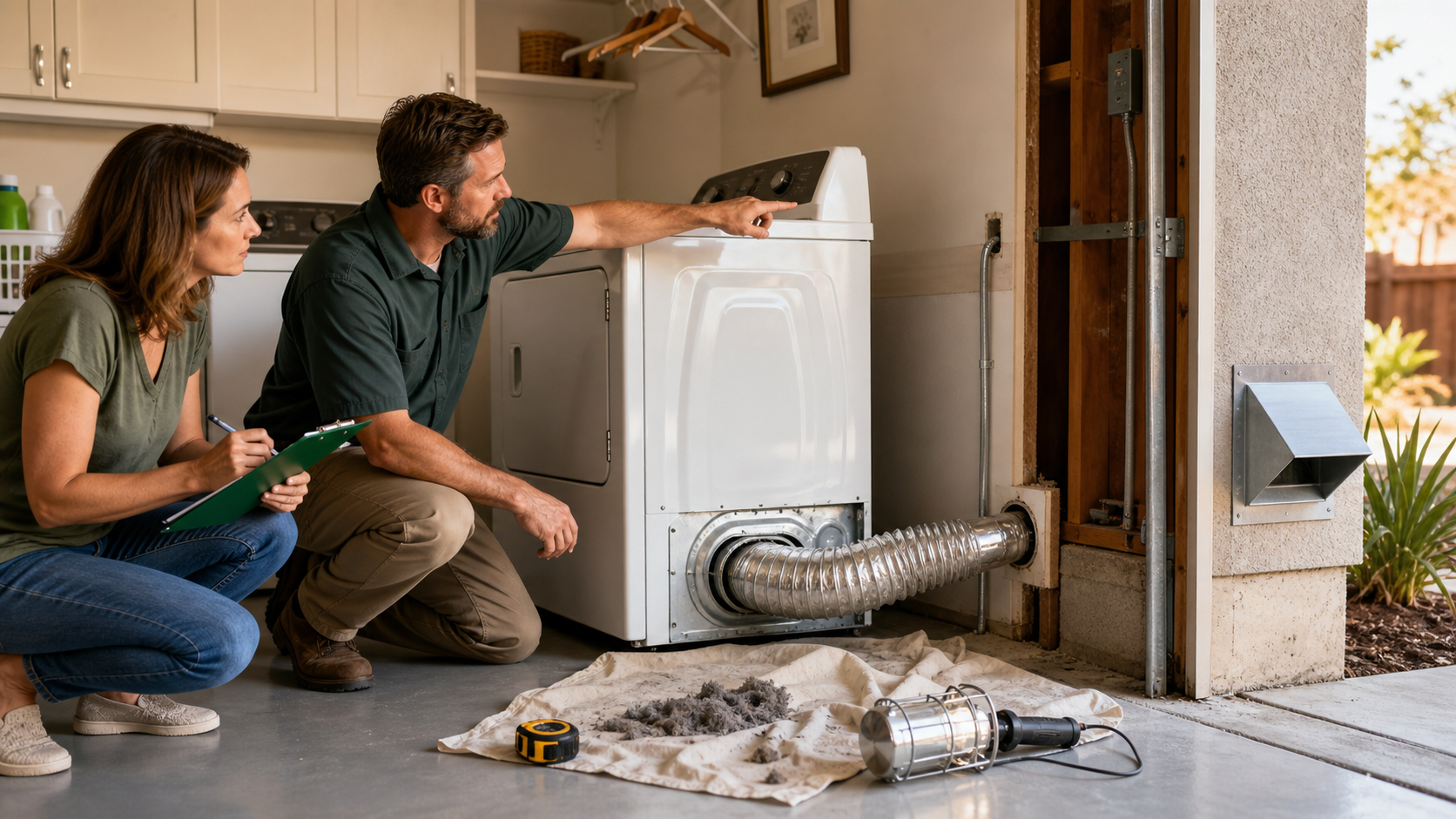
Elk Grove Dryer Vent Rerouting: Laundry Safety, Permits, and Who to Call
The dryer still gets hot. The drum still turns. Nothing looks broken from the front. But the towels need two cycles, the laundry room feels humid, and the outside vent barely moves when the dryer is running.
That is the moment many Elk Grove homeowners start with the wrong question: "Do I need a new dryer?" Sometimes the appliance is tired. Just as often, the problem is the vent path behind it. A crushed transition hose, a long run through the garage wall, a roof exit packed with lint, or a remodel that boxed the duct into a bad route can make a perfectly decent dryer act weak, run hot, and waste time every week.
Dryer vent work sounds small until the contractor has to open a wall, cross a garage fire separation, move a gas dryer, add a new exterior cap, patch stucco, or climb onto a tile roof. Then it becomes a contractor-selection problem, not just a cleaning appointment.
Use this chart before comparing bids. A dryer vent estimate is not complete until airflow, route length, wall or roof work, fire separation, fuel type, and finish repair are visible.
Start With The Symptom, Not The Appliance
Before calling contractors, run one normal load and pay attention. Does the dryer finish late only on towels and jeans, or on everything? Is the laundry room warm and damp? Does the dryer top feel unusually hot? Is there lint around the wall connection? Does the outside vent flap open strongly, barely move, or not open at all?
Then photograph the whole setup: the dryer, the space behind it, the wall connection, the laundry room wall, the garage side if the duct passes through it, the exterior vent cap, and the roof exit if you can see it from the ground. Do not pull a gas dryer forward aggressively if the connector is short or stiff. A careful photo from each side is enough for the first conversation.
Those details help separate a simple lint cleaning from a real reroute. If the duct run is short, accessible, and intact, a cleaning may solve the problem. If the vent disappears into a wall, crosses a garage, exits the roof, or has multiple bends, the contractor needs to prove the route before promising an easy fix.
Why Elk Grove Homes Run Into This
Elk Grove has a lot of homes built with laundry rooms tucked between the garage, hallway, and kitchen, plus newer two-story layouts where the laundry sits upstairs or deep inside the floor plan. That is convenient for daily life, but not always convenient for dryer exhaust. The shortest path to the outside may have been lost to cabinet layouts, garage walls, second-story framing, patio covers, or later remodels.
The problem gets worse when someone "improves" the laundry room without thinking about the vent. New cabinets can pinch the transition hose. A stacked washer and dryer can force a tight bend. A garage storage wall can hide an old duct connection. A roof termination can clog faster because lint, lint dampness, wind, and screen-like debris collect where no one looks.
The goal is not just to make the dryer work today. The goal is a vent path that is short, cleanable, code-aware, and still accessible after the laundry room looks finished.
What It Might Cost In 2026
These are planning ranges for Elk Grove and nearby Sacramento County homes, not quotes:
- Dryer vent inspection and cleaning: $150 to $450 when the route is accessible and the work is mostly lint removal and airflow confirmation.
- Replace a crushed transition hose or simple exposed duct section: $250 to $900 depending on access, materials, clamps, clearances, and whether the dryer must be moved safely.
- Reroute through a nearby exterior wall: $900 to $3,500 when the work includes a new smooth metal duct path, exterior hood, wall patching, and basic finish repair.
- Garage wall, stucco, or fire-separation repair: $1,500 to $6,500 when the vent crosses a garage wall, the wall assembly must be restored correctly, or the exterior finish needs careful patching.
- Roof exit correction or concealed long run: $2,500 to $8,500-plus when the contractor has to trace hidden ductwork, work around framing, repair drywall, coordinate roofing details, or replace an unsafe route.
- Laundry remodel tied to venting, plumbing, gas, electrical, cabinets, and flooring: $6,000 to $30,000-plus depending on how much of the room is changing.
The cheapest line item is not always the safest one. A $250 cleaning that leaves a crushed hose behind the dryer is not a finished repair. A $4,000 reroute can be reasonable if it removes a bad roof run, preserves garage fire separation, and leaves a clean serviceable path.
Which Contractor Should Lead?
For a basic cleaning, a dryer vent cleaning specialist or appliance service company may be enough. The moment the job changes the duct route, opens finished walls, penetrates stucco, crosses a garage wall, touches roof flashing, or moves a gas or electrical connection, the lead contractor needs broader scope control.
An HVAC contractor can be a good fit for mechanical ventilation routing, airflow, duct materials, and terminations. A general contractor makes sense when the work includes drywall, cabinets, fire-rated garage walls, exterior patching, roofing coordination, or a laundry room remodel. Bring in a licensed electrician if the dryer outlet, dedicated circuit, stacked-unit outlet, or nearby laundry lighting changes. Bring in a licensed plumbing contractor if a gas dryer line, shutoff, water valves, washer drain, or laundry sink is part of the project.
A roofer should own roof penetrations and flashing details when the vent exits through the roof. A drywall contractor may be enough for finish repair only after the mechanical path is correct. Do not let a cleaner, handyman, or appliance installer casually cut a new exterior opening unless they are also qualified and licensed for the real scope.
Permits, Code, And Elk Grove Questions
The City of Elk Grove's Building Safety, Inspection and Permits division says it issues permits and performs plan checks and inspections for building, plumbing, mechanical, and electrical permits. The city's plan review and permits page also points homeowners toward electronic submittals and the eTrakit portal for eligible minor permits.
A simple cleaning usually does not need a building permit. Changing the duct route, opening a rated garage wall, adding or moving electrical, changing gas piping, altering exterior wall penetrations, or doing the work as part of a laundry remodel can change that answer. Elk Grove's own permit guidance tells homeowners to contact the Building Division when they are unsure whether a permit is required.
Ask each contractor to state the code and permit assumptions in writing:
- Is this cleaning only, duct replacement, duct reroute, laundry remodel, or gas/electrical work?
- What is the proposed duct material, diameter, route, length, and number of elbows?
- Does the duct terminate outdoors at a wall or roof cap that can be inspected and cleaned?
- Will the exterior hood have a proper damper and no lint-trapping screen?
- Does the route pass through a garage wall, fire-rated assembly, cabinet, soffit, attic, or roof?
- Who patches drywall, stucco, siding, trim, roof flashing, and paint?
- Who pulls any mechanical, electrical, plumbing, or building permit if the scope requires it?
California licensing matters too. The CSLB explains that a contractor license is generally required when the work requires a permit, uses employee labor, or totals $1,000 or more in combined labor, materials, and other costs. A real vent reroute or laundry remodel can clear that threshold quickly.
Red Flags In Dryer Vent Quotes
Be cautious if a contractor wants to push the dryer back with a long crushed foil hose and call the job done. Be careful with anyone who says roof exits are always fine without checking whether the cap is cleanable, whether the duct is smooth metal, and whether the route length and elbows are reasonable.
Other warning signs include no airflow check after cleaning, no discussion of where lint will be removed from the full route, no plan for gas shutoff safety, no explanation of garage wall repair, and no written scope for drywall or exterior patching. If the contractor cannot point to the final outside termination, they do not know the whole job yet.
A weak bid says "fix dryer vent." A useful bid names the route, materials, access openings, finish repairs, permits if needed, and how the contractor will verify airflow before leaving.
If This Is Part Of A Laundry Remodel
Laundry remodels are where dryer vent problems get buried. The cabinets, counters, tile, and stacked-unit layout are visible. The vent path is not. Decide the appliance layout before cabinets are ordered, then have the contractor confirm venting, water valves, washer drain, gas or electric dryer connection, service clearances, and how the machines will be pulled out later.
If the washer and dryer are moving, the vent is only one system. Plumbing, electrical, gas, flooring slope, shutoff access, pan details, cabinet clearance, and garage fire separation can all enter the scope. A general contractor can be useful because the room has several small trades packed into one tight space.
Ask whether the finished room will still allow cleaning the vent. A beautiful laundry wall that hides a long, unserviceable duct is a future callback.
Internal Homework Before You Hire
Start with our Elk Grove contractor guide, compare licensed HVAC contractors, general contractors, electrical contractors, plumbing contractors, drywall contractors, and roofing contractors. Use the contractor search when you are ready to build a shortlist.
For related planning, pair this with our Roseville laundry room remodel guide, laundry leak prevention guide, bathroom exhaust fan venting guide, California permit basics, and license verification guide.
The Bottom Line
A dryer vent problem is easy to underestimate because the appliance still runs. In Elk Grove homes with long routes, garage walls, roof exits, stacked laundry layouts, and remodel layers, the vent path deserves the same attention as the dryer itself.
Start with symptoms and photos. Ask the contractor to prove the route, explain the materials, identify permit and trade handoffs, and verify airflow at the end. The right fix should make laundry faster, reduce heat and moisture, and leave a vent path that someone can actually clean the next time lint starts winning.
Who to Hire for This Project
For the work covered in this guide, these are the contractor types to contact and the CSLB classification to verify before you take quotes:
Questions to Ask Before You Sign
- "Is your CSLB license active and bonded?" Verify it yourself at cslb.ca.gov the license number must appear on their bid.
- "Who pulls the permit, and is it included in the bid?" The contractor should handle any required permits a pro who suggests skipping one is a red flag.
- "Can you itemize labor, materials, and allowances?" Itemized bids are the only way to compare quotes on the same scope.
- "What's the payment schedule?" California caps the down payment at $1,000 or 10%, whichever is less payments should track completed work.
- "Who from this area can I call as a reference?" Ask for a recent local job of similar scope, not just photos.
Sacramento Contractors for This Project
Related Articles
Frequently Asked Questions
How do I know if my Elk Grove dryer vent is clogged or poorly routed? +
Common signs include clothes taking more than one cycle to dry, a hot or humid laundry room, lint around the wall connection, a dryer that feels unusually hot, or an outside vent flap that barely opens while the dryer runs. A contractor should inspect the full route before recommending a cleaning, repair, or reroute.
How much does dryer vent rerouting cost? +
A simple cleaning may cost $150 to $450, while replacing a crushed exposed section may run $250 to $900. Rerouting through a wall often lands around $900 to $3,500, and complex garage, roof, stucco, drywall, or concealed-route work can move into the $2,500 to $8,500-plus range.
Do I need a permit to reroute a dryer vent in Elk Grove? +
Cleaning only usually does not need a permit. Changing the duct route, opening a rated garage wall, adding or moving electrical, changing gas piping, altering exterior penetrations, or including the work in a laundry remodel can trigger permit or inspection requirements. Ask the City of Elk Grove Building Division or have your contractor state the permit assumption in writing.
Who should I call for dryer vent work? +
For cleaning only, a dryer vent cleaning specialist may be enough. For rerouting, concealed ducts, wall openings, roof caps, garage fire separation, electrical, gas, or finish repairs, consider an HVAC contractor or general contractor, with electricians, plumbers, roofers, or drywall contractors brought in for their parts of the scope.
Is a roof dryer vent a bad idea? +
Not automatically, but roof exits need careful routing, a proper cap, cleanability, and safe roof flashing. A long or hidden roof run can clog, hold lint, and become difficult to maintain. Ask the contractor how the full duct path will be cleaned and how airflow will be verified after the work.
Can I use flexible foil hose behind the dryer? +
A short listed transition connector may be acceptable in some installations, but long, crushed, kinked, or hidden flexible hose is a common cause of poor airflow and lint buildup. Ask for smooth metal duct in concealed runs and enough clearance behind the dryer so the transition is not crushed when the appliance is pushed back.