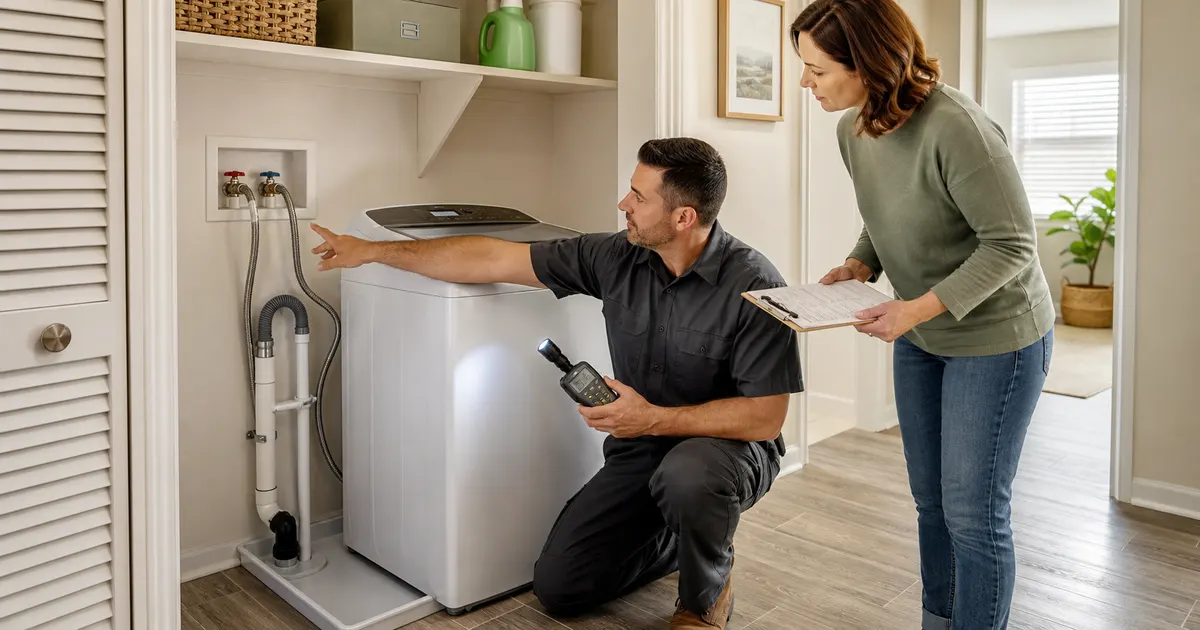
Antelope Laundry Room Leak Prevention: Shutoffs, Drains, and Washer Pans
Watch: Quick Homeowner Overview
A short vertical explainer for this guide share it on socials or preview the project before you read.
Laundry leaks rarely announce themselves like a burst pipe. More often, an Antelope homeowner notices a warped baseboard behind the washer, a little rust on the hot-water valve, a drain that burps during the spin cycle, or a faint stain on the ceiling below the laundry closet. The washer still runs. The floor still looks mostly fine. That is exactly why the problem gets ignored.
Then one load of towels turns into water under the machine, swollen LVP, wet drywall, and a frantic question: "Do we call a plumber, an appliance repair company, a restoration crew, or a flooring contractor?"
Start with the water path. In Antelope's 1990s and 2000s homes, laundry rooms and laundry closets are often tucked near halls, garages, bedrooms, or second-floor living space. That makes small failures more expensive than they look. A complete laundry leak prevention project is not just new hoses. It is shutoff valves, the recessed washer box, drain standpipe, pan, wall condition, flooring edges, leak detection, and a clear plan for who handles any damage already hiding behind the machine.
Use this chart before comparing bids. The visible hose is only one part of the leak path; the valve, drain, pan, floor, and wall condition decide the real scope.
Do Not Start With New Flooring
If the floor is cupping, swelling, or soft near the washer, a flooring contractor should not be the first call unless the water source is already solved. New flooring can hide an active leak, trap moisture, and make the next repair more expensive. The first question is simple: where did the water come from, and can it happen again?
Common laundry leak clues include mineral crust on shutoff valves, braided hoses older than the homeowner remembers, rubber hoses that feel stiff, a washer box with valves that do not fully close, a standpipe that splashes during drain cycles, stains under the baseboard, a musty smell in the wall cavity, or flooring that moves near the machine. A plumber can test the valve, hose, standpipe, trap, drain line, and supply pressure before anyone prices finish repair.
Take photos before moving the washer if you can do it safely. Show the floor edge, valve box, hoses, wall base, drain hose, pan, and any ceiling below. Those photos help a contractor separate a simple maintenance visit from a repair that needs drywall, flooring, or water-damage cleanup.
The Three Failure Points Behind the Machine
Most washer leak prevention conversations should cover three separate systems.
First are the supply lines. Old rubber hoses are a known weak point, and even braided stainless hoses should not be treated as permanent. The connection points matter too. A new hose on a corroded valve is not much comfort if the valve will not shut off when the hose fails.
Second is the drain. Modern washers can discharge water quickly. If the standpipe is wrong, the hose is pushed too far down, the trap is slow, or the line is partially blocked, water can overflow behind the machine before anyone sees it. A plumber should explain whether the issue is installation, drain restriction, venting, or an appliance problem.
Third is the containment path. A washer pan helps only if it is sized correctly, the machine sits in it properly, and the pan has a useful drain or alarm strategy. A pan with no drain can still buy time if paired with a leak sensor. A second-floor laundry room deserves extra attention because a small overflow can damage ceiling drywall, insulation, lighting, and flooring below.
What a Useful Estimate Should Separate
For Antelope homeowners, broad planning ranges often look like this:
- Hose replacement and basic leak check: $150 to $450 when access is simple and valves work.
- Shutoff valve or washer box repair: $350 to $1,400 depending on wall access, parts, and patching.
- Washer box replacement with drywall repair: $900 to $2,800 before paint and flooring surprises.
- Drain troubleshooting or standpipe correction: $300 to $2,500 depending on blockage, access, and whether wall work is needed.
- Washer pan, leak sensor, or automatic shutoff upgrade: $150 to $1,500 depending on device type and plumbing layout.
- Water-damage repair after a leak: $2,000 to $18,000 or more when drywall, flooring, baseboards, insulation, or ceiling repair are involved.
The useful bid separates diagnosis from repair. Ask the plumber to identify the valve condition, hose age, supply pressure concerns, drain behavior, washer-box access, wall repair assumptions, and what is excluded. If the bid includes drywall, flooring, or paint, ask whether those are performed by the plumbing company, a subcontractor, or a separate contractor you need to hire.
For leak-prevention work, the cheapest bid is often the one that only replaces the visible hoses. That may be fine if the valves, drain, floor, and wall are sound. It is not fine if the valve handles are frozen, the standpipe overflows, or the baseboard is already swollen.
Which Contractor Should Lead?
Start with a licensed plumbing contractor when the issue involves supply valves, washer boxes, drain standpipes, traps, drain lines, or water pressure. If the washer itself is leaking from a pump, tub seal, dispenser, or internal hose, an appliance repair technician may need to diagnose the machine. If water has already spread into drywall, insulation, flooring, or ceiling finishes, a restoration or drywall contractor may be needed after the active leak is stopped.
A flooring contractor belongs later, once the subfloor or slab edge is dry and the water source is corrected. A general contractor can make sense if the repair opens several trades at once: plumbing, drywall, paint, baseboards, flooring, cabinetry, and possibly electrical. If a second-floor laundry area has ceiling damage below, do not let each trade guess separately. Someone needs to own the sequence.
The best first conversation sounds boring and specific: "We will test the valves, run the washer drain cycle, check the standpipe, inspect the pan and floor edge, and tell you what remains unknown until the machine moves." That is better than a quick promise to "swap the hoses and call it good."
Permits, Licensing, and Contract Questions
Antelope is in unincorporated Sacramento County, so permit questions usually run through Sacramento County rather than a city building counter. Replacing hoses or like-for-like valves may be simple service work. Moving water lines, replacing a recessed washer box inside the wall, changing drain or vent piping, adding a new pan drain, opening walls, or doing electrical work can change the permit conversation.
Ask the contractor to state in writing whether permits are needed and who confirms that answer. If the laundry repair is part of a larger remodel, do not treat it as a separate tiny job just because one line item is small.
California licensing matters even for small laundry projects because water damage can get expensive quickly. The limited minor-work exemption is now under $1,000 only when the work does not require a permit and does not involve employees. Written home improvement contracts are required for projects over $500 in combined labor and materials. For plumbing work, verify the license, bond, workers' compensation status, and insurance before anyone opens the wall.
Red Flags in Laundry Leak Bids
Slow down if you see any of these:
- The contractor wants to replace hoses but will not test whether the shutoff valves actually close.
- The bid ignores a standpipe that overflows or smells during drain cycles.
- A second-floor washer has no pan, no sensor, and no discussion of ceiling risk below.
- Wall, baseboard, or flooring damage is dismissed before moisture is checked.
- The estimate does not say who patches drywall or resets flooring after plumbing work.
- The contractor says permits never apply, even if pipes are being moved inside the wall.
- There is no written change-order process for hidden mold-like staining, wet insulation, damaged subfloor, or additional plumbing repair.
- License, insurance, bond, or workers' compensation proof is vague.
None of those red flags proves the job is huge. They prove the scope is not ready yet.
Questions to Ask Before You Sign
- How old are the washer hoses, and what type are you installing?
- Do both shutoff valves close fully, or should the washer box be repaired or replaced?
- Does the standpipe handle a full drain cycle without splashing, backing up, or gurgling?
- Is there evidence of moisture behind the baseboard, under the pan, or below the laundry room?
- Would a leak sensor, automatic shutoff, or pan upgrade make sense for this location?
- If drywall or flooring must be removed, who repairs it and how is that priced?
- Are permits or inspections needed for this exact plumbing scope in Sacramento County?
- What is excluded from the plumbing bid: appliance repair, restoration, drywall, paint, flooring, baseboards, or cleanup?
Those questions make a small project feel more deliberate. That is the point. Laundry leaks are cheaper when the scope is boring before the water appears.
Internal Homework Before You Hire
For local context, start with our Antelope contractor guide, compare licensed plumbing contractors, drywall contractors, flooring contractors, and general contractors. Use the contractor search when you are ready to build a shortlist.
For related planning, pair this with our spring plumbing checkup, water heater replacement guide, whole-house repiping cost guide, ceiling stain and drywall leak guide, Antelope condensate drain guide, California permit basics, and license verification guide.
The Bottom Line
A laundry leak prevention visit is not glamorous, but it can save a homeowner from flooring, drywall, ceiling, and insurance headaches. In Antelope, start with the shutoffs, hoses, standpipe, pan, and first signs of moisture. Fix the water path before the finishes. Then hire the contractor who can explain exactly where the plumbing scope ends and where any repair work begins.
Who to Hire for This Project
For the work covered in this guide, these are the contractor types to contact and the CSLB classification to verify before you take quotes:
Questions to Ask Before You Sign
- "Is your CSLB license active and bonded?" Verify it yourself at cslb.ca.gov the license number must appear on their bid.
- "Who pulls the permit, and is it included in the bid?" The contractor should handle any required permits a pro who suggests skipping one is a red flag.
- "Can you itemize labor, materials, and allowances?" Itemized bids are the only way to compare quotes on the same scope.
- "What's the payment schedule?" California caps the down payment at $1,000 or 10%, whichever is less payments should track completed work.
- "Who from this area can I call as a reference?" Ask for a recent local job of similar scope, not just photos.