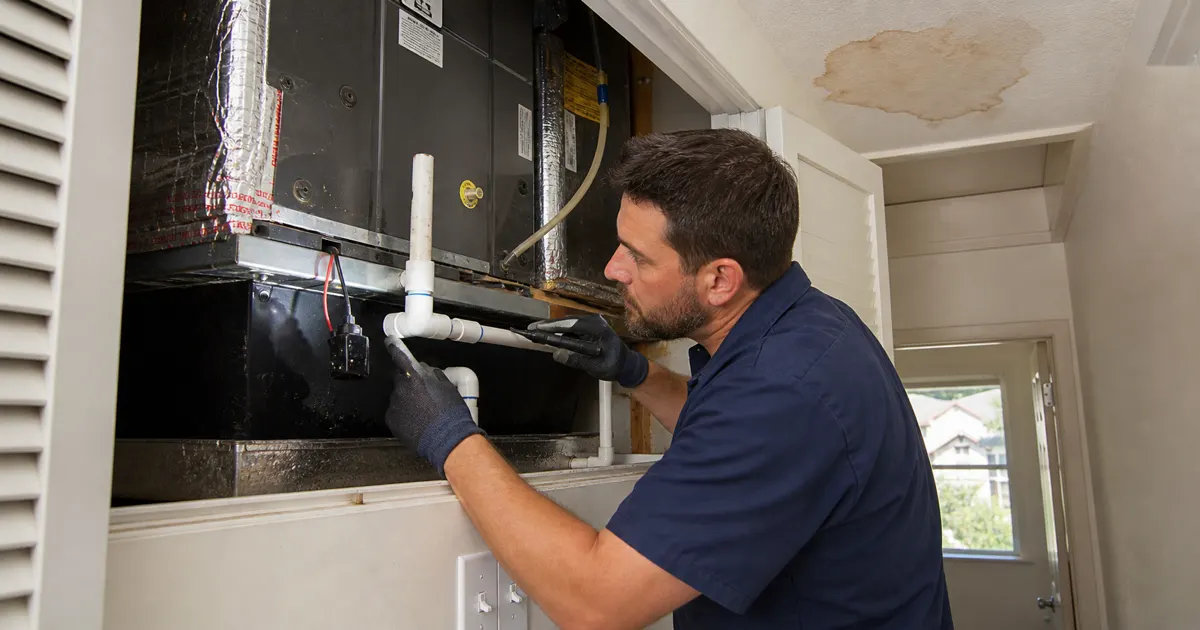
Antelope AC Condensate Drain Problems Before Summer: Who to Call
Watch: Quick Homeowner Overview
A short vertical explainer for this guide share it on socials or preview the project before you read.
An air conditioner can cool perfectly and still create a water problem inside the house.
In Antelope, this often starts during the first hard stretch of summer weather. The AC runs longer than it has all spring. A homeowner notices water near the furnace closet, a wet mark under an attic access, a dripping secondary pipe outside, or a ceiling stain that seems to appear overnight. The thermostat is doing its job, so everyone assumes the equipment is fine. Then the drywall gets soft.
That is the wrong moment to start guessing. Condensate is normal. Overflow is not. The first contractor conversation should separate a simple clogged drain from a system, plumbing, drywall, or permit-sensitive repair.
Use this chart before approving drywall repair or AC replacement. The important question is why water left the drain path and who is responsible for each surface it touched.
Why Antelope Homes See This in Early Summer
Many Antelope homes were built in the 1990s and early 2000s with forced-air systems tucked into garages, closets, attics, or upstairs mechanical spaces. Those layouts can work fine for years. The weak point is that air conditioning removes humidity from indoor air, and that water has to leave through a drain line every time the system runs.
During mild weather, a partly restricted line may not reveal itself. Once the AC runs for long afternoon cycles, algae, dust, insulation debris, rust, a sagging line, or a missing cleanout can turn a slow drain into an overflow. If the air handler is above finished space, the first visible clue may be a ceiling stain instead of water on a garage slab.
The job is not automatically a new AC system. It is a water-control problem first.
Match the Contractor to the Real Problem
Start with an HVAC contractor when the water is coming from the evaporator coil area, furnace closet, attic air handler, secondary drain, overflow pan, condensate pump, or shutoff switch. A C-20 HVAC contractor should be able to clear and test the drain, inspect the pan, confirm slope, check for a frozen coil, and explain whether the system is producing normal condensate or showing a larger performance issue.
Bring in a plumber when the condensate line ties into a plumbing drain, when the discharge point is blocked, or when the repair involves real drain piping beyond the HVAC equipment. Use a drywall contractor only after the source is fixed and the wet area is dry enough to close. A general contractor makes sense when the work crosses several scopes: HVAC, plumbing, insulation removal, drywall, paint, trim, flooring, or insurance documentation.
A handyman may be useful for small access panels, trim, or non-regulated cleanup. They are not the right lead for diagnosing AC equipment, wiring a safety switch, rebuilding a drain route, or promising that wet ceiling materials are safe to cover.
What a Useful Estimate Should Separate
For a straightforward condensate drain service in the Sacramento area, a maintenance visit may be $150 to $450. Adding a cleanout, float switch, condensate pump, pan repair, line reroute, or minor drywall repair can move the work into the $600 to $2,800 range. If the overflow damaged insulation, ceilings, flooring, or cabinets, the total repair can climb into the $3,000 to $9,000 range before any major AC replacement is considered.
Ask each bidder to separate:
- Diagnosis. What confirms the water source, and how will the contractor test the drain after clearing it?
- Drain cleaning. Is the primary drain being flushed, vacuumed, blown out, treated, or rebuilt?
- Pan and switch work. Is the overflow pan rusted, pitched correctly, and protected by a float switch?
- Discharge point. Where does the condensate leave the house, and can you see when the backup drain is active?
- System condition. Is the coil freezing, the filter clogged, the airflow weak, or the unit short of maintenance?
- Repair boundaries. Who handles insulation, drywall, texture, paint, trim, flooring, and moisture documentation?
- Permit assumptions. Is this maintenance, a drain reroute, an equipment changeout, or work that triggers another trade?
The cheapest visit is only useful if it leaves proof that the drain now works under real AC operation.
The Small Details That Prevent Repeat Damage
A cleanout matters because it gives the technician a proper service point instead of forcing them to improvise. A float switch matters because it can shut the system down before water reaches drywall. A visible secondary drain matters because it gives you a warning. If that little pipe starts dripping outside a window or near an eave, do not ignore it. It may be telling you the primary line is already in trouble.
Ask the contractor to show the route. Does the line slope continuously? Does it sag in the attic? Does it terminate near the foundation, over a walkway, into a sink tailpiece, or somewhere you cannot monitor? Is there insulation around cold lines where sweating could be mistaken for a leak? Are there old stains in the pan that suggest this happened before?
Those details sound small until the same ceiling gets patched twice.
Permits, Licensing, and Insurance Questions
Antelope is in Sacramento County, so county rules matter for permit questions. Routine AC maintenance and drain clearing are usually simpler than equipment replacement or remodel work. The scope can change if the contractor replaces HVAC equipment, alters electrical controls, reroutes plumbing, opens walls, repairs structural damage, or performs larger restoration after water damage.
For licensing, match the work. HVAC diagnosis and condensate components commonly belong with a C-20 HVAC contractor. Plumbing drain work belongs with a C-36 plumber. Drywall repairs belong with a C-9 drywall contractor, and painting may involve a C-33 painter. A B general contractor can coordinate a multi-trade repair when water damage spreads beyond the equipment area.
Before signing, verify the CSLB license, bond, insurance, and workers' compensation status. If the repair follows a sudden overflow, take photos before cleanup, during the source repair, and before drywall closes. That paper trail helps if the stain returns or an insurance claim needs clear evidence.
Questions to Ask Before You Approve the Repair
- What made the water leave the normal drain path?
- Did you test the primary drain after clearing it?
- Is the overflow pan sound, pitched, and connected to a visible discharge?
- Should a float switch or cleanout be added now?
- Is the coil freezing or is airflow causing extra condensate trouble?
- What materials are wet, and how will you confirm they are dry before repair?
- Does any part of this work require a permit, licensed plumber, electrician, or drywall contractor?
Good contractors do not turn a ceiling stain into a mystery. They show the source, test the drain, and write down what still needs repair.
Internal Homework Before You Hire
For local context, start with our Antelope contractor guide, compare licensed HVAC contractors, plumbing contractors, drywall contractors, and general contractors. Use the contractor search when you are ready to build a shortlist.
For related planning, pair this with our HVAC maintenance guide, summer AC breakdown prevention guide, AC repair and replacement cost guide, ceiling stain repair guide, and California permit basics.
The Bottom Line
An AC condensate problem is not just an HVAC annoyance. In Antelope, it can become a drywall, insulation, flooring, or insurance problem if the drain path is not proven before cleanup starts. Hire the contractor who can show where the water should go, why it stopped going there, and what needs to be fixed so the first hot week does not leave a new stain behind.
Who to Hire for This Project
For the work covered in this guide, these are the contractor types to contact and the CSLB classification to verify before you take quotes:
Questions to Ask Before You Sign
- "Is your CSLB license active and bonded?" Verify it yourself at cslb.ca.gov the license number must appear on their bid.
- "Who pulls the permit, and is it included in the bid?" The contractor should handle any required permits a pro who suggests skipping one is a red flag.
- "Can you itemize labor, materials, and allowances?" Itemized bids are the only way to compare quotes on the same scope.
- "What's the payment schedule?" California caps the down payment at $1,000 or 10%, whichever is less payments should track completed work.
- "Who from this area can I call as a reference?" Ask for a recent local job of similar scope, not just photos.