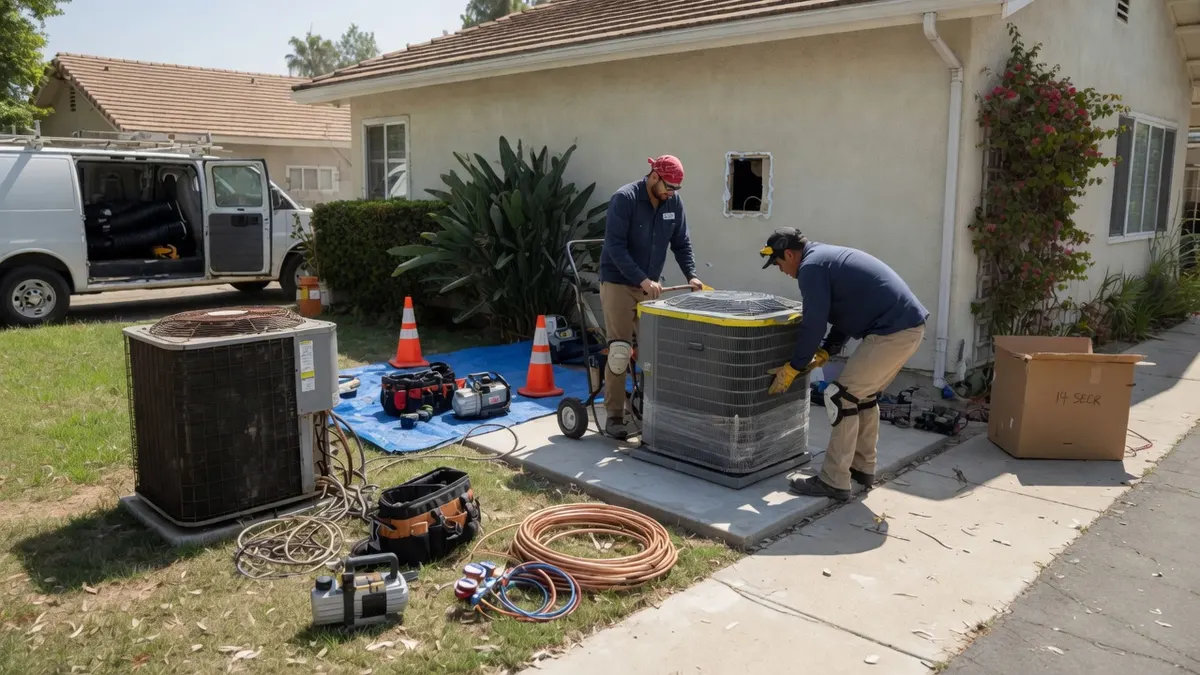
Elk Grove HVAC Replacement Before the First Real Heat Wave
There's a particular sound an aging air conditioner makes in early April around Elk Grove. A rattle, a longer-than-usual startup, a faint warm draft from the vents on a 78-degree afternoon. It's easy to ignore in spring. Then the first stretch of triple digits arrives in late June, the unit runs nonstop for three days, and on day four it quietly gives up. Now you're calling for emergency service alongside half the neighborhood, paying peak-season rates, and taking whatever equipment can be installed fastest rather than what's actually right for your house.
Replacing a tired system before that first real heat wave flips the whole experience. You set the timeline. You compare equipment without a sweltering bedroom forcing your hand. And you get a contractor's full attention instead of a rushed swap squeezed between four other no-cooling calls.
The early-2000s subdivision problem
A lot of Elk Grove sits on homes built during the building boom of the late 1990s and early 2000s. By Sacramento Valley standards these houses still feel newish, and that's exactly the trap. The stucco looks fine, the roof has years left, but the original furnace, condenser, and ductwork have now been baking through twenty-plus summers. Twenty years is right at the wall for most residential HVAC.
What fails first usually isn't the equipment everyone obsesses over. It's the supporting cast: ductwork that's pulled loose at the boots, attic insulation that settled and thinned, a return that was undersized from day one. You can bolt a brand-new high-efficiency condenser onto a leaky duct system and still have a back bedroom that never cools. A good HVAC contractor walks the attic and crawls the system before quoting, not after.
What a Sacramento Valley replacement actually runs
For a full replacement in our area, plan on roughly $8,000 to $18,000. That's a wide range on purpose, because the equipment is only one line on the invoice. Duct sealing, return-air resizing, a new thermostat location, a condensate fix, or an electrical panel that needs attention can each move the number meaningfully.
Here's the counterintuitive part: the cheapest bid is often the least informative one. A two-line quote that says "new 4-ton system, $9,500" is hiding all the decisions that determine whether you're comfortable in August. The estimate worth trusting spells out the equipment model and efficiency rating, the duct work included, who handles permits, the warranty terms, and what could change the price once the old unit comes out. When two bids are thousands apart, compare what each one assumes before you decide one company is simply overcharging.
It's smart to keep a contingency too. Older homes hide things, and the contract should say what happens when the crew finds them.
License checks people skip and shouldn't
In California, any home-improvement work valued at $1,000 or more in combined labor and materials has to be done by a contractor holding a CSLB license. An HVAC replacement clears that threshold many times over, so a license isn't a nicety here, it's the baseline. Verify it yourself at the CSLB website by the contractor's name or license number, and confirm the classification is C-20 for warm-air heating and air conditioning. While you're there, check that workers' compensation and liability insurance are current.
This takes about four minutes and it's the single best filter against the trucks that show up every heat wave promising same-day installs at suspiciously round prices. If you're still building a shortlist, the Elk Grove contractor guide and the contractor search are reasonable starting points for finding licensed local crews.
The HERS test nobody mentions until the end
California ties HVAC replacements to its energy code, and that means permits plus third-party HERS testing on most jobs. HERS verification checks duct leakage and refrigerant charge, and if your ducts don't pass, sealing them becomes part of the work rather than an optional upsell. This is where the early-2000s duct problem and the code requirement collide in a useful way: the test essentially forces a fix you probably needed anyway.
Ask, before signing, who pulls the permit, who schedules the HERS rater, and whether duct sealing is already inside the quote or sitting as a maybe. A contractor who treats testing as an afterthought is one who'll be improvising on your roof in July. The City of Elk Grove inspects this work, and an unpermitted install can resurface later as a headache when you sell.
While the system is open is also the cheapest moment to address attic insulation, since the crew is already up there and a tighter envelope lets a right-sized unit work less. It's optional, but rarely cheaper to do later.
Buying in spring instead of surviving in summer
Spring and early summer get busy fast for HVAC, roofing, and exterior trades across the valley, so the calendar advantage shrinks the longer you wait. Reach out in March or April and you're choosing from real availability and equipment that's in stock. Wait until the system dies in a heat wave and you're at the back of a long line, paying for urgency.
Before that first estimate, do a little homework. Note which rooms never feel right, photograph the existing condenser's model and serial plate and the furnace label, and pull last summer's utility bills so a contractor can see the real load. Then line up at least three licensed bids through the Sacramento Valley contractor search and compare them on scope, not just the bottom line. The win isn't shaving a few hundred dollars off the lowest number. It's a clean, permitted, properly tested install you stop thinking about the moment it's running, right as the first 100-degree week rolls in.
Who to Hire for This Project
For the work covered in this guide, these are the contractor types to contact and the CSLB classification to verify before you take quotes:
Questions to Ask Before You Sign
- "Is your CSLB license active and bonded?" Verify it yourself at cslb.ca.gov the license number must appear on their bid.
- "Who pulls the permit, and is it included in the bid?" The contractor should handle any required permits a pro who suggests skipping one is a red flag.
- "Can you itemize labor, materials, and allowances?" Itemized bids are the only way to compare quotes on the same scope.
- "What's the payment schedule?" California caps the down payment at $1,000 or 10%, whichever is less payments should track completed work.
- "Who from this area can I call as a reference?" Ask for a recent local job of similar scope, not just photos.
Sacramento Contractors for This Project
Related Articles
Frequently Asked Questions
How much does a full HVAC replacement cost in Elk Grove? +
For a complete replacement in the Sacramento Valley, plan on roughly $8,000 to $18,000. The spread is wide because equipment is only part of the job; duct sealing, return-air resizing, electrical work, and thermostat changes all affect the total. Get at least three licensed bids and compare what each one includes, not just the headline price.
Do I need a permit and HERS testing to replace my AC in Elk Grove? +
Yes. California's energy code requires a permit and third-party HERS testing on most residential HVAC replacements, and the City of Elk Grove inspects this work. HERS verification checks duct leakage and refrigerant charge, so if your ducts leak, sealing them becomes part of the job. Confirm before signing that your contractor handles the permit and schedules the HERS rater.
What license should an Elk Grove HVAC contractor have? +
In California, any project worth $1,000 or more in labor and materials must be done by a CSLB-licensed contractor, and an HVAC replacement easily clears that. Look specifically for an active C-20 classification, which covers warm-air heating and air conditioning. Verify the license, workers' compensation, and insurance directly on the CSLB website before hiring.
Why replace my HVAC before summer instead of waiting until it breaks? +
Spring and early summer book up fast for HVAC crews across the valley, so replacing before the first heat wave gives you better scheduling, more equipment choices, and your contractor's full attention. If the system dies mid-heat-wave, you're competing with every other no-cooling call and often paying urgency pricing for whatever can be installed fastest. Reaching out in March or April keeps you in control.
My Elk Grove home is only about 20 years old. Why is the AC already failing? +
Most residential HVAC systems last around 20 years, and many Elk Grove homes were built in the late 1990s and early 2000s, so the original equipment is right at the end of its life even though the house feels newer. Ductwork, attic insulation, and undersized returns from the original build often fail before the equipment itself. A contractor should inspect the whole system, not just quote a new condenser.
Should I add attic insulation when replacing my Elk Grove HVAC? +
It's worth considering. The crew is already in the attic during a replacement, which makes it the cheapest moment to top up settled or thinned insulation. A tighter envelope lets a properly sized system work less and run more efficiently through Sacramento Valley summers, and doing it later means paying for attic access twice.