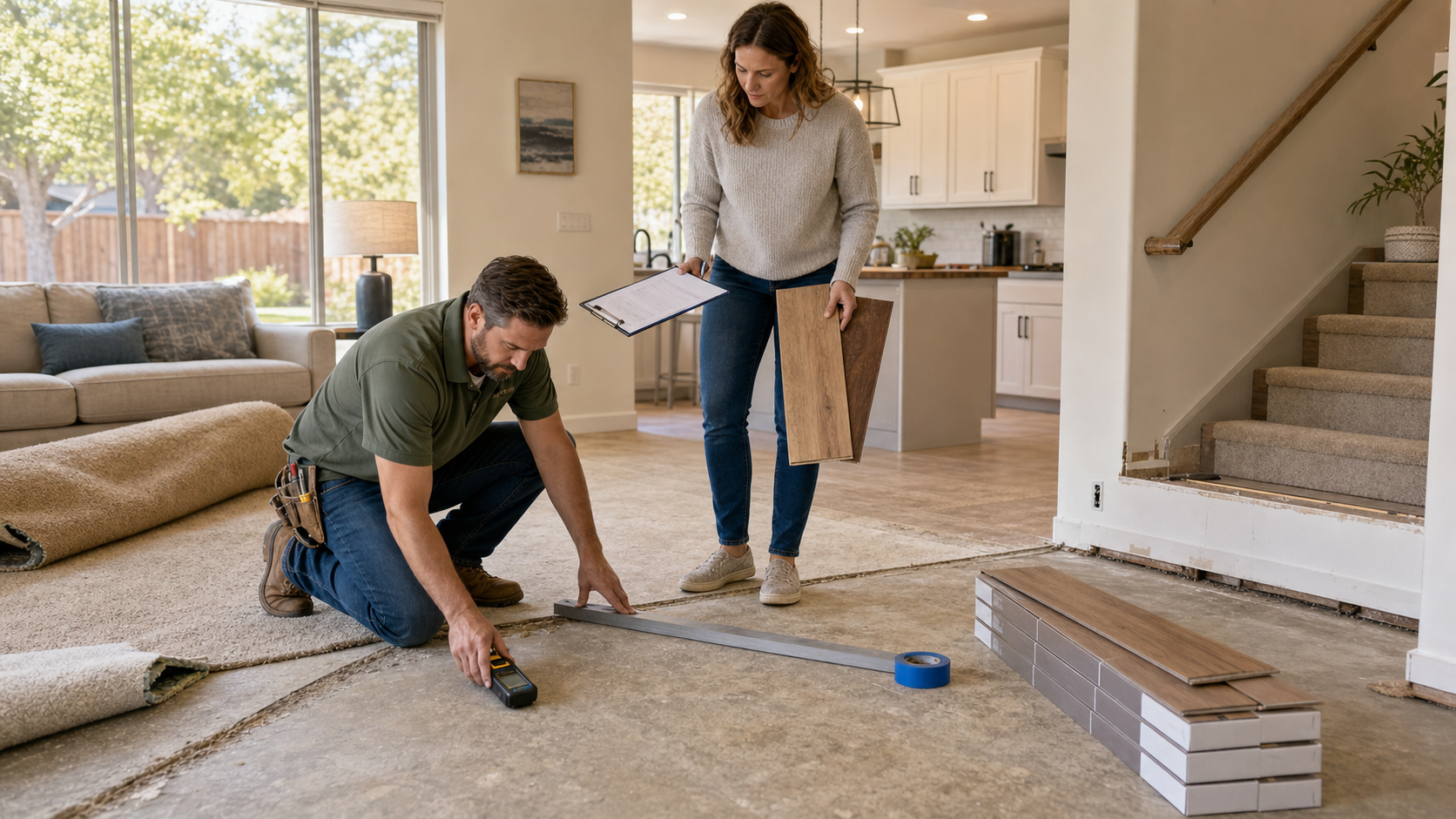
Roseville Builder Carpet to LVP: Slab Prep, Stairs, and Scope Questions
The floor sample looks harmless when it is sitting on the kitchen counter. One plank of warm oak LVP. One plank of engineered hardwood. Maybe a second color because the first one looks different in afternoon light.
Then the flooring contractor walks the house and starts pointing at everything the sample did not explain: carpet over pad in the living room, tile in the kitchen, a raised transition at the hallway, a concrete slab that is not quite flat, baseboards that may or may not survive removal, and stairs that need their own trim plan.
That is a normal Roseville flooring conversation. Many homes built from the 1990s through the 2010s are reaching the point where original builder carpet, small-format tile, and mixed flooring no longer match how the house is used. Homeowners want one cleaner surface through the main floor. The project can be a great upgrade, but only if the bid treats prep, removal, transitions, stairs, and finish repair as part of the job instead of surprises.
Use this chart before comparing bids. A flooring estimate is not complete until demolition, slab prep, trim, transitions, stairs, and wet-area details are visible.
Start With The Walk-Through, Not The Plank
Before you fall in love with a color, walk the house in the order the installation crew will see it. Start at the front door. Where does tile meet carpet? Where does carpet meet vinyl, sheet goods, a fireplace hearth, a bathroom doorway, a laundry room, or a stair landing? Are there sliders with sun exposure, pet water bowls, rolling office chairs, or heavy kitchen islands?
Take photos from low angles so the contractor can see height changes. Open closet doors. Photograph the stair treads, nosing, bottom step, top landing, and any curved or angled steps. Pull back a floor vent if one exists and note whether you are on slab, raised subfloor, or a mix. If you have had a dishwasher leak, refrigerator leak, pet accident problem, or water heater overflow, say that early.
The best flooring bids start with the existing house. Product choice comes next. A beautiful plank cannot fix a slab hump, a loose tile bed, a bad stair nose, or a baseboard scope nobody priced.
Why Roseville Homes Hit This Point
Roseville has a lot of homes with open living areas, kitchen-family-room layouts, upstairs bedrooms, and original flooring packages that were split by room. Carpet kept the living spaces soft. Tile handled kitchens, entries, baths, and laundry rooms. It worked when the house was new, but after kids, pets, office chairs, water spills, and 15 to 25 years of traffic, those surfaces age differently.
Many homeowners now want one continuous floor through the main level because it makes the house feel cleaner and less chopped up. That can work well with quality LVP, engineered hardwood, or porcelain tile, but the transition from mixed old flooring to one new surface is where bids diverge.
Tile demolition can reveal thinset ridges, slab cracks, old adhesive, low spots, and uneven patched areas. Carpet removal can expose tack-strip damage, pet staining, or slab cracks that were invisible before. Stairs introduce a separate trim system. Baseboards decide whether the finished job looks intentional or like the floor was slid under yesterday's paint line.
What It Might Cost In 2026
These are planning ranges for Roseville and nearby Sacramento-area homes, not quotes:
- Carpet removal and disposal: $1 to $3 per square foot for straightforward carpet and pad removal, more if furniture moving, stairs, odor treatment, or heavy disposal is included.
- Floating LVP installed over a prepared slab: $5 to $12 per square foot for common mid-grade products and labor, depending on plank quality, layout, underlayment, and prep.
- Engineered hardwood installed: $10 to $22 per square foot or more depending on material, installation method, adhesive, moisture control, and finish details.
- Tile demolition and thinset grinding: $4 to $10 per square foot, sometimes higher for thick mortar beds, difficult access, dust control, or occupied homes.
- Slab patching, grinding, or self-leveling: $1.50 to $8 per square foot in affected areas, with larger corrections priced by actual conditions.
- Baseboard removal, replacement, caulking, and paint touch-up: often $3 to $10 per linear foot depending on whether old trim is reused or replaced.
- Stair work: $150 to $450 per tread or more when matching stair nosing, risers, landings, code-sensitive geometry, and finish carpentry are included.
A simple bedroom carpet replacement can be modest. A whole downstairs conversion from carpet and tile to continuous LVP can land in the $8,000 to $28,000 range. Larger homes, stairs, lots of tile demo, slab leveling, new baseboards, furniture moving, appliance moving, or engineered hardwood can push the project into the $18,000 to $45,000-plus range.
The number that matters is not the square-foot price on the product tag. It is the installed, finished, cleaned-up, ready-to-live-on price.
Slab Prep Is Not Optional
Most Roseville main-floor flooring projects happen over concrete slab. That slab may look flat after the carpet comes up, but flooring manufacturers usually care about flatness tolerances, moisture conditions, adhesive compatibility, and surface cleanliness. Those details affect warranty and long-term performance.
Ask how the contractor checks slab flatness. A long straightedge, laser, or documented inspection is better than a glance. Low spots can make floating planks flex. High spots can break locking edges. Old thinset can telegraph through thinner products. Cracks may need evaluation before they are covered.
Moisture also matters. LVP is more forgiving than many materials, but the installation system still has rules. Engineered hardwood is more sensitive. If the contractor is installing over slab, ask what moisture test they use, what result is acceptable for the product, and whether a vapor barrier, adhesive system, or different product would be recommended if the slab tests high.
Do not skip this conversation because the floor is "waterproof." Waterproof marketing usually describes the plank surface, not every condition below the floor.
Tile Removal Changes The Job
Removing carpet is usually predictable. Removing tile is not. Tile demo creates noise, dust, debris, and sometimes slab repair. The contractor may need to protect cabinets, appliances, HVAC returns, smoke alarms, and adjacent rooms. Occupied homes need a plan for where the family can walk, how dust is contained, and whether the kitchen or laundry room will be unavailable.
Ask whether the bid includes dust control, haul-off, thinset grinding, appliance movement, toilet removal and reset if bathrooms are included, and protection of cabinets or stone countertops. If tile runs under cabinets or a built-in island, ask where the cut line will be and how the new floor edge will be finished.
Be especially careful with "install over existing tile" proposals. Sometimes it is reasonable if the tile is sound, flat, and height transitions work. Other times it creates door clearance problems, dishwasher clearance problems, awkward stair or exterior door transitions, and a floor stack that future contractors will curse. Make the contractor explain why overlay is appropriate for your house, not just cheaper this week.
Stairs, Baseboards, And Doors Decide How Finished It Looks
Stairs are not just more square footage. They are visible finish carpentry. The stair nose profile, tread depth, riser treatment, landing transition, top step, bottom step, and handrail clearances all need to work together. If the new flooring changes thickness, the stair details may need different parts than the main floor.
Baseboards are another common bid gap. Some contractors remove and reinstall existing baseboards. Some cut in quarter-round. Some include new taller baseboards and paint. Each option has a different look and cost. In many Roseville homes with clean painted trim, replacing baseboards during flooring can make the whole project look sharper, but only if caulking and paint touch-up are included.
Door clearance can also change. Bedroom doors, pantry doors, closet doors, and exterior thresholds may need trimming or adjustment. Ask who handles that work, and whether it is included for every door or priced as needed.
Which Contractor Should Lead?
A licensed flooring contractor is usually the right lead for carpet, LVP, engineered wood, laminate, and related surface prep. For ceramic or porcelain tile installation, the scope may point to a tile contractor. The CSLB's license classification list includes C-15 Flooring and Floor Covering Contractors and C-54 Ceramic and Mosaic Tile Contractors as separate specialties.
A general contractor can make sense when the flooring is part of a larger kitchen remodel, wall removal, stair rebuild, cabinet change, plumbing move, or whole-home renovation. A demolition contractor may be appropriate for heavy tile removal or multi-room demo that is separate from the flooring install. A painter or finish carpenter may enter the job if new baseboards, casing, door trimming, stair skirt boards, or paint touch-ups are outside the flooring contractor's scope.
California licensing is not a formality here. The CSLB explains that contractors generally must be licensed when a project requires a permit, uses additional workers, or totals $1,000 or more in labor and materials. A full-floor replacement clears that threshold quickly.
Permits And Roseville Questions
Replacing floor covering by itself is often treated as cosmetic work, but do not let that become a blanket answer for every related scope. The City of Roseville's building permit page points homeowners to the California Building Code rule that regulated building work generally needs a permit, while some exemptions exist.
For a flooring project, the permit question changes when the job includes structural subfloor repair, stair geometry changes, guard or handrail changes, plumbing or electrical relocation, shower or bathroom waterproofing, kitchen remodel work, wall changes, or other construction beyond surface replacement. If the contractor says no permit is needed, ask them to state the reason in writing and separate any work that would change that answer.
Roseville homeowners should also ask about HOA or architectural review only when the flooring affects visible exterior details, noise rules in attached housing, common areas, or work-hour limits. For detached single-family homes, the bigger issue is usually not HOA approval. It is having a written scope clear enough that everyone knows what happens when demolition reveals more prep than expected.
What A Useful Flooring Bid Should Include
Ask each contractor to separate:
- Existing flooring removal by material: carpet, pad, tack strip, tile, vinyl, laminate, or wood
- Disposal, dump fees, dust control, furniture moving, appliance moving, and occupied-home protection
- Slab inspection, moisture testing, flatness correction, crack treatment, grinding, patching, and leveling
- Product brand, thickness, wear layer, attached pad, underlayment, adhesive, stair parts, trims, and warranty rules
- Layout direction, plank staggering, transition locations, expansion gaps, and wet-area details
- Baseboards, shoe molding, door trimming, closet tracks, registers, toilet resets, and appliance reinstall
- Stair treads, nosing, risers, landings, skirt boards, and handrail or guardrail assumptions
- Permit assumptions, contractor license classification, insurance, workers' compensation, and warranty terms
- Change-order pricing for hidden slab damage, extra leveling, pet odor treatment, or damaged trim
If a bid only says "install LVP," it is not ready for comparison.
Red Flags In Flooring Quotes
Be cautious if a contractor prices the whole job from a room count without asking what flooring is coming out. Be careful with a bid that ignores tile demo, does not mention slab flatness, or says moisture testing is unnecessary for every product.
Other warning signs include no written plan for stairs, vague "trim included" language, no dust-control details for tile removal, no product spec sheet, no warranty language tied to prep, and no answer about who moves appliances or trims doors. Also watch for a contractor who pushes the cheapest plank while avoiding questions about wear layer, locking system, sun exposure, pets, rolling chairs, or whether the manufacturer approves the installation method.
A good contractor should be comfortable slowing down. The expensive flooring mistakes usually happen when product decisions move faster than site conditions.
Internal Homework Before You Hire
Start with our Roseville contractor guide, compare licensed flooring contractors, general contractors, demolition contractors, and painting contractors. Use the contractor search when you are ready to build a shortlist.
For related planning, pair this with our Sacramento flooring material guide, old flooring removal and LVP prep guide, Roseville cabinet painting vs replacement guide, Roseville contractor selection guide, and California contractor license verification guide.
The Bottom Line
Replacing builder carpet and tile in a Roseville home can make the whole house feel newer, cleaner, and easier to maintain. The success of the project depends less on the sample board and more on the prep plan.
Before you compare prices, make sure every bid sees the same job: demolition, slab prep, moisture testing, stairs, transitions, baseboards, doors, cleanup, and warranty conditions. The right contractor will talk about the floor you cannot see yet as much as the plank you already picked.
Who to Hire for This Project
For the work covered in this guide, these are the contractor types to contact and the CSLB classification to verify before you take quotes:
Questions to Ask Before You Sign
- "Is your CSLB license active and bonded?" Verify it yourself at cslb.ca.gov the license number must appear on their bid.
- "Who pulls the permit, and is it included in the bid?" The contractor should handle any required permits a pro who suggests skipping one is a red flag.
- "Can you itemize labor, materials, and allowances?" Itemized bids are the only way to compare quotes on the same scope.
- "What's the payment schedule?" California caps the down payment at $1,000 or 10%, whichever is less payments should track completed work.
- "Who from this area can I call as a reference?" Ask for a recent local job of similar scope, not just photos.
Sacramento Contractors for This Project
Related Articles
Frequently Asked Questions
How much does it cost to replace builder carpet with LVP in Roseville? +
A straightforward LVP installation over a prepared slab often falls around $5 to $12 per square foot for common mid-grade products and labor. Whole downstairs projects can range from about $8,000 to $28,000, while tile demo, slab leveling, stairs, baseboards, furniture moving, and engineered wood can raise the total.
Do I need a permit to replace flooring in Roseville? +
Floor covering replacement by itself is often treated as cosmetic work, but the answer can change if the project includes structural repairs, stair changes, plumbing or electrical relocation, bathroom waterproofing, wall changes, or a larger remodel. Ask the contractor to state the permit assumption in writing.
Should I remove tile before installing LVP? +
Sometimes yes, especially when tile is loose, uneven, cracked, too high at transitions, or likely to cause door, appliance, stair, or cabinet clearance problems. Installing over sound tile can work in selected cases, but the contractor should explain flatness, height, moisture, and manufacturer requirements first.
What license should a flooring contractor have in California? +
Many carpet, LVP, laminate, wood, and similar floor-covering projects point to a C-15 Flooring and Floor Covering contractor. Tile work may point to a C-54 Ceramic and Mosaic Tile contractor. Larger remodels may involve a general contractor or additional licensed trades.
Why does slab prep matter before LVP or engineered hardwood? +
Flatness, moisture, old adhesive, thinset ridges, cracks, and high or low spots can affect how the new floor locks together, feels underfoot, and qualifies for warranty coverage. A good bid should include inspection and specify how prep is priced.