Orangevale Well Pump and Pressure Tank Problems: No Water, Low Pressure, and Who to Call
The shower turns weak first. Then the kitchen faucet spits air. By the time the irrigation timer starts, the pressure gauge bounces, the pump clicks on and off, and an Orangevale homeowner realizes the house is one pressure tank away from a no-water morning.
Well pump problems feel different from normal plumbing problems because the whole property depends on the same system. The issue might be a tired pressure tank, a bad pressure switch, a failing pump, a stuck check valve, a leak between the well and the house, a wiring problem, or a water level issue. Replacing random parts is an expensive way to guess.
Orangevale has larger lots, older ranch homes, custom properties, shops, gardens, animals, and irrigation loads that standard suburban plumbing advice does not always cover. This guide explains how to read common symptoms, what a useful service call should include, when permits and specialized licensing matter, and how to compare contractor scopes before the pump quits completely.
Use this before calling around. The right first contractor depends on whether the problem is pressure storage, pump equipment, wiring, underground piping, water level, or treatment equipment after the well.
Start With The Pressure Clues
Before calling contractors, write down exactly what changed. Does pressure start strong and fade? Does the pump click every few seconds when a faucet is running? Does the pressure gauge rise to cut-off pressure and hold, or does it drop when nobody is using water? Does the breaker trip? Does the water come back after the system sits for an hour?
Those details matter. A waterlogged pressure tank can make the pump short-cycle, which wears out the motor and controls. A clogged filter can look like low well output. A bad pressure switch may fail to start the pump even when the well has water. A leak in the line between the well and the house can make the pump run when fixtures are off. A dry or low-producing well is a different conversation entirely.
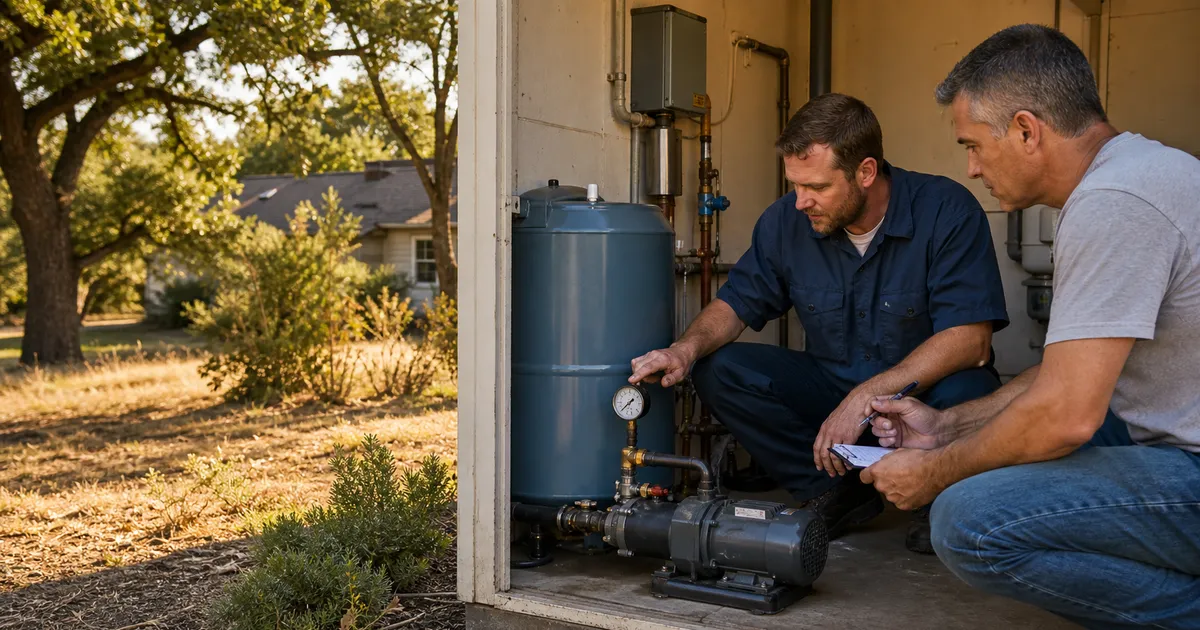
Take photos of the pressure tank label, pressure gauge, pressure switch, control box, pump model if accessible, filters, shutoff valves, well cap, electrical panel breaker, and any wet ground between the well and the house. If the system serves irrigation, a shop, animals, or an accessory dwelling unit, note that too. The contractor needs to know the real water demand, not just the number of bathrooms.
Why Orangevale Systems Need A Broader Walkthrough
Orangevale properties often ask more of a water system than a compact tract home. A well may feed a house, garden, landscape zones, hose bibs, a detached workshop, animals, or fire-season cleanup routines. Older properties may also have equipment added over time: sediment filters, softeners, pressure boosters, old galvanized piping, irrigation tie-ins, or a pressure tank that was sized for yesterday's household.
That does not mean every low-pressure complaint is expensive. It means the walkthrough should follow the full path: well, pump, drop pipe, wire, pressure tank, switch, control box, filters, treatment system, house main, irrigation branches, and any buried lines. If the contractor only looks at the kitchen faucet, the estimate is not done.
Timing matters too. A marginal pump can limp through spring and fail when July irrigation demand rises. A pressure tank that short-cycles ten times every shower may survive for a while, but it is also forcing the pump to start far more often than it should. The cheapest moment to diagnose the system is before the household has no water.
Common Scopes And 2026 Cost Ranges
These are planning ranges for Orangevale and nearby Sacramento County homes, not quotes:
- Diagnostic well pump or pressure service call: $250 to $850 depending on travel, electrical testing, pressure testing, and whether after-hours service is needed.
- Pressure switch, gauge, small fittings, or control adjustment: $250 to $900 when access is simple and the pump is otherwise healthy.
- Pressure tank replacement: $900 to $3,500 depending on tank size, piping changes, valves, pad or strapping, disposal, and whether electrical controls are corrected at the same time.
- Jet pump or above-ground pump replacement: $1,500 to $5,500 depending on horsepower, suction conditions, piping, controls, priming, and protection from weather.
- Submersible pump pull and replacement: $3,500 to $12,000 or more depending on well depth, pump size, wire, drop pipe, access, crane or hoist needs, and permit handling.
- Underground leak repair between well and house: $1,500 to $10,000-plus depending on locating, trenching, pipe material, driveway or landscape restoration, and whether excavation equipment can reach the line.
- Water treatment or filtration corrections after pump work: $800 to $8,000-plus depending on sediment, iron, hardness, odor, flow rate, and maintenance requirements.
The lowest number may only swap a switch. The higher number may include diagnosis, permit responsibility, pump pull equipment, new wire, a properly sized pressure tank, controls, startup testing, water sampling advice, and documentation. Compare scope before comparing totals.
Pump, Tank, Pipe, Or Filter?
Homeowners often say "the pump is bad" when they really mean "the water pressure is bad." Those are not the same sentence.
A pressure tank stores pressurized water so the pump does not start every time someone rinses a cup. If the tank bladder fails or the air charge is wrong, the pump may short-cycle. A pressure switch turns the pump on and off at set pressures. If it is clogged, worn, burned, or set incorrectly, the pump may behave strangely even when the motor is fine.
Filters and softeners can also confuse the diagnosis. A clogged sediment filter, fouled treatment media, bypass valve problem, or undersized system can choke flow after the pump has already done its job. If pressure is good before the filter and poor after it, do not replace the pump first.
Underground piping is another possibility. If the pump runs with no water being used, wet spots appear in the yard, or the pressure drops when the house is quiet, the line may be leaking. That can bring excavation, landscaping, concrete, or driveway restoration into the project.
Permits And Licensing To Ask About
Orangevale is in unincorporated Sacramento County, and well work has a different permit path than normal fixture plumbing. Sacramento County's well code says a permit is required before digging, drilling, deepening, modifying, repairing, inactivating, or destroying a well, and before installing, repairing, or replacing a well pump unless an exemption applies. The county also publishes a Water Supply Well/Well Repair/Pump Repair & Replacement form through Environmental Management.
For homeowners, the practical move is simple: ask the contractor whether the exact work requires a Sacramento County well permit, who files it, what fee is included, and whether the job needs inspection or county closeout paperwork. Do not wait until the pump is already out of the well to ask.
Licensing should match the work. A C-57 well drilling contractor is the specialized license to verify for well drilling, well repair, and many pump-related well scopes. A C-61/D-21 machinery and pumps classification can be relevant for some pump equipment work. A C-36 plumbing contractor may handle house-side plumbing, pressure piping, valves, and treatment connections. A C-10 electrical contractor belongs in the conversation when breakers, wiring, disconnects, controls, grounding, or unsafe electrical conditions are part of the problem.
If one company is coordinating several pieces, ask which license classification covers each part and whether any subcontractors will be used.
What A Complete Well Pump Bid Should Include
Ask each contractor to separate:
- The symptom being diagnosed: no water, low pressure, rapid cycling, noise, breaker trip, sediment, or poor flow under irrigation load
- Test steps: pressure readings, amp draw, voltage, tank air charge, switch operation, flow rate, and leak check
- What is included: pump, pressure tank, switch, gauge, check valve, wire, drop pipe, fittings, valves, trenching, filters, startup, and disposal
- Permit responsibility for well pump repair or replacement through Sacramento County when required
- Who handles electrical work, house-side plumbing, excavation, and landscape or concrete restoration
- Whether irrigation, shops, animals, or accessory units are included in sizing assumptions
- What happens if the well depth, water level, casing, wire, drop pipe, or pitless connection is different than expected
- Warranty terms for labor, pump, tank, controls, and any excluded water-quality issues
- Closeout documents: permit records, equipment model numbers, pressure settings, photos, and maintenance instructions
A bid that says only "replace pump" leaves too much room for surprise.
Red Flags
Slow down if a contractor wants to replace the pump without checking the pressure tank, switch, filters, electrical supply, and obvious leak clues. Be careful if the estimate does not mention Sacramento County well permit requirements, if the license classification is vague, or if electrical corrections are treated as a casual add-on.
Also watch for advice that ignores household demand. A system sized for one retired owner may not be right for a family, a garden, and a detached shop. On the other hand, oversizing the pump without understanding the well's production can create its own problems. The right contractor talks about flow, pressure, recovery, and use patterns together.
Internal Homework Before You Call
For local context, start with our Orangevale contractor guide, compare licensed plumbing contractors, electrical contractors, excavation contractors, landscaping contractors, and general contractors. Use the contractor search when you are ready to build a shortlist.
For related planning, pair this with our Orangevale well water filtration guide, Sacramento County permit jurisdiction guide, Orangevale workshop planning guide, spring plumbing checkup, whole-house repiping cost guide, California permit basics, and license verification guide.
For official starting points, review the Sacramento County wells and pumps code, the county water well forms page, and the CSLB license classification descriptions before you sign.
The Bottom Line
A weak well system is not just a plumbing nuisance. In Orangevale, it can affect showers, gardens, shops, animals, irrigation, and the daily rhythm of a larger property. Start by documenting pressure behavior, then hire the contractor who tests before replacing parts, explains the permit path, and matches the license to the work. The right repair should leave you with steady pressure, clear equipment records, and fewer surprises the next time summer demand climbs.
Who to Hire for This Project
For the work covered in this guide, these are the contractor types to contact and the CSLB classification to verify before you take quotes:
Questions to Ask Before You Sign
- "Is your CSLB license active and bonded?" Verify it yourself at cslb.ca.gov the license number must appear on their bid.
- "Who pulls the permit, and is it included in the bid?" The contractor should handle any required permits a pro who suggests skipping one is a red flag.
- "Can you itemize labor, materials, and allowances?" Itemized bids are the only way to compare quotes on the same scope.
- "What's the payment schedule?" California caps the down payment at $1,000 or 10%, whichever is less payments should track completed work.
- "Who from this area can I call as a reference?" Ask for a recent local job of similar scope, not just photos.
Sacramento Contractors for This Project
Related Articles
Frequently Asked Questions
How much does well pump repair cost in Orangevale? +
A diagnostic service call may run $250 to $850. Small pressure-switch or gauge repairs may be $250 to $900, while pressure tank replacement often runs $900 to $3,500. Submersible pump replacement can reach $3,500 to $12,000 or more depending on depth, access, wire, drop pipe, and permit handling.
Does Sacramento County require permits for well pump work? +
Sacramento County code generally requires a permit before installing, repairing, or replacing a well pump unless an exemption applies. Ask the contractor whether your exact scope requires a county well permit, who files it, and what closeout documentation you will receive.
Is low water pressure always a bad pump? +
No. Low pressure can come from a failed pressure tank, clogged sediment filter, pressure switch problem, electrical fault, underground leak, house-side plumbing restriction, or well production issue. A good service call tests the system before recommending a pump replacement.
What license should I verify for well pump work? +
For well drilling, well repair, and many well pump scopes, ask about a C-57 well drilling contractor license. C-61/D-21 machinery and pumps may apply to some pump equipment work, C-36 plumbing may apply to house-side piping, and C-10 electrical should handle electrical corrections. Verify the license classification with CSLB before signing.
What should I do before calling a well pump contractor? +
Take photos of the pressure tank, gauge, switch, control box, filters, shutoffs, well cap, and electrical breaker. Write down when pressure drops, whether the pump short-cycles, whether irrigation affects the house, and whether water returns after the system rests. That makes the first visit more useful.