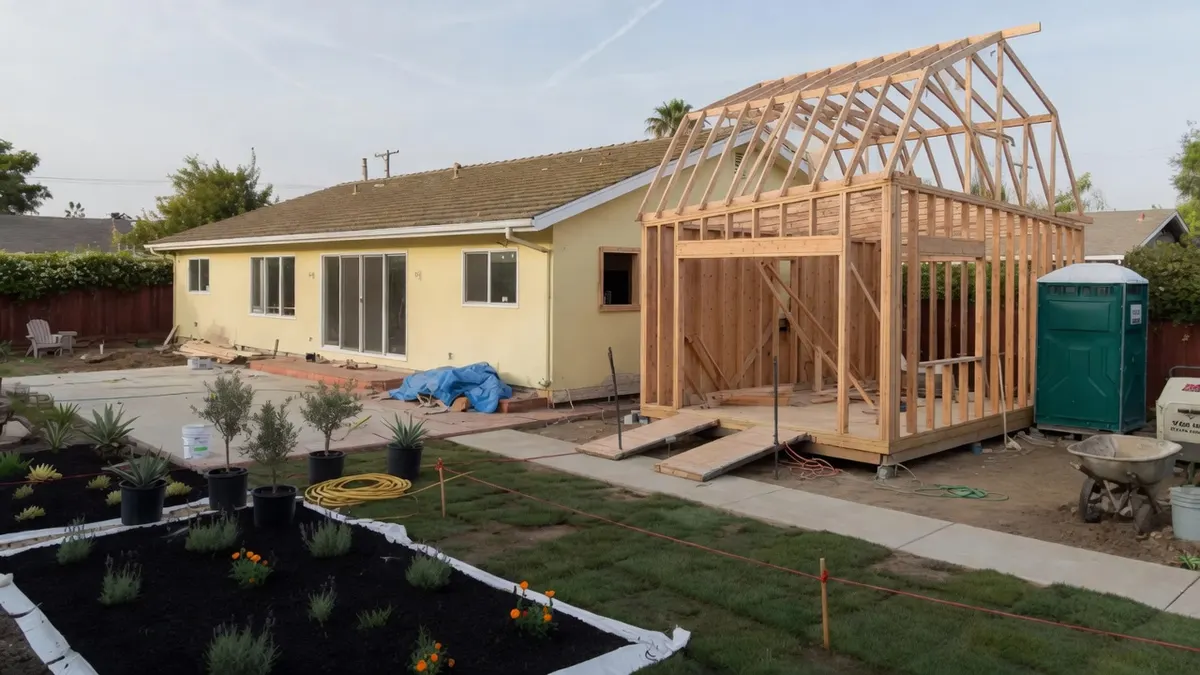
Orangevale Detached Workshop Planning for Hobbies and Home Businesses
A lot of Orangevale homeowners look at their backyard, mentally measure the gap between the house and the fence, and start picturing a real workshop out there. Maybe it's a woodworking shop, a pottery studio, a spot to rebuild motorcycles, or the quiet headquarters for a side business that has outgrown the garage. Out here, where lots tend to run larger than in the tighter neighborhoods closer to Sacramento, that vision is genuinely doable. The question is never really "can I build it." It's "what kind of building do I actually need, and what will the county want me to do to get there."
Storage shed versus serious shop: pick a lane before you draw a line
The first fork in the road decides almost everything downstream. A bare outbuilding for stashing the mower and holiday bins is a different animal from a conditioned, wired, insulated space you'll spend forty hours a week inside. The slab, the framing, the electrical service, the ventilation, the door sizes, the insulation package, the lighting plan all shift depending on which one you're really building.
Be honest with yourself here, because the hidden cost of indecision is redoing work. If you pour a thin slab meant for storage and later decide you want a lathe, a dust collector, and a 50-gallon compressor running off the same panel, you're paying twice. Decide up front whether the space is conditioned, whether you need a sub-panel, and whether the floor needs to carry real equipment loads.
What a real Orangevale shop tends to cost
Plan for a wide range, because a detached workshop is less a single product than a stack of decisions. Across the Sacramento Valley, these projects commonly land somewhere between roughly $35,000 for a modest, mostly-uninsulated shell and $160,000 or more for a fully conditioned, finished, code-built space with its own electrical service and proper access. The big line items each pull their own weight: the foundation, the framing and shell, the electrical, the doors, insulation and venting, and the driveway or pad you need to actually reach the thing.
When estimates come in, resist the instinct to crown the lowest number. The most useful bid is usually the longer one, the document that spells out materials, labor, exclusions, allowances, who's responsible for permits, cleanup, and warranty terms. If two quotes are thousands apart, the gap is almost always buried in assumptions, not in one contractor being generous. Set aside a contingency too. Older Orangevale parcels sometimes have prior work that doesn't match current code or never got documented, and that surfaces once shovels are in the ground.
You can sanity-check what's reasonable by comparing licensed general contractors and reading through the Orangevale contractor guide before you ever take a phone call.
The backyard puzzle most people underestimate
Square footage on paper is not the same as buildable space. Setbacks from property lines, the location of a septic system or leach field, where the utilities run, mature trees you'd rather not lose, and how visible the structure will be to neighbors all narrow your real footprint fast. A contractor worth hiring will walk the lot with you and talk through how local soil, the Valley's summer heat, utility access, and neighborhood expectations shape the design, rather than handing you a stock plan that ignores your specific yard.
If your project sits near a jurisdictional edge, it's worth checking nearby city pages too. A homeowner one town over may face a different permit path for what looks like the same building.
Permits, licenses, and the rules that actually bite
Detached accessory structures past a certain size need a permit, full stop, and the electrical work needs to be installed by someone licensed. If you intend to run a home business out of the space, zoning and use restrictions matter as much as the structural drawings, so confirm what's actually allowed before you commit to a layout.
This is also where contractor vetting stops being optional. In California, anyone doing construction work valued at $1,000 or more in combined labor and materials must hold a license from the Contractors State License Board. Before you sign anything, verify the contractor's CSLB license number on the board's own website, and confirm their insurance and workers' compensation are current. A clean license lookup takes two minutes and saves you from the kind of mess that ends up in small claims court. The electrical scope in particular deserves a licensed pro who can give you an honest load estimate, since shops are power-hungry and undersized service is a common regret.
Timing plays a role as well. Spring and early summer get crowded for exterior trades, concrete, and roofing, so if your build leans on those, expect schedules to stretch. Lock down material lead times early no matter the season.
Before the first crew shows up
Walk the property with your phone, take photos, and write down exactly what you want the space to do, ranked by priority. Ask any bidder for a site plan, an electrical load estimate, a slab specification, a ventilation strategy, and a clear note on permitted use. Request photos of similar completed shops, a payment schedule tied to actual progress, and one named person you can call when a detail gets complicated, because a contractor who communicates clearly before the job tends to keep doing it once the job gets messy. When you're ready to line up estimates, compare at least three licensed builders through the contractor search and aim for the cleanest scope, not just the smallest invoice. The shop you'll still love in ten years comes from the careful planning you do now, not the corner you cut to save a few thousand.
Who to Hire for This Project
For the work covered in this guide, these are the contractor types to contact and the CSLB classification to verify before you take quotes:
Questions to Ask Before You Sign
- "Is your CSLB license active and bonded?" Verify it yourself at cslb.ca.gov the license number must appear on their bid.
- "Who pulls the permit, and is it included in the bid?" The contractor should handle any required permits a pro who suggests skipping one is a red flag.
- "Can you itemize labor, materials, and allowances?" Itemized bids are the only way to compare quotes on the same scope.
- "What's the payment schedule?" California caps the down payment at $1,000 or 10%, whichever is less payments should track completed work.
- "Who from this area can I call as a reference?" Ask for a recent local job of similar scope, not just photos.
Sacramento Contractors for This Project
Related Articles
Frequently Asked Questions
Do I need a permit to build a detached workshop in Orangevale? +
In most cases, yes. Detached accessory structures above a certain size require a building permit through Sacramento County, and any electrical work must be installed under permit by a licensed contractor. If you plan to run a business from the space, zoning and use restrictions apply on top of the structural permit, so confirm allowed use before finalizing your design.
What does a detached workshop typically cost in the Sacramento Valley? +
It varies widely with finish level. A modest, largely uninsulated shell can start around $35,000, while a fully conditioned, wired, and finished workshop with its own electrical service can run $160,000 or more. The foundation, shell, electrical, doors, insulation, and access drive are the major cost lines, so decide whether the space is conditioned before you price it.
How do I verify a contractor is licensed for my Orangevale workshop? +
Look up the contractor's license number directly on the California Contractors State License Board (CSLB) website, which is free and takes a couple of minutes. Confirm the license is active and that their bond, liability insurance, and workers' compensation are current. In California, any project of $1,000 or more in combined labor and materials legally requires a licensed contractor.
Can I legally run a home business out of a backyard workshop in Orangevale? +
Often yes, but it depends on the type of business and local zoning rules. Home occupations typically have limits on signage, customer traffic, employees, and noise. Check Sacramento County zoning for your parcel before building, and make sure your contractor's plans reflect any use-specific requirements like additional parking or separate access.
Why are workshop bids so different from one contractor to the next? +
The gap is almost always in the assumptions, not the quality of the contractor. One bid might include conditioned space, a sub-panel, and a finished interior while another assumes a bare shell. Compare what's written into each estimate, including materials, allowances, exclusions, permit responsibility, and warranty, before deciding which number is actually the better deal.
What should the electrical service be for a serious hobby or business shop? +
That depends on your equipment, but shops are power-hungry, and undersized service is one of the most common regrets. Ask a licensed electrician for a load estimate based on your specific tools, like dust collectors, compressors, welders, or 240-volt machines. It is far cheaper to size a sub-panel correctly during the build than to upgrade it later.