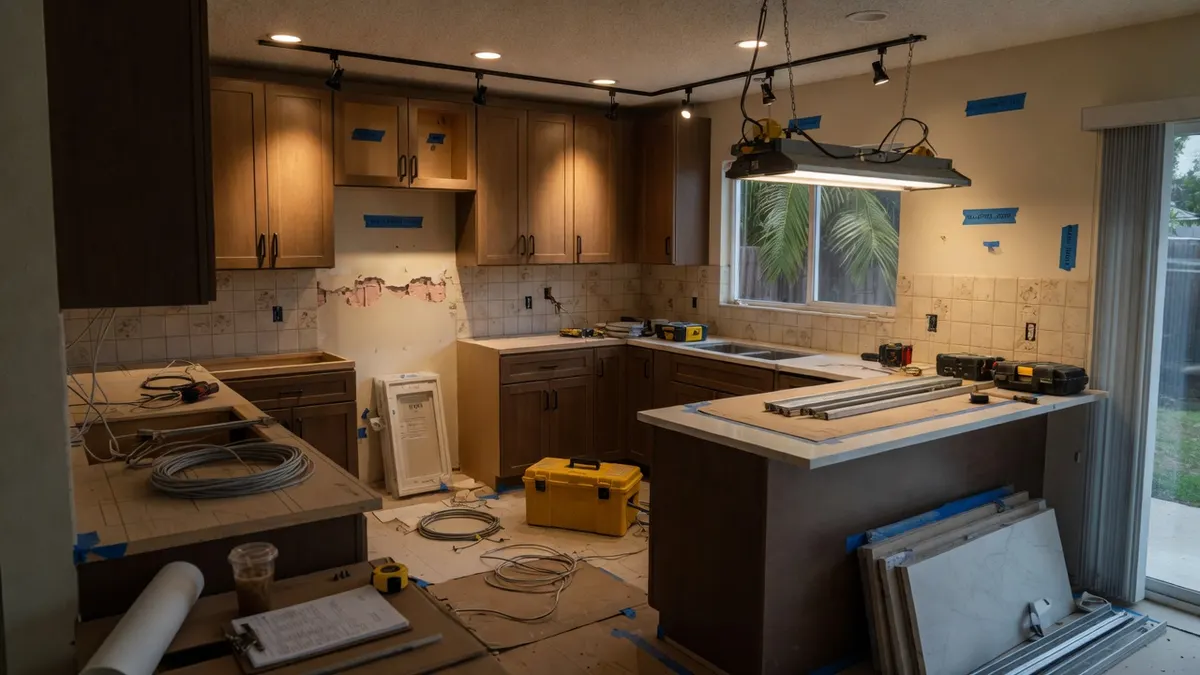
El Dorado Hills Kitchen Lighting Layers That Make Remodels Feel Finished
There's a moment that happens in a lot of El Dorado Hills kitchens around 6 p.m. in January. The big windows that felt so generous at noon go black, the single can light or the builder-grade flush mount over the island clicks on, and suddenly the whole room reads flat. Counters fall into shadow. The backsplash you paid good money for disappears. Half the people standing around the island are lit from behind like a police interrogation. The cabinets are fine, the quartz is fine, but the room feels unfinished, and nobody can quite say why.
The why is almost always lighting. Specifically, the lack of layers.
One bulb is not a plan
A kitchen does at least four different jobs, and each one wants a different kind of light. You're chopping onions at the counter, which needs bright, shadow-free task light right where your hands are. You're hosting on a Friday, which wants softer ambient light that fills the room. You want the open shelving or the range hood to actually look like something, which is where accent light earns its keep. And on a Tuesday at 9 p.m. you just want enough glow to find the dishwasher without flipping on the full noon-grade array.
Trying to do all of that with one fixture is the original sin of builder kitchens, and it's incredibly common in the production homes that went up across El Dorado Hills in the late '90s and 2000s. Those houses got one or two recessed cans and called it done. The fix isn't a brighter bulb. It's recessed cans for general coverage, under-cabinet strips for the counters, pendants over the island for both task and presence, and maybe a little toe-kick or in-cabinet accent for the evening. Then you put the whole thing on dimmers so the room can shift from prep mode to dinner mode without touching a single fixture.
The detail that ruins more layered-lighting jobs than any other
Color temperature. If your recessed cans are a cool 4000K, your pendants are a warm 2700K, and the under-cabinet tape light is whatever was cheapest at the big-box store, your beautiful layered kitchen is going to look like a mismatched thrift-store lamp collection at night. The layers fight instead of stacking.
A good electrician or lighting-focused contractor will spec one color temperature across the whole room, usually somewhere in the warm-white 2700K to 3000K range for an El Dorado Hills kitchen that opens to a living space. They'll also talk to you about beam spread and where the switches land before any wire gets pulled, because moving a switch leg after the drywall is closed is exactly the kind of change that turns a clean budget into a messy one. If a bidder won't sketch a lighting plan and just promises "we'll add some cans," that's a flag.
What the layers actually cost around here
For a real layered lighting upgrade in the Sacramento Valley, plan on roughly $2,500 to $12,000, and understand that the spread is that wide for a reason. The low end is a handful of new cans, under-cabinet lighting, and dimmers in a kitchen where the wiring cooperates. The high end is pendants, accent circuits, smart controls, multiple switching zones, and the drywall patching and repainting that comes with cutting into ceilings.
That patch-and-paint line is the one homeowners forget. Every new can and every relocated switch means a hole, and somebody has to close it and blend it. Get it in the written estimate. While you're at it, make sure the bid spells out fixture allowances versus labor, who's responsible for permits, and what happens if the crew opens the ceiling and finds the previous owner's questionable junction box. Older Sacramento-area homes hide that kind of thing constantly, so build in a contingency rather than assuming the first number is the final number. When two bids look far apart, it's usually the assumptions that differ, not the quality. Read both line by line before you decide one electrician is "expensive."
If you're still assembling names, our El Dorado Hills contractor guide is a reasonable place to start, and you can filter to licensed electrical contractors from there.
Permits, Title 24, and the license you should actually verify
New lighting circuits, added recessed fixtures, and changed switching almost always need an electrical permit in El Dorado County, and yes, that means an inspection. People grumble about this, but the inspection is the thing standing between you and a buried wiring problem that shows up as a flickering kitchen three years later. California's Title 24 energy code also has opinions about kitchen lighting, including requirements around high-efficacy fixtures and certain controls, so the fixtures and dimmers your contractor picks aren't purely an aesthetic call. A pro who works in this area already designs around those rules.
On the licensing side: in California any home-improvement job where labor plus materials runs $1,000 or more must be done by a contractor holding a current CSLB license. Lighting work clears that threshold almost immediately, so this isn't optional. Take ten seconds and verify the license yourself at the CSLB website before you sign anything, and confirm they carry liability insurance and workers' compensation. Electrical is exactly the trade where you do not want an unlicensed handyman improvising in your ceiling. If a price feels suspiciously low, an expired or missing license is often the reason.
When the lighting is really part of a bigger remodel
Sometimes the dim kitchen is a symptom of a kitchen that's getting reworked anyway. If you're moving cabinets, changing the island, or opening a wall, the lighting plan should be designed alongside that work, not bolted on at the end. Coordinating it with a kitchen remodel means the electrician and the cabinet installer aren't surprising each other, and your under-cabinet wiring actually lines up with where the cabinets end up.
So here's the practical move. Stand in your kitchen after dark, notice exactly where the light fails, and write it down: dark counters, no island light, harsh overhead, can't dim it. Take a few phone photos. Then pull together at least three licensed bids through our Sacramento Valley contractor search and ask each one to walk you through a layered plan with a single color temperature and a switching scheme before they quote. The contractor who can explain how the layers stack, instead of just promising more cans, is the one who'll hand you a kitchen that finally feels finished at 6 p.m. in January.
Who to Hire for This Project
For the work covered in this guide, these are the contractor types to contact and the CSLB classification to verify before you take quotes:
Questions to Ask Before You Sign
- "Is your CSLB license active and bonded?" Verify it yourself at cslb.ca.gov the license number must appear on their bid.
- "Who pulls the permit, and is it included in the bid?" The contractor should handle any required permits a pro who suggests skipping one is a red flag.
- "Can you itemize labor, materials, and allowances?" Itemized bids are the only way to compare quotes on the same scope.
- "What's the payment schedule?" California caps the down payment at $1,000 or 10%, whichever is less payments should track completed work.
- "Who from this area can I call as a reference?" Ask for a recent local job of similar scope, not just photos.
Sacramento Contractors for This Project
Related Articles
Frequently Asked Questions
How much does a layered kitchen lighting upgrade cost in El Dorado Hills? +
For a kitchen in the Sacramento Valley, plan on roughly $2,500 to $12,000. The low end covers new recessed cans, under-cabinet lighting, and dimmers in a kitchen where the existing wiring cooperates. The high end adds island pendants, accent circuits, smart controls, multiple switching zones, plus the drywall patching and repainting that comes with cutting into ceilings. Always confirm whether patch-and-paint is included in the bid.
Do I need a permit to add recessed lighting in El Dorado County? +
Usually yes. New circuits, added recessed fixtures, and changed switching typically require an electrical permit and an inspection in El Dorado County. The inspection is worth it because it catches buried wiring issues before they become a flickering kitchen down the road. A licensed local electrician will pull the permit and design the job to pass inspection the first time.
How does California's Title 24 affect my kitchen lighting choices? +
Title 24 is the state energy code, and it has specific requirements for kitchen lighting, including high-efficacy fixtures and certain control or dimming provisions. That means the fixtures and dimmers your contractor specs aren't purely an aesthetic decision; they have to comply. A contractor who works in the El Dorado Hills area regularly will design around these rules automatically, so ask how they're handling Title 24 compliance.
Do I really need a licensed contractor for kitchen lighting in California? +
Yes. California requires a current CSLB license for any home-improvement job where labor and materials total $1,000 or more, and lighting work clears that threshold almost immediately. Electrical is also a trade where unlicensed work is genuinely dangerous. Verify the license yourself on the CSLB website and confirm the contractor carries liability insurance and workers' compensation before signing.
Why does my new kitchen lighting look mismatched at night? +
It's almost always color temperature. If your recessed cans, pendants, and under-cabinet strips are different Kelvin ratings, the layers clash instead of blending. For an El Dorado Hills kitchen that opens to a living space, a single warm-white temperature around 2700K to 3000K across every fixture usually reads best. Insist your contractor specs one consistent color temperature for the whole room.
Should I plan lighting separately or as part of a full kitchen remodel? +
If you're already moving cabinets, reworking the island, or opening a wall, design the lighting alongside that work rather than adding it at the end. Coordinating it with your kitchen remodel keeps the electrician and cabinet installer in sync, so under-cabinet wiring actually lines up with the finished cabinets. Standalone lighting upgrades make sense when the cabinetry and layout are staying put.