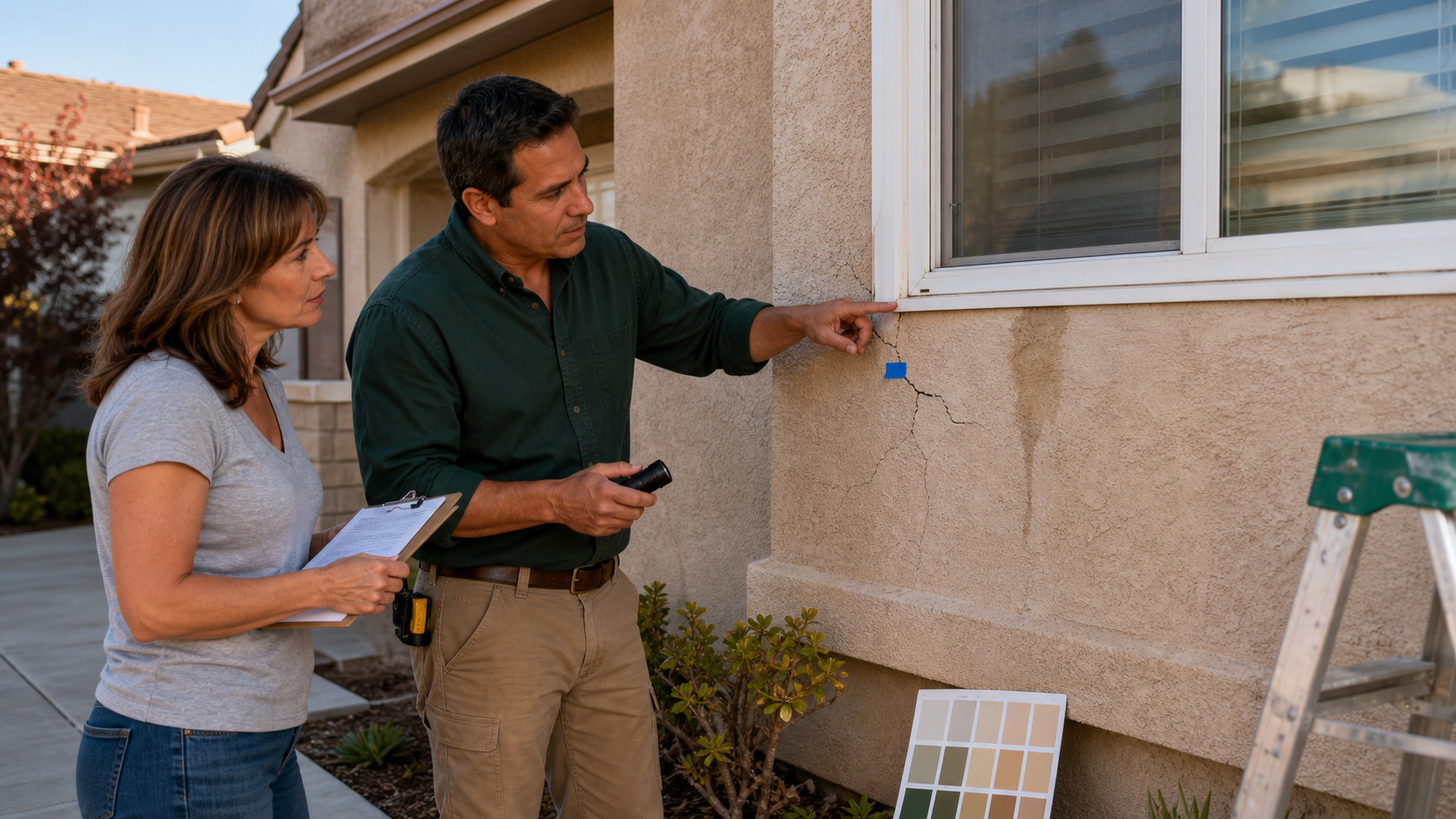
Antelope Stucco Cracks and Window Leaks: Fix Water Intrusion Before Exterior Paint
The paint bid looks simple until the painter taps below the bedroom window and the stucco sounds hollow.
That is the moment an Antelope homeowner has to stop thinking in colors and start thinking in causes. A hairline crack near a window corner may be normal movement. A brown stain under the sill may be a bad caulk joint. A soft patch, bubbling paint, or dark line at the trim can mean water has been getting behind the wall every winter and quietly drying out every summer.
Exterior paint can hide that for a season. It cannot fix it. If the wall has a flashing problem, failed sealant, missing weep detail, wet sheathing, or a stucco patch that was never tied into the weather barrier, the new paint becomes an expensive cover-up.
Use this chart before comparing bids. A paint-ready wall is not just dry on the surface; the leak path, stucco patch, window joint, hidden substrate, and coating sequence all need to be named.
Start With The Leak Path, Not The Paint Color
Before calling contractors, walk the outside wall slowly. Look at window corners, trim joints, stucco control joints, hose bibs, light fixtures, roof-to-wall areas, and the bottom edge of the stucco near soil or concrete. Take wide photos that show the whole elevation, then close photos of cracks, stains, gaps, soft spots, and peeling paint.
Inside, check the matching wall. Is there a faint stain below the window? A swollen baseboard? A musty smell after rain? Blinds that hide water marks on the sill? A leak that only shows up during wind-driven rain can disappear by the time a contractor arrives, so photos and dates matter.
Do not let the first conversation become "How much to paint the house?" if the real question is "Why did this wall fail?" A strong estimate should separate diagnosis, stucco repair, window or trim work, primer, paint, and exclusions. If the contractor cannot explain how water gets out of the wall, the bid is not complete yet.
Why Antelope Homes Run Into This
Many Antelope homes were built in the 1980s, 1990s, and early 2000s with textured stucco, foam trim, aluminum or vinyl windows, and large sun-exposed wall faces. That construction can perform well, but it depends on small details homeowners rarely see: flashing, sealant joints, weather-resistive barrier laps, weep screeds, kick-out flashing, and enough clearance above soil or paving.
The local weather cycle is hard on those details. Summer heat bakes caulk until it shrinks and splits. Winter rain finds the joint. Sprinklers hit the wall every morning. Soil and bark get piled too high against the stucco. A previous paint job seals a hairline crack without fixing the reason it opened. Over time, the wall gives little clues before it gives big ones.
The goal is not to make every small crack sound scary. Hairline stucco cracks are common. The goal is to spot the cracks and stains that connect to water, movement, poor flashing, or hidden substrate damage before a paint crew locks the problem behind a new finish.
What It Might Cost In 2026
These are planning ranges for Antelope and nearby Sacramento County homes, not quotes:
- Exterior leak and stucco inspection: $250 to $900 when the contractor checks wall conditions, window joints, moisture clues, roof edges, and paint failure areas.
- Sealant renewal and minor crack prep before paint: $700 to $2,500 when the wall is sound and the work is mostly cleaning, routing, elastomeric sealant, primer, and touch-up prep.
- Small stucco patch with texture match: $1,200 to $4,500 for localized cut-out, lath or base repair, patching, texture blending, and primer.
- Window trim, flashing, or full-frame correction: $2,500 to $9,500-plus depending on window size, access, stucco cutback, flashing details, interior trim, and finish repair.
- Sheathing, framing, dry rot, or insulation repair behind stucco: $4,000 to $18,000-plus when the wall has to be opened and rebuilt correctly.
- Whole-house exterior paint after repairs: $6,000 to $18,000-plus depending on prep, height, stucco condition, trim, product, color changes, and warranty.
The cheapest path is a real bargain only when the wall is dry and sound. If two bids are far apart, compare the assumptions. One contractor may be pricing paint and caulk. Another may be pricing stucco cut-out, flashing correction, substrate repair, texture match, and paint. Those are different jobs.
Which Contractor Should Lead?
For a clean exterior repaint with minor prep, a licensed painting contractor can be the right lead. They should still be able to identify cracks, failed sealant, peeling paint, and areas that need repair before primer.
For actual stucco repair, look for a contractor with stucco or siding experience and ask how they handle lath, weather barrier tie-ins, texture matching, curing, and paint sequencing. For window leaks, a window contractor may need to evaluate whether the existing unit can be sealed, whether the trim detail failed, or whether a full-frame window and flashing correction is needed.
A roofing contractor belongs in the conversation when the stain starts under a roof edge, gutter, kick-out flashing, balcony, or roof-to-wall intersection. A general contractor makes sense when the wall may include framing repair, sheathing replacement, insulation, drywall, window work, stucco, and paint under one coordinated scope.
The lead contractor should be honest about what they do not self-perform. If the bid includes stucco, windows, roofing, drywall, and paint, ask who is licensed for each portion and who is responsible for the finished wall if the leak returns.
Sacramento County Permit And License Questions
Antelope is in unincorporated Sacramento County, so homeowners generally start with Sacramento County's Building Permits and Inspection services when a repair may need permit review or inspection. Simple painting, cleaning, and small cosmetic crack work usually do not need a building permit. Replacing windows, opening exterior walls, repairing sheathing or framing, changing wall assemblies, or doing larger stucco replacement can change the answer.
California licensing is a separate issue. The CSLB explains that the license exemption only applies when the work does not require a permit, uses no employee labor, and the combined value of labor, materials, and other costs is less than $1,000. A real stucco leak repair or exterior paint project usually clears that threshold quickly.
Ask every bidder to put these assumptions in writing:
- Is this paint prep only, stucco repair, window flashing correction, or hidden wall repair?
- Does the scope require a building permit, window permit, or inspection?
- What license classification will perform stucco, window, roofing, framing, drywall, and paint work?
- Who handles any Sacramento County submittal, inspection scheduling, and correction notices?
- What happens if the opened wall shows wet sheathing, dry rot, mold concern, or missing flashing?
- How long does the stucco patch cure before primer and finish paint?
Red Flags In Stucco And Paint Bids
Be cautious if a contractor promises that elastomeric paint will solve every crack without explaining the leak path. Elastomeric coatings can be useful in the right scope, but they are not a substitute for flashing, sealant joints, substrate repair, or drainage.
Other warning signs include no moisture checks, no photos of the suspect areas, no discussion of texture matching, no plan for window trim gaps, and no written allowance for hidden damage. A painter who says "we caulk everything" may be fine for normal prep. That is not the same as diagnosing water intrusion.
Also be careful with stucco patches that stop at the visible surface. The repair should address the layers behind the finish where needed: weather-resistive barrier, lath, fasteners, edge details, and clearances. A patch that looks good on day one but traps water behind the wall is not a repair.
Timing The Work
Exterior stucco and paint work is easiest to plan when the wall is dry and temperatures are moderate. Spring and fall are usually friendlier than the hottest stretch of summer. Summer work can still be done, but crews may need earlier start times, shade planning, surface-temperature checks, and product-specific curing windows.
If you notice stains after winter rain, do not wait until the week before painters arrive. A leak investigation, window order, stucco repair, cure time, primer, and paint schedule can easily turn one "paint the house" project into a staged exterior repair. That is not bad news if you find it early. It is expensive when it appears after the crew has already washed and masked the house.
Internal Homework Before You Hire
Start with our Antelope contractor guide, compare licensed siding and stucco contractors, painting contractors, window contractors, roofing contractors, and general contractors. Use the contractor search when you are ready to build a shortlist.
For related planning, pair this with our Sacramento stucco repair cost guide, Carmichael window and stucco guide, siding replacement cost guide, window replacement guide, California permit basics, and license verification checklist.
The Bottom Line
If an Antelope stucco wall is cracking around a window, do not start with the paint chip. Start with the water path. Photograph the stain, check the matching interior wall, ask how the contractor will confirm the cause, and make the repair sequence visible in the bid.
The right project may be as simple as careful prep and paint. It may also require window flashing, stucco patching, sheathing repair, or a different lead contractor than you first expected. That distinction is exactly why a good estimate names the cause before it names the color.
Who to Hire for This Project
For the work covered in this guide, these are the contractor types to contact and the CSLB classification to verify before you take quotes:
Questions to Ask Before You Sign
- "Is your CSLB license active and bonded?" Verify it yourself at cslb.ca.gov the license number must appear on their bid.
- "Who pulls the permit, and is it included in the bid?" The contractor should handle any required permits a pro who suggests skipping one is a red flag.
- "Can you itemize labor, materials, and allowances?" Itemized bids are the only way to compare quotes on the same scope.
- "What's the payment schedule?" California caps the down payment at $1,000 or 10%, whichever is less payments should track completed work.
- "Who from this area can I call as a reference?" Ask for a recent local job of similar scope, not just photos.
Sacramento Contractors for This Project
Related Articles
Frequently Asked Questions
Should I paint over hairline stucco cracks on my Antelope home? +
Only after the contractor confirms the wall is dry, sound, and not leaking. Small hairline cracks are common, but cracks radiating from window corners, stains below sills, bubbling paint, or hollow-sounding stucco should be checked before primer and paint.
How much does stucco leak repair cost in Antelope? +
Minor sealant and crack prep may run about $700 to $2,500. Localized stucco patching often lands around $1,200 to $4,500. Window flashing corrections, sheathing repair, or hidden wall damage can push the project into the $4,000 to $18,000-plus range before final paint.
Do I need a permit for stucco or window leak repairs in Sacramento County? +
Simple painting and minor cosmetic prep usually do not need a building permit. Replacing windows, opening exterior walls, repairing sheathing or framing, changing a wall assembly, or larger stucco replacement may require permit review. Antelope homeowners should confirm with Sacramento County Building Permits and Inspection services for the exact scope.
Who should I call first for stucco cracks around a window? +
If the wall is only ready for paint prep, a licensed painting contractor may be enough. If there are stains, soft areas, hollow stucco, window trim gaps, or suspected flashing problems, talk to a stucco or siding contractor, window contractor, or general contractor who can coordinate hidden wall repair if needed.
Can exterior paint stop a window leak? +
Paint can protect a prepared surface, but it should not be treated as the leak repair. Water intrusion usually needs the failed joint, flashing, trim detail, stucco patch, roof edge, or substrate problem corrected before coating.
What should a good stucco and paint estimate include? +
A useful estimate should list diagnosis, crack or sealant prep, stucco cut-out and texture matching if needed, window or flashing work, hidden-damage allowances, permit assumptions, primer, paint product, number of coats, cleanup, warranty, and who owns each trade scope.