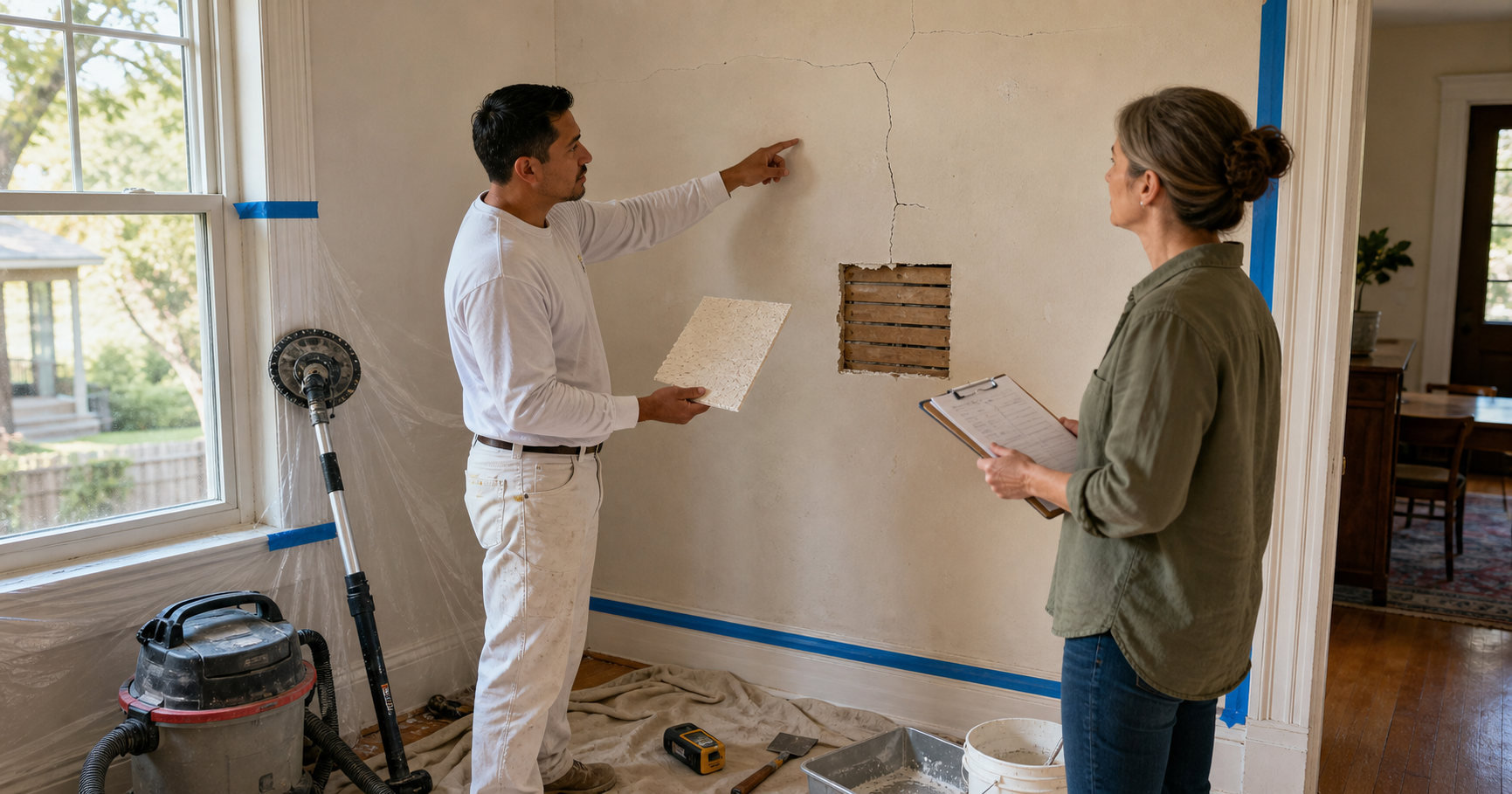
Woodland Plaster Wall Repairs: Cracks, Lead-Safe Work & Texture
Plaster walls were standard in Woodland homes built before the early 1960s, and a lot of those houses are still standing on the blocks near downtown, along Lincoln Avenue, and throughout the older neighborhoods north of Main Street. The material has real advantages: it is dense, it deadens sound between rooms, and when it is in good shape, it holds paint better than drywall. The problem is that plaster repairs are a specialized skill, and most of the drywall contractors working in the Sacramento Valley today were trained on gypsum board. The two materials behave differently. A patch done with the wrong technique or the wrong compound will crack again, telegraph through the finish paint, or never quite match the texture of the surrounding wall.
This guide covers what causes plaster cracks in Woodland's older housing stock, when patching makes sense versus a full conversion to drywall, what lead-safe work actually requires on pre-1978 homes, realistic repair costs in 2026, and how to screen a contractor who actually knows the difference between a three-coat plaster system and a drywall skim coat.
Use this chart before comparing bids. The visible crack is only one part of the job; the wall type, paint age, attachment, texture, and moisture history decide the real scope.
Why Plaster Cracks in Older Woodland Homes
Most cracks in older plaster have one of four causes, and the cause shapes the repair approach.
Settling and seasonal movement. Woodland sits on clay-heavy soils that expand and shrink with the wet-dry cycle. The Central Valley's dramatic temperature swings add thermal movement on top of that. Over decades, even a well-built foundation shifts slightly, and the rigid plaster system cracks where the movement concentrates. These cracks tend to be fine, follow the lath lines, and reopen in the same locations year after year if only the surface is patched without addressing what is moving underneath. Substrate failure. The original plaster in most Woodland homes is a three-coat system: a scratch coat and brown coat applied over wood lath, then a thin finish coat on top. When the wood lath dries out, shrinks, or the keys that hold the plaster break, sections of the wall lose their mechanical attachment. Tapping gently on the wall produces a hollow sound -- the plaster is delaminating. Surface patching does not fix this; the section needs to be removed and replaced. Water intrusion. A slow roof leak, a failing exterior window sill, or a crack in the stucco above can introduce moisture that migrates through the wall cavity and deteriorates the plaster from behind. These repairs need the moisture source found and fixed before the wall surface is touched. Patching over an active water problem gives you two repair bills instead of one. Previous poor repairs. Many older Woodland homes have walls that have been patched multiple times with incompatible materials -- drywall compound over plaster, latex caulk in a structural crack, or joint tape applied over a base that never fully cured. Those patches tend to fail at the edges and create larger damaged areas that are harder to feather invisibly.Patch or Convert to Drywall?
When a single wall or ceiling is moderately damaged, patching with a compatible plaster base coat and finish is almost always the better choice. It preserves the original density and performance, avoids disturbing adjacent surfaces, and costs less than opening up the entire room.
When damage is extensive -- more than 30 to 40 percent of a room's surface is hollow, cracked, or water-stained -- a drywall conversion becomes economically competitive and sometimes simpler. The decision point is usually the ceiling: plaster ceilings that are delaminating overhead need to come down for safety reasons, and replacing them with 5/8-inch drywall is the standard approach. Walls in the same room can often stay if they are still well-bonded.
A general contractor who has worked on Woodland's older housing stock can assess which approach makes sense for your specific room. The right call depends on the condition of the lath, the extent of the damage, the texture you are trying to match, and your budget. Get that assessment before committing to either path.
Lead-Safe Work on Pre-1978 Homes
This is the part of the repair process that surprises some Woodland homeowners. Any home built before 1978 may contain lead-based paint on its walls and trim. When plaster repair involves grinding, sanding, or significant disturbance of the surrounding paint film, California law and federal EPA regulations require that work to follow lead-safe practices.
What this means practically: the contractor should be EPA Lead Renovation, Repair and Painting (RRP) certified. The work area is isolated with plastic sheeting, ventilation is controlled, and debris is bagged and disposed of properly. Workers wear appropriate respiratory protection. After the work, the area is cleaned to specific standards before the plastic comes down.
If a contractor quotes your job without mentioning lead-safe containment on a pre-1978 home -- and your Woodland home was almost certainly built before 1978 if it has plaster walls -- ask directly. The cost difference for proper containment is real but modest compared to the liability of non-compliant work. You can verify EPA RRP certification on the EPA's contractor search tool. Any job over $500 in labor and materials on a home-improvement project requires a written contract under California law; that contract should spell out lead-safe procedures if they apply.
Texture Matching: The Hard Part
Finish plaster in older Woodland homes was applied by hand, and the texture is specific to whoever did the work: hand-troweled smooth, skip-troweled, orange peel, sand finish, or some regional variation that does not have a clean name. Matching it under artificial light on freshly dried compound looks different from how it looks in natural light after paint. The patch shows.
Contractors who are skilled at texture matching typically have done enough plaster work to understand how the finish behaves at different moisture levels and application speeds. Ask specifically: can you see photos of plaster texture matches they have completed? Did those patches show after painting? Were those jobs on homes with a similar vintage? A contractor who has only worked on new drywall construction has a different baseline of experience.
For smooth plaster ceilings -- the hardest match to do invisibly -- some contractors apply a thin skim coat over the entire ceiling surface rather than attempting to feather a patch. This adds cost but produces a consistent result. Discuss both options.
What Repairs Cost in 2026
Plaster repair costs in the Sacramento Valley vary by extent, access, and whether lead-safe containment is required. General ranges for Woodland-area work:
- Small hairline crack injection or fill (one wall): $150 to $400
- Section repair covering a few square feet with texture match: $400 to $900
- Large damaged section or full wall re-plaster: $800 to $2,500 or more depending on the room
- Full plaster-to-drywall conversion for a bedroom: $1,800 to $5,000 depending on size and finish work
- Lead-safe containment and cleanup add-on: $200 to $600 depending on area size and debris volume
Most plaster repair projects that involve more than a single hairline crack will clear the $1,000 threshold where California requires a CSLB-licensed contractor. Before you sign anything, verify the license is active on the CSLB website, confirm the contractor carries general liability and workers' compensation insurance, and check that the down payment requested does not exceed the lesser of 10 percent of the contract price or $1,000 -- that is California law for home-improvement contracts.
Screening a Contractor for This Work
When you contact contractors through the Woodland contractor directory or the Sacramento Valley contractor search, add these questions to your initial call:
- Have you repaired plaster in homes from the 1920s to 1950s? Can you share photos?
- Are you EPA RRP certified for lead-safe renovation work?
- What base material do you use for plaster patches -- a true base coat or drywall compound?
- How do you approach texture matching when the original is hand-troweled?
- Who pulls the permit if structural work or electrical is involved?
A contractor who can answer those questions specifically, with examples, is drawing on actual plaster experience. Vague answers about "all types of repairs" without specifics on plaster technique are a signal to keep looking. The drywall contractors listed on this site include specialists who work with both plaster and gypsum board -- start there if you are not sure where to begin.
Who to Hire for This Project
For the work covered in this guide, these are the contractor types to contact and the CSLB classification to verify before you take quotes:
Questions to Ask Before You Sign
- "Is your CSLB license active and bonded?" Verify it yourself at cslb.ca.gov the license number must appear on their bid.
- "Who pulls the permit, and is it included in the bid?" The contractor should handle any required permits a pro who suggests skipping one is a red flag.
- "Can you itemize labor, materials, and allowances?" Itemized bids are the only way to compare quotes on the same scope.
- "What's the payment schedule?" California caps the down payment at $1,000 or 10%, whichever is less payments should track completed work.
- "Who from this area can I call as a reference?" Ask for a recent local job of similar scope, not just photos.
Sacramento Contractors for This Project
Related Articles
Frequently Asked Questions
How do I tell if my older Woodland home has a plaster problem that needs a professional, not a DIY patch? +
Tap the wall lightly. If it sounds hollow compared to surrounding areas, the plaster has delaminated from the lath and a surface patch will not hold. Hairline cracks that reopen seasonally, water staining behind the finish, or large sections that feel soft or flex when pressed all indicate conditions that require a contractor who understands the underlying three-coat plaster system, not just surface finishing.
Does my pre-1978 Woodland home require lead-safe practices for plaster repair? +
Potentially yes. Homes built before 1978 may have lead-based paint on walls and trim. If the repair involves grinding, significant sanding, or disturbing more than six square feet of painted surface, California and federal EPA rules require lead-safe work practices including containment, proper respiratory protection, and controlled cleanup. Ask any contractor working on a pre-1978 home whether they are EPA RRP certified before work begins.
Should I patch plaster or convert to drywall when a wall has multiple damaged areas? +
If damage covers less than 30 to 40 percent of the wall and the surrounding plaster is still well-bonded, patching preserves the original density and usually costs less. When damage is extensive, the lath is deteriorating, or a ceiling is delaminating overhead, converting to drywall becomes the more practical choice. A contractor experienced with older Woodland homes can assess which approach makes sense for your specific room after checking whether the plaster is still mechanically attached.
What is the legal maximum deposit a contractor can ask for before starting plaster repair work? +
California law caps the initial down payment on home-improvement contracts at the lesser of 10 percent of the contract price or $1,000. On a $3,000 plaster repair job, the maximum deposit is $300. Any contractor requesting a larger upfront payment is not complying with California home-improvement law. Tie subsequent payments to completed work milestones rather than paying large sums before work starts.
Why do plaster texture patches sometimes show through paint even when they look fine before painting? +
Fresh plaster compound reflects light differently than aged, painted plaster. A patch that blends at close range under a work light can become visible when painted and viewed in raking sunlight from across the room. Skilled contractors address this by applying the finish texture slightly beyond the repair boundary to blend the transition, or by applying a thin skim coat over the entire wall surface to create a uniform texture. Ask to see completed examples of texture matching on similar homes before hiring.
Does plaster wall repair in Woodland require a CSLB-licensed contractor? +
Yes, for most repair jobs. California requires a CSLB license for any home-improvement project where the combined cost of labor and materials reaches $1,000 or more. Most plaster repairs involving texture matching, structural patching, or lead-safe work will exceed that threshold. Verify the license is active at cslb.ca.gov, confirm the contractor carries general liability and workers' compensation insurance, and make sure any job over $500 has a written contract before work begins.