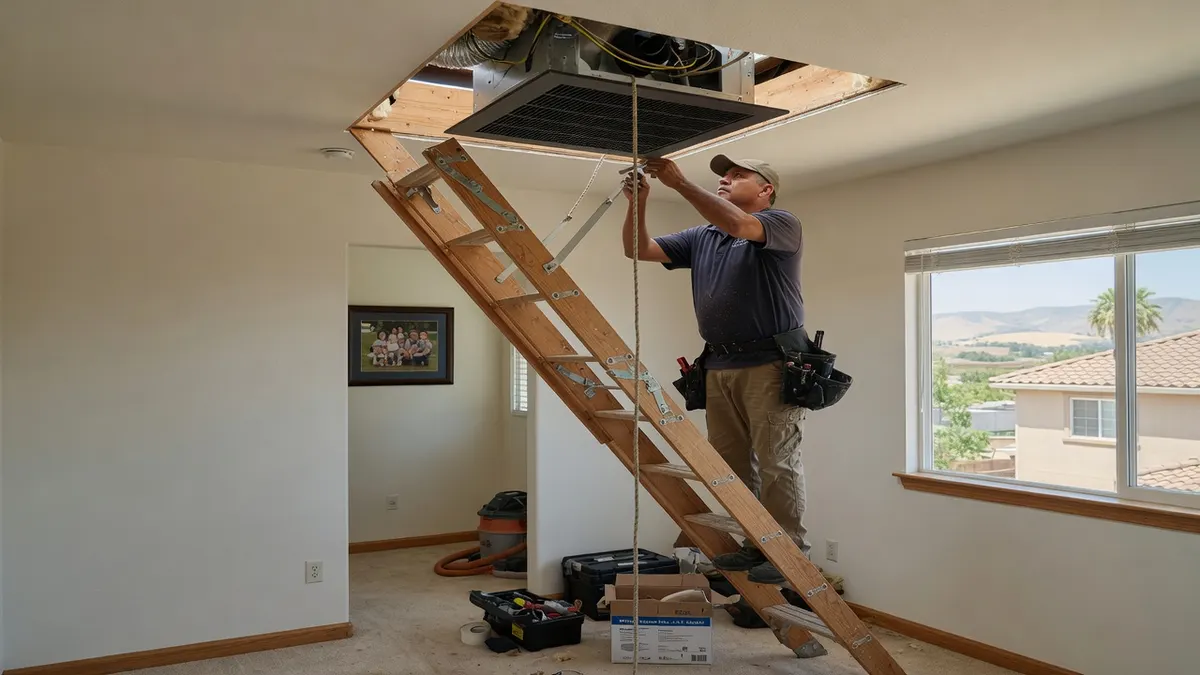
Whole-House Fans in Sacramento: Costs, Installation, and When They Actually Work
A whole-house fan is one of those Sacramento upgrades that sounds almost too simple: open a few windows in the evening, turn on a large ceiling-mounted fan, pull cool Delta breeze air through the house, and push trapped heat out through the attic vents. In the right home, it works beautifully. In the wrong home, it becomes a noisy ceiling appliance that barely gets used.
Sacramento is one of the better markets for whole-house fans because our summer heat usually drops sharply after sunset. A 101°F afternoon in July can turn into a 67°F or 72°F evening, especially when the Delta breeze reaches the valley. That temperature swing is exactly what a whole-house fan needs. The trick is choosing the right size, making sure the attic can exhaust the air, and understanding that a whole-house fan complements air conditioning rather than replacing it.
Here is what Sacramento homeowners should know before installing one.
How a Whole-House Fan Works
A whole-house fan is installed in the ceiling, usually in a central hallway. When it runs, it pulls air from the living space into the attic. That creates negative pressure inside the house, so outdoor air comes in through open windows and doors. The fan then forces the hot attic air out through existing roof vents, gable vents, ridge vents, or added ventilation.
This is different from an attic fan. An attic fan only ventilates the attic. A whole-house fan ventilates the entire home and the attic at the same time.
Most Sacramento installations use one of three styles:
- Traditional belt-drive or direct-drive fans: Powerful, lower equipment cost, and usually louder. These are common in older homes.
- Quiet ducted fans: The motor sits above the ceiling with insulated ducting between the intake grille and fan. These cost more but are much quieter.
- Multi-speed modern units: These let you run low speed overnight and high speed for a quick evening flush.
For most occupied homes, I would choose a quiet ducted model. The cheaper traditional fans move plenty of air, but noise is the reason many whole-house fans stop getting used.
What Whole-House Fan Installation Costs in Sacramento
Most Sacramento-area installations fall between $1,800 and $4,500, including the fan, electrical work, ceiling cut-in, basic framing, and labor.
Typical cost ranges:
- Basic traditional fan: $1,200 to $2,200 installed
- Quiet ducted fan for a 1,200 to 1,800 square foot home: $2,000 to $3,500 installed
- Larger quiet system for a 2,000 to 3,000 square foot home: $3,000 to $5,000 installed
- Added attic venting: $300 to $1,500 depending on the roof and existing vents
- New dedicated electrical circuit, if needed: $300 to $900
- Drywall patching or attic access improvements: $200 to $800
The biggest price swing is attic access. A single-story ranch home in Carmichael, Fair Oaks, or Land Park with a roomy attic is usually straightforward. A two-story home with low roof clearance, tight trusses, or complicated attic zones takes more labor. Tile roofs can also raise the cost if new roof vents are needed because tiles must be removed and reset carefully.
Sizing: Bigger Is Not Always Better
Whole-house fans are rated by cubic feet per minute, or CFM. A common rule is 2 to 3 CFM per square foot of living space for cooling comfort. That means:
- 1,200 square foot home: 2,400 to 3,600 CFM
- 1,800 square foot home: 3,600 to 5,400 CFM
- 2,400 square foot home: 4,800 to 7,200 CFM
But Sacramento homes do not all need the same size fan. If your floor plan is open and you have good cross-ventilation, a smaller quiet fan may be enough. If your bedrooms are far from the hallway intake, or you want fast cooling after a 105°F day, you may want more airflow.
Oversizing creates two problems. First, the fan gets louder. Second, it needs more open window area and more attic exhaust area. If the attic cannot exhaust the air, the fan will pressurize the attic and lose performance. In extreme cases it can push dusty attic air through recessed lights, gaps, and ceiling penetrations.
Attic Ventilation Is the Make-or-Break Detail
A whole-house fan can only move as much air as the attic can exhaust. This is where cheap installations go wrong.
Manufacturers usually specify a required amount of net free vent area. As a rough field estimate, many systems need about 1 square foot of net free attic vent area for every 750 CFM of fan capacity. A 4,500 CFM fan may need around 6 square feet of true venting, not just 6 square feet of vent covers. Screens, louvers, and vent shapes reduce the actual opening.
Common Sacramento attic vent upgrades include:
- Adding gable vents on older raised-foundation homes
- Adding dormer or eyebrow roof vents
- Improving soffit intake and ridge vent balance
- Replacing undersized vents that were fine for passive attic ventilation but not enough for a whole-house fan
If a contractor does not calculate attic ventilation, that is a red flag. The fan might still turn on, but it will not perform the way it should.
Electrical and Permit Considerations
Many whole-house fans can run on a standard 120-volt circuit, but that does not mean they should be tapped into any random attic junction box. The installer needs to confirm circuit capacity, switch location, timer controls, and code-compliant wiring.
In Sacramento, a simple replacement may not trigger much paperwork, but a new hardwired fan installation often involves electrical work that should be permitted. The rules can vary between the City of Sacramento, Sacramento County, Elk Grove, Roseville, Folsom, and other nearby jurisdictions. The safe approach is simple: ask the installer who pulls the permit, what inspection is required, and whether the price includes it.
A licensed electrical contractor or HVAC contractor with proper electrical scope can handle many installations. For a project that involves new roof vents, framing changes, and electrical work, a general contractor may coordinate the pieces.
When Whole-House Fans Work Best in Sacramento
A whole-house fan is most useful when the outdoor temperature is lower than the indoor temperature. In Sacramento, that usually means evenings, overnight, and early mornings from May through October.
The best use pattern is:
- Keep the house closed during the hottest part of the afternoon.
- When outside air drops below the indoor temperature, open selected windows 3 to 6 inches.
- Turn the fan on high for 20 to 45 minutes to flush hot air out.
- Switch to low speed overnight if outdoor air stays comfortable.
- Shut windows in the morning before the day heats up.
This works especially well in neighborhoods that catch evening breeze, including parts of West Sacramento, Davis, Land Park, Pocket, Natomas, and Elk Grove. It can be less effective on smoky wildfire days, during unusual humid heat, or when nighttime lows stay above 75°F.
Energy Savings: Realistic Expectations
A whole-house fan uses far less electricity than central air conditioning. Many systems draw a few hundred watts on low speed and 500 to 800 watts on high speed. A central AC system can draw several thousand watts.
For a typical Sacramento home, realistic savings are $100 to $400 per cooling season if the fan is used consistently. The bigger benefit is comfort. You can cool the house quickly in the evening without running the AC for another two or three hours. You also reduce attic heat, which helps the home start the next morning cooler.
The payback period is usually 5 to 10 years if you are looking only at utility bills. If you value better nighttime comfort and less AC runtime, the upgrade feels worthwhile sooner.
Problems to Watch For
Wildfire smoke. A whole-house fan pulls outdoor air inside. During smoke events, keep it off and use filtered HVAC circulation instead. Allergies. Spring pollen can be heavy in the Sacramento Valley. If someone in the home has severe allergies, use the fan selectively. Backdrafting. Homes with atmospherically vented gas water heaters or furnaces need extra caution. Strong negative pressure can pull combustion gases back into the home if windows are not opened enough. Ask the installer to check combustion appliance locations and explain safe operation. Security. The fan requires open windows. Use window stops or open second-story windows when possible. Noise. Do not underestimate this. If the fan is outside a bedroom hallway, choose a quiet ducted model and consider a variable-speed control.What to Ask Before Hiring an Installer
Before approving the work, ask:
- What CFM size do you recommend for this house, and why?
- How much attic vent area do I currently have?
- Do I need added roof, gable, soffit, or ridge ventilation?
- Will the fan have a timer and multi-speed control?
- Is a new electrical circuit required?
- Are permits included if my jurisdiction requires them?
- How loud is the fan at low and high speed?
- What warranty covers the fan and the installation?
A good installer should inspect the attic before quoting. They should also talk about airflow paths, not just the fan size.
Is a Whole-House Fan Worth It?
For many Sacramento homes, yes. It is one of the most climate-appropriate comfort upgrades you can make, especially if your house heats up in the afternoon but outdoor air cools down after sunset. It is most worthwhile for single-story or accessible-attic homes, households comfortable opening windows at night, and owners who want to reduce AC runtime without spending HVAC replacement money.
It is less compelling if your home already stays cool overnight, your attic is extremely difficult to access, you live in an area with frequent smoke exposure, or you rarely open windows.
If you move forward, do not shop by fan price alone. The quality of the installation matters more than the brand. Proper sizing, adequate attic venting, safe electrical work, and low noise are what determine whether you use the fan every summer night or forget it exists after the first week.
Sacramento homeowners comparing options can browse HVAC contractors and electrical contractors to find licensed pros who understand local cooling loads, attic conditions, and code requirements.
Who to Hire for This Project
For the work covered in this guide, these are the contractor types to contact and the CSLB classification to verify before you take quotes:
Questions to Ask Before You Sign
- "Is your CSLB license active and bonded?" Verify it yourself at cslb.ca.gov the license number must appear on their bid.
- "Who pulls the permit, and is it included in the bid?" The contractor should handle any required permits a pro who suggests skipping one is a red flag.
- "Can you itemize labor, materials, and allowances?" Itemized bids are the only way to compare quotes on the same scope.
- "What's the payment schedule?" California caps the down payment at $1,000 or 10%, whichever is less payments should track completed work.
- "Who from this area can I call as a reference?" Ask for a recent local job of similar scope, not just photos.
Sacramento Contractors for This Project
Related Articles
Frequently Asked Questions
How much does a whole-house fan cost in Sacramento? +
Most whole-house fan installations in Sacramento cost $1,800 to $4,500. Basic traditional fans can be closer to $1,200 to $2,200 installed, while quiet ducted systems for larger homes often run $3,000 to $5,000, especially if added attic venting or electrical work is needed.
Do whole-house fans work well in Sacramento? +
Yes, they work well when evening outdoor temperatures drop below indoor temperatures. Sacramento's dry summer nights and Delta breeze make the area a good fit. They are less useful during wildfire smoke, unusually warm nights, or periods when outdoor air quality is poor.
Do I need more attic vents for a whole-house fan? +
Possibly. Whole-house fans need enough attic exhaust area to move air out efficiently. If the attic is under-vented, the fan will be louder, less effective, and may push dusty attic air through ceiling gaps. A good installer should calculate the required net free vent area before installation.
Can a whole-house fan replace air conditioning? +
Usually no. In Sacramento, a whole-house fan is best used to reduce AC runtime in the evening and overnight. It cannot cool the house when outdoor air is hotter than indoor air, so most homes still need central AC or another cooling system for hot afternoons.
Is a permit required to install a whole-house fan? +
Permit requirements vary by jurisdiction and scope. A new hardwired installation often involves electrical work that should be permitted, and roof vent additions may also require approval. Ask the installer whether permits and inspections are included for your city or county.