Rancho Cordova Main Shutoff and Pressure Regulator Planning: Small Plumbing Fixes That Prevent Big Damage
The valve that matters most in a plumbing emergency is usually the one nobody has touched in years.
A Rancho Cordova homeowner notices a slow drip from the water heater closet, tries to turn off the main valve, and the old handle barely moves. Another homeowner gets a washing machine replaced and the installer says the pressure feels high. A third sees a sprinkler valve box full of water and cannot tell whether the leak is irrigation, house plumbing, or the service line from the meter.
None of those problems sounds like a remodel. That is exactly why they get postponed. But the main shutoff, pressure reducing valve, hose bibs, and first few feet of visible supply piping are the controls that decide whether a small leak stays small. A planned plumbing visit is much cheaper than learning during an emergency that the valve you were counting on does not work.
Use this chart before comparing bids. A small plumbing estimate is not ready until the contractor has tested shutoff function, measured water pressure, found the PRV, checked irrigation tie-ins, and explained access.
Start With the Part You Would Need at 10 P.M.
The first question is simple: if a pipe breaks tonight, can you stop the water quickly?
Many Rancho Cordova homes were built in waves from the 1950s through the 1990s. Some have older gate valves that seize, multi-turn handles that no longer close fully, galvanized or mixed-metal piping near the entry point, irrigation connections added later, or a pressure reducing valve hidden behind landscaping. The valve may look fine from a distance and still fail when you actually need it.
Do not crank on an old valve as a strength test. If the handle is corroded, buried, leaking, or difficult to move, forcing it can turn a maintenance appointment into an active leak. A plumber can test it, identify whether the meter-side valve should be left to the utility, and recommend a modern quarter-turn ball valve where appropriate.
For a homeowner, the practical goal is not a perfect plumbing diagram. It is knowing three things: where the water enters the house, which valve shuts off the house, and whether that valve works without drama.
Pressure Is a Quiet Damage Multiplier
High water pressure feels nice in a shower until it starts wearing out toilet fill valves, faucet cartridges, washing machine hoses, water heaters, irrigation fittings, and angle stops. Low pressure has its own clues: weak showers, long appliance fill times, or pressure that collapses when two fixtures run at once.
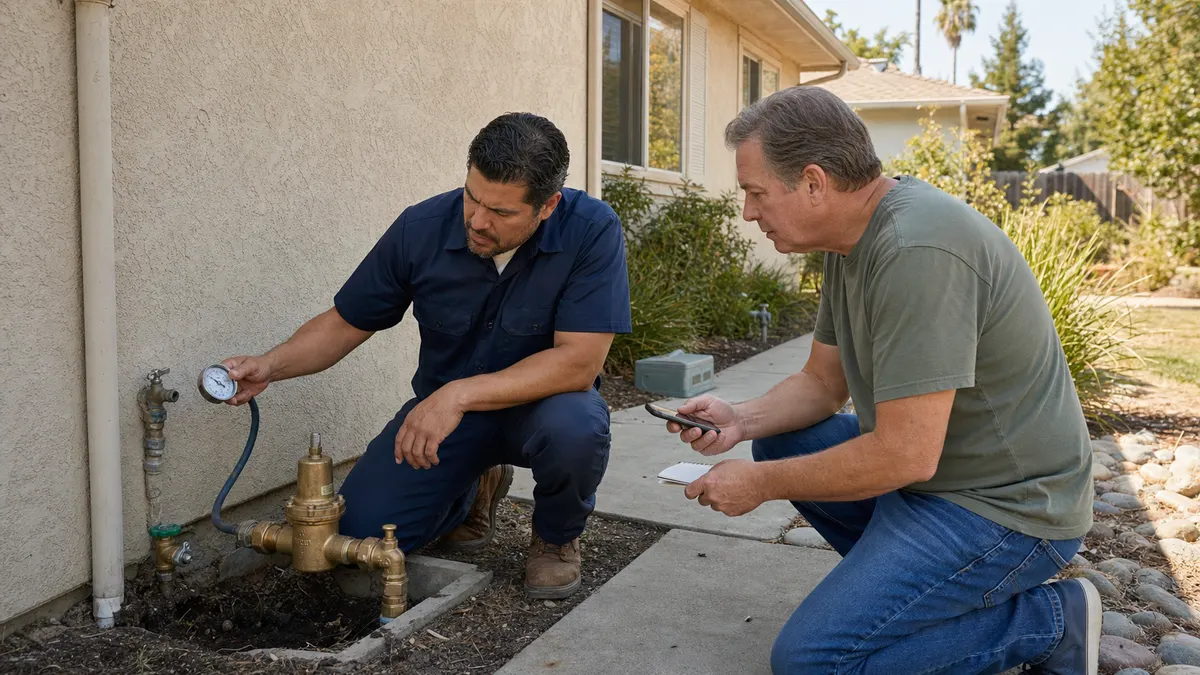
A hose bib pressure gauge is a useful first clue, but it is not the full diagnosis. Static pressure should be checked with no fixtures running. The plumber may also ask whether pressure changes by time of day, whether a PRV is already installed, whether the irrigation system is connected before or after the regulator, and whether the water heater has an expansion tank if the system is closed.
If the gauge reads high, the next question is not automatically "replace the PRV." The contractor should first find the existing regulator, confirm it is not bypassed, inspect unions and shutoffs, check whether it can be adjusted, and explain whether replacement is safer than repair. If the regulator is buried, painted in place, missing unions, or tied into older pipe, the labor may be in access and reconnection rather than the part itself.
What a Useful Estimate Should Separate
For a simple Rancho Cordova plumbing evaluation, a service visit and pressure test may run a few hundred dollars. Replacing an accessible hose bib, fixture shutoff, or small valve can land in the low hundreds to low thousands depending on access and material. Replacing a main shutoff, PRV, and nearby fittings commonly moves into the $900 to $3,500 range. If concrete, wall repair, meter-box complications, irrigation rerouting, galvanized pipe transitions, or trenching are involved, the job can move higher.
Ask each bidder to separate:
- Diagnosis. Pressure readings, whether they tested more than one hose bib, whether pressure holds overnight, and whether the PRV is confirmed.
- Main shutoff scope. Existing valve type, proposed new valve, location, whether the house can be isolated safely, and whether utility coordination is needed.
- PRV scope. Brand or model, size, unions, bypass assumptions, adjustment range, and whether an expansion tank is needed at the water heater.
- Pipe material. Copper, PEX, galvanized, PVC, CPVC, mixed metals, dielectric transitions, and what material will be used for the repair.
- Irrigation boundary. Whether sprinkler valves, backflow devices, drip zones, or landscape piping are part of the job or excluded.
- Access and restoration. Landscaping, valve box work, stucco cuts, drywall patching, concrete, insulation, paint, and cleanup.
- Permits and inspection. Whether the work is treated as a repair, replacement, alteration, or larger plumbing permit scope.
- Warranty. Parts, labor, exclusions for old pipe, and what happens if adjacent fittings fail after being disturbed.
That list may feel too detailed for a small job. It is exactly what keeps a $1,200 valve replacement from turning into a confusing $4,000 change order.
Which Contractor Should You Call?
Start with a licensed plumbing contractor when the work touches the potable water supply, pressure regulation, main shutoff, house-side supply piping, water heater expansion, or leak diagnosis. In California, this usually points to a C-36 plumbing contractor.
Bring in a landscaping contractor when the problem is clearly in the irrigation system after the house supply connection: leaking sprinkler valves, broken lateral lines, drip emitters, controller zones, or irrigation valve boxes. The tricky jobs are the ones where the leak sits near the handoff between house plumbing and landscape irrigation. Ask both contractors to name where their responsibility starts and ends.
A general contractor can make sense when the plumbing repair is bundled with wall opening, stucco repair, concrete cutting, cabinet removal, a laundry remodel, or several trades. A drywall or painting contractor may be needed after the plumber finishes if the pipe is inside a wall and the plumbing bid excludes finish repair.
Be cautious with a general handyman for this scope. A loose hose bib or a very small task may be simple, but once the project reaches the house main, pressure regulator, permit-sensitive work, or the California licensing threshold, you want a properly licensed contractor.
Permits and Licensing in Rancho Cordova
Rancho Cordova's Building and Safety Division says permits are handled online through Rancho Cordova Online, where applicants can submit permits and plans, pay, print permits, upload documents, and schedule inspections. That does not mean every tiny plumbing maintenance task needs a permit. It does mean your contractor should be able to explain the difference between a minor like-for-like repair and work that alters the plumbing system.
Ask directly:
- Is this a like-for-like repair, or are we altering the house plumbing?
- Does replacing the PRV or main shutoff require a plumbing permit for this exact scope?
- If the work affects the water heater expansion requirements, who checks that?
- If concrete, exterior wall, trenching, or irrigation rerouting is included, does that change the permit path?
- Who applies through Rancho Cordova Online and who meets the inspector if one is required?
California licensing rules matter even when the work feels small. CSLB materials updated for 2025 raised the minor-work exemption to $1,000, but the exemption does not apply if the work requires a permit or if the unlicensed person hires workers for the project. For homeowners, the easy rule is this: if the job is at or above $1,000, permit-related, or touching critical plumbing, verify the contractor's active CSLB license before you sign.
Red Flags in Shutoff and PRV Bids
Slow down if you hear any of these:
- "Pressure is high, so the regulator is bad" without an actual pressure reading.
- The contractor cannot find or identify the house main shutoff.
- The bid does not say whether irrigation piping is included.
- No one discusses what happens if old galvanized or brittle plastic pipe breaks during replacement.
- The estimate excludes restoration but does not say who handles it.
- The contractor tells you permits never apply to plumbing repairs, no matter the scope.
- The person doing the work is not licensed for plumbing and the job is clearly more than a small maintenance task.
Good plumbers are specific. They show you the valve, test the pressure, explain the failure point, and put the repair boundary in writing.
Questions to Ask Before You Sign
- Where is my main house shutoff, and does it fully close?
- Is there a separate irrigation shutoff?
- What pressure did you measure, at what hose bib, and under what conditions?
- Do I already have a PRV, and can it be adjusted safely?
- If you replace the PRV, are unions, shutoffs, and pressure testing included?
- Does my water heater need an expansion tank because of the regulator or closed system?
- What pipe materials are you connecting to, and what could break when disturbed?
- Are permits, inspection scheduling, cleanup, and finish repair included?
Those questions do not make the job bigger. They make the estimate honest.
Internal Homework Before You Hire
For local context, start with our Rancho Cordova contractor guide, compare licensed plumbing contractors, landscaping contractors, general contractors, and drywall contractors. Use the contractor search when you are ready to build a shortlist.
For related planning, pair this with our spring plumbing checkup, whole-house repiping guide, water heater replacement guide, Rancho Cordova water heater permit checklist, license verification guide, and California permit basics.
The Bottom Line
A working shutoff and a sane pressure reading are not glamorous upgrades. They are the controls that protect everything else. Find the valve, test the pressure, document the PRV, separate house plumbing from irrigation, and get the permit and license questions answered before the next leak turns a small fix into a rushed cleanup.
Who to Hire for This Project
For the work covered in this guide, these are the contractor types to contact and the CSLB classification to verify before you take quotes:
Questions to Ask Before You Sign
- "Is your CSLB license active and bonded?" Verify it yourself at cslb.ca.gov the license number must appear on their bid.
- "Who pulls the permit, and is it included in the bid?" The contractor should handle any required permits a pro who suggests skipping one is a red flag.
- "Can you itemize labor, materials, and allowances?" Itemized bids are the only way to compare quotes on the same scope.
- "What's the payment schedule?" California caps the down payment at $1,000 or 10%, whichever is less payments should track completed work.
- "Who from this area can I call as a reference?" Ask for a recent local job of similar scope, not just photos.