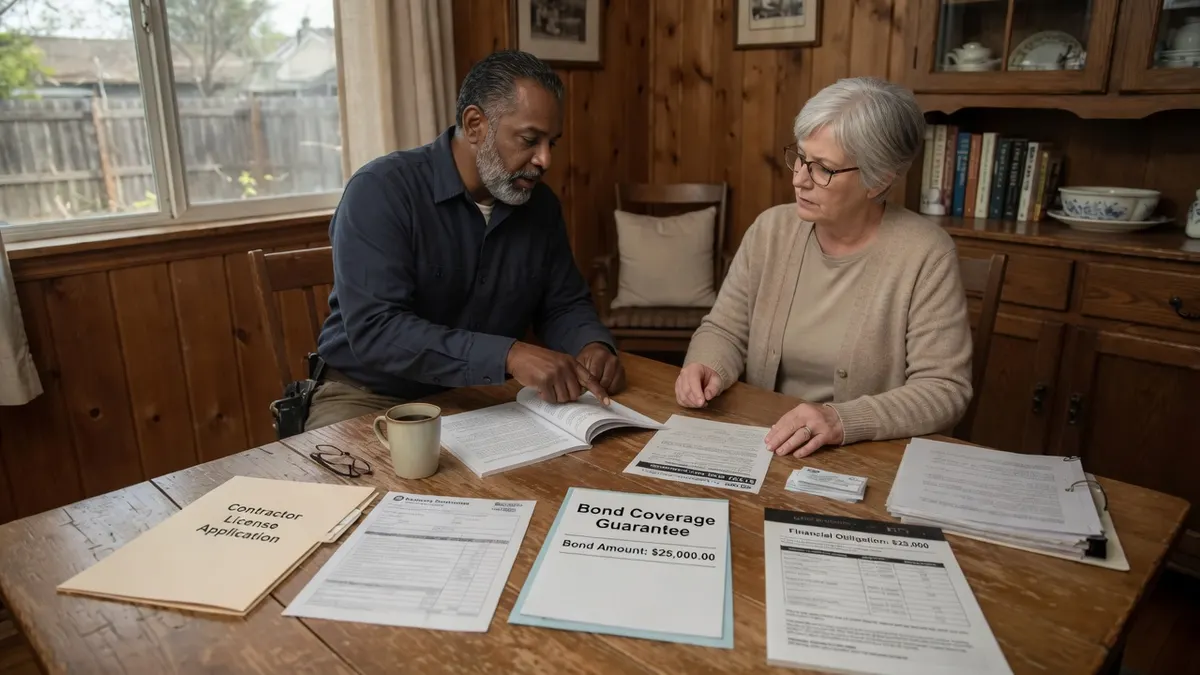
Contractor Bond Amounts: What the Dollar Amount Really Covers
The dollar amount on a contractor bond is a ceiling, not a promise that every homeowner will recover that amount.
That matters when you compare a small fence repair with a whole-house remodel. The same bond requirement may apply to both contractors, but the bond feels very different when the project is $7,500 versus $175,000. Sacramento homeowners should understand the number before treating it as full protection.
This guide explains what the bond amount really does.
Bond Amount Reality Check
| Project Example | Bond Amount Feels Like | Extra Protection to Consider |
| --- | --- | --- |
| Small plumbing repair | Potentially meaningful | Written scope and receipt |
| Fence replacement | Useful but still limited | Milestone payments |
| Roof replacement | Partial protection | Permit, warranty, insurance proof |
| Kitchen remodel | Often not enough alone | Lien releases and detailed allowances |
| ADU or addition | Small slice of total risk | Strong contract, plans, possible performance bond |
The larger the project, the more you need protections beyond the basic license bond.
What the Dollar Amount Covers
The contractor license bond may respond to certain contractor-law violations that cause documented financial loss. Examples include abandonment, unpaid suppliers, illegal payment practices, or work that materially violates the contract or code.
The amount is not:
- A cash account reserved for your job
- A workmanship guarantee
- General liability insurance
- Workers' compensation
- Unlimited protection for every dispute
For the broader concept, read what a contractor bond is.
The Shared-Pool Problem
The bond amount may be shared by multiple valid claimants. If a contractor causes problems on several jobs at once, the available bond protection may not make every homeowner whole.
That is one reason to check complaint history and avoid contractors who already show warning signs. Do not rely on the bond to rescue a bad hiring decision.
When to Ask for More Protection
For larger projects, ask about:
- Progress payments tied to completed work
- Lien releases from subcontractors and suppliers
- Joint checks for large material purchases
- Retainage until final inspection
- Separate performance bond where appropriate
- Builder's risk or additional insurance for certain scopes
Not every residential project needs a performance bond, but the question is reasonable on high-dollar work.
How to Reduce Your Exposure
Before hiring:
- Verify license and bond
- Confirm insurance separately
- Keep the deposit within legal limits
- Use a written contract
- Tie payments to visible progress
- Save photos, invoices, and messages
- Do not pay ahead of completed work
For projects involving roofing, kitchen remodeling, bathroom remodeling, or general contracting, this payment discipline matters as much as the bond.
The Bottom Line
The contractor bond amount is useful, but it is limited. It can help with certain documented legal violations, yet it is not a substitute for license verification, insurance proof, lien management, smart payments, and a clear contract.
Use our $25,000 bond guide and contractor directory before you sign.
Who to Hire for This Project
For the work covered in this guide, these are the contractor types to contact and the CSLB classification to verify before you take quotes:
Questions to Ask Before You Sign
- "Is your CSLB license active and bonded?" Verify it yourself at cslb.ca.gov the license number must appear on their bid.
- "Who pulls the permit, and is it included in the bid?" The contractor should handle any required permits a pro who suggests skipping one is a red flag.
- "Can you itemize labor, materials, and allowances?" Itemized bids are the only way to compare quotes on the same scope.
- "What's the payment schedule?" California caps the down payment at $1,000 or 10%, whichever is less payments should track completed work.
- "Who from this area can I call as a reference?" Ask for a recent local job of similar scope, not just photos.
Sacramento Contractors for This Project
Related Articles
Frequently Asked Questions
What does the $25,000 contractor bond amount mean? +
The $25,000 is the maximum amount that can be paid out to consumers from a contractor's surety bond. It's not what the contractor paid for the bond (they pay 1-5% annually as a premium), and it's shared among all valid claimants. If your documented loss from a contractor's legal violation is less than $25,000, you may recover the full amount. If it exceeds $25,000, that's the maximum you can receive from the bond.
Is $25,000 enough to protect me on a large renovation? +
For projects under $25,000, the bond provides good protection. For larger projects like kitchen remodels ($25,000-$75,000+), room additions, or new construction, the bond covers only a portion of potential losses. Supplement the bond's protection with structured milestone payments, performance bonds for very large projects, lien waivers, and detailed written contracts.
What's the difference between a license bond and a performance bond? +
A license bond ($25,000) is required by the CSLB for all licensed contractors and covers violations of contractor licensing laws. A performance bond (typically 100% of contract value) is an optional bond that guarantees the contractor will complete the project per the contract terms. Performance bonds provide much more financial protection but must be specifically negotiated and written into the contract.
Do some contractors have bonds larger than $25,000? +
Yes. While all contractors must have the standard $25,000 license bond, LLC contractors must carry an additional $100,000 bond, and contractors with disciplinary history may be required to carry disciplinary bonds of $25,000 to $150,000. Some contractors also voluntarily carry larger bonds or offer performance bonds on large projects.
What if multiple homeowners file claims against the same contractor's bond? +
The $25,000 bond is a shared pool. If multiple valid claims are filed and the total exceeds $25,000, the funds are distributed among claimants. Generally on a first-come, first-served basis, though courts may order equitable distribution. This is why acting quickly when you have a valid claim is important.