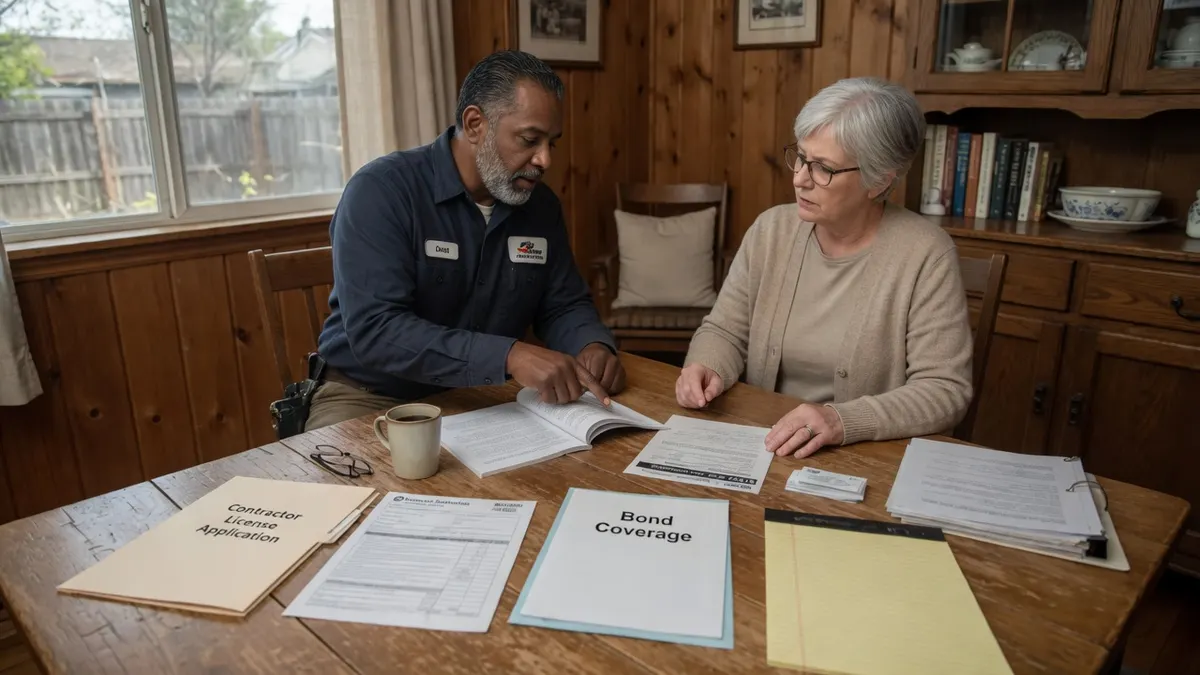
Understanding the $25,000 CSLB Contractor Bond Requirement
The $25,000 contractor bond is real protection, but it is not the same as having $25,000 reserved just for your project.
That distinction matters. A homeowner planning a $12,000 fence repair and a homeowner planning a $180,000 ADU are both looking at the same basic contractor license bond requirement. The bond may fully cover some smaller losses, but it may only cover a slice of a larger project problem.
Here is what Sacramento-area homeowners should understand before relying on the number.
What the $25,000 Number Means
The $25,000 amount is the required California contractor license bond amount. It is the maximum bond pool available for valid claims under that bond, subject to the surety's investigation and any other claims.
It is not:
- A cash deposit held for you
- The contractor's insurance limit
- A project warranty
- A guarantee you will recover the full amount
- A substitute for a careful payment schedule
It is one layer in the hiring-risk stack.
How the Bond Limit Feels by Project Size
| Project Size | What the Bond May Mean | Extra Protection to Consider |
| --- | --- | --- |
| Under $10,000 | Potentially meaningful coverage if valid claim succeeds | Written scope and legal deposit |
| $10,000-$25,000 | May cover a substantial loss | Payment tied to progress |
| $25,000-$100,000 | May cover only part of the loss | Lien releases, insurance proof, strong contract |
| $100,000+ | Often not enough by itself | Milestone payments, professional plans, possible performance bond |
For large projects like ADUs, additions, and major remodels, the bond should not be your main protection.
Why the Bond Still Matters
The bond matters because contractors need it to keep an active license. Claims can affect the contractor's cost, ability to stay bonded, and CSLB standing. That accountability helps screen out some bad actors.
It also gives homeowners a formal path when the contractor violates California contractor law and causes documented financial loss.
How to Use the Requirement While Hiring
Before signing:
- Verify the license and bond are active
- Confirm the business name matches the contract
- Check the classification against your scope
- Look for complaints or discipline
- Ask for insurance proof separately
- Keep the down payment within legal limits
Then build the contract so your payments do not run far ahead of completed work. This is especially important when the project value is higher than the bond.
When to Ask About More Protection
For larger projects, ask about:
- Lien releases from subcontractors and suppliers
- Joint checks for major material or subcontractor payments
- Separate performance bond, if appropriate
- Builder's risk coverage for certain projects
- Clear change-order rules
- Retainage or final payment after inspection
An experienced general contractor should be able to discuss payment and risk controls without acting offended.
The Bottom Line
The $25,000 CSLB bond requirement is useful, but it is not unlimited protection. It helps most when the contractor is properly licensed, the homeowner keeps good records, and payments stay tied to completed work.
For more context, read what a contractor bond is, then verify contractors through our directory before you sign.
Who to Hire for This Project
For the work covered in this guide, these are the contractor types to contact and the CSLB classification to verify before you take quotes:
Questions to Ask Before You Sign
- "Is your CSLB license active and bonded?" Verify it yourself at cslb.ca.gov the license number must appear on their bid.
- "Who pulls the permit, and is it included in the bid?" The contractor should handle any required permits a pro who suggests skipping one is a red flag.
- "Can you itemize labor, materials, and allowances?" Itemized bids are the only way to compare quotes on the same scope.
- "What's the payment schedule?" California caps the down payment at $1,000 or 10%, whichever is less payments should track completed work.
- "Who from this area can I call as a reference?" Ask for a recent local job of similar scope, not just photos.
Sacramento Contractors for This Project
Related Articles
Frequently Asked Questions
Why did California increase the contractor bond to $25,000? +
California increased the contractor bond from $15,000 to $25,000 effective January 1, 2023, through Assembly Bill 2164. The increase was prompted by rising construction costs and the recognition that the previous $15,000 bond was insufficient to provide meaningful consumer protection for modern home improvement projects, which often cost well above that amount.
Does the contractor pay $25,000 for the bond? +
No. The $25,000 is the maximum claim amount. The most that can be paid out to consumers from the bond. The contractor pays an annual premium to a surety company, typically 1% to 5% of the bond amount ($250 to $1,250 per year). The exact premium depends on the contractor's credit score, business history, and claims history.
Is $25,000 enough to cover my project if something goes wrong? +
For small to medium projects (under $25,000), the bond can potentially cover your full loss. For larger projects, the $25,000 bond may only partially cover your losses. To protect yourself on large projects, follow California's down payment law (max $1,000 or 10%), tie payments to completed milestones, and consider requiring a separate performance bond.
Can multiple homeowners file claims against the same contractor bond? +
Yes, and the $25,000 bond amount is shared among all valid claimants. If three homeowners each file valid claims of $10,000, $8,000, and $12,000 against the same contractor's bond, the $25,000 total would be divided proportionally since the claims ($30,000) exceed the bond amount.
What happens to a contractor's license if their bond is depleted? +
If a contractor's bond is exhausted by claims, the surety company may cancel the bond. Once the bond is canceled, the contractor's CSLB license becomes inactive, and they cannot legally perform work requiring a license in California until they obtain a new bond and restore their license to active status.