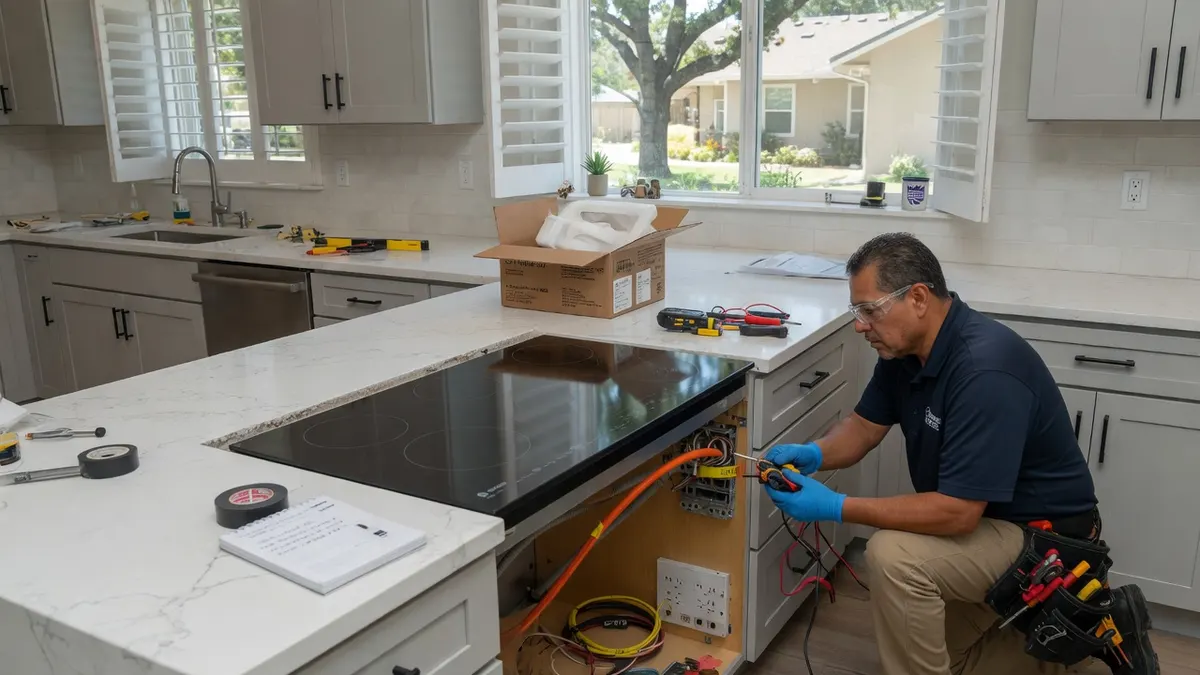
Induction Range Installation in Sacramento: Costs, Circuits, Panel Capacity, and Permit Questions
Switching from a gas range to an induction range sounds like an appliance purchase, but in many Sacramento homes it is really a small electrical project with a kitchen finish detail attached. The range may be delivered in a week. The circuit, panel capacity, outlet location, countertop fit, ventilation, and permit question are what decide whether the installation is simple or turns into a second round of appointments.
Induction makes sense for a lot of Sacramento-area homeowners. It is fast, easier to clean than gas grates, adds less heat to the kitchen during summer, and fits the broader shift toward all-electric homes. It can also pair well with solar, heat pump HVAC, and heat pump water heaters. But the project needs to be scoped honestly. A kitchen that has only a gas line and a standard 120-volt receptacle behind the range is not ready for most full-size induction ranges.
Here is what to check before you order the appliance or tell the delivery crew to haul away the old stove.
What Induction Installation Usually Costs
For a typical Sacramento-area home, the appliance and installation costs often fall into these ranges:
- Freestanding induction range appliance: $1,200 to $3,500 for many homeowner-grade models
- Slide-in or premium induction range: $2,000 to $5,000 or more
- Basic appliance delivery and set-in: $100 to $300 when the electrical is already correct
- New 240-volt range circuit from a nearby panel: $600 to $1,500
- Longer circuit run through attic, crawl space, garage, or finished walls: $1,500 to $3,500
- Outlet, cord, breaker, and small wall repair: $200 to $800 depending on access
- Panel capacity work, load management, subpanel, or panel upgrade: $1,500 to $6,000 or more
- Gas line cap-off by a plumber: $150 to $600 when access is straightforward
- Countertop or cabinet modification for a slide-in range: $300 to $1,500 or more
A simple swap is possible if the kitchen already has a correct 240-volt range receptacle, enough amperage, a compatible cord, and enough cabinet clearance. Many older Sacramento houses do not. Homes in Land Park, East Sacramento, Tahoe Park, Carmichael, Arden-Arcade, Citrus Heights, and older parts of Roseville may have been wired around gas cooking and a smaller electrical load than modern families use today.
The Circuit Is the First Question
Most full-size induction ranges need a dedicated 240-volt circuit, commonly 40 or 50 amps. Some compact units, portable cooktops, and certain specialty models have different requirements, but the answer must come from the specific manufacturer's installation instructions. Do not assume every induction appliance uses the same breaker size.
The electrician should confirm:
- The required voltage, amperage, breaker type, and wire size for the exact model
- Whether the existing range outlet, if present, is properly wired and grounded
- Whether the circuit is dedicated to the range
- Whether the outlet location matches the appliance clearance diagram
- Whether the cord and receptacle configuration are compatible
- Whether any GFCI or AFCI requirements apply under the local code cycle
This matters because delivery crews are not electricians. If the outlet is wrong, the circuit is undersized, or the range cannot slide back because the receptacle is in the wrong spot, the appliance may be left in the middle of the kitchen while you scramble for a contractor.
Panel Capacity Can Decide the Real Budget
Adding a 40- or 50-amp cooking circuit is not just about finding an empty breaker slot. The electrician needs to look at the home's service size, existing loads, and future plans. A 100-amp panel that already serves central air conditioning, a dryer, a spa, and an EV charger may not have simple room for another large appliance. A 200-amp panel may still need a load calculation if several electrification projects are happening at once.
Sacramento homeowners are often planning more than one upgrade: EV charging in the garage, a heat pump HVAC system, a heat pump water heater, solar with battery storage, or an ADU. If induction is one step in that sequence, say so during the first walkthrough. It is cheaper to plan the electrical path once than to keep reopening the panel and attic every year.
There may be alternatives to a full panel upgrade. In some cases, a load management device, circuit sharing equipment, subpanel, or different appliance selection can solve the problem. In other cases, the service really does need more capacity. The bid should explain which path is being used and why.
Gas Line Cap-Off Is a Separate Trade Detail
If you are removing a gas range, the old gas valve needs to be handled safely. Some appliance installers will disconnect a flexible connector, but permanent gas line changes should involve a licensed plumber or contractor with the proper scope. The line may need to be capped, tested, and left accessible. Do not bury an abandoned valve behind cabinets or drywall without a clear plan.
Also think about timing. If the gas range is your only cooking appliance, schedule the electrical work before appliance delivery. Then schedule the gas cap-off and range install so you are not without a working kitchen for longer than necessary.
Fit, Countertops, and Ventilation
Freestanding ranges are usually more forgiving than slide-in ranges, but measurements still matter. Sacramento kitchens remodeled in the 1990s and early 2000s can have tight openings, uneven floors, thick tile backsplashes, or countertop lips that interfere with a new appliance. Measure the opening width, depth, counter height, backsplash clearance, and rear outlet space before ordering.
For cooktop-only induction units, countertop cutout size is critical. A new cooktop may not fit the existing opening. Enlarging stone, quartz, or tile countertops is specialized work and can add cost quickly. If the old gas cooktop had a downdraft system, do not assume the new induction cooktop uses the same ventilation approach.
Induction produces less waste heat than gas, but it still creates steam, grease, and cooking odors. A range hood, microwave hood, or downdraft system may still be needed. If you are using induction as part of a bigger kitchen remodel, settle the ventilation plan before cabinets are ordered.
Permits and Inspections
Permit rules vary by jurisdiction and scope. A new dedicated 240-volt circuit is electrical work and generally should be permitted and inspected. Panel upgrades, subpanel work, service changes, and load management equipment make the permit question even clearer. The process can differ between the City of Sacramento, Sacramento County, Elk Grove, Roseville, Folsom, Davis, Rancho Cordova, and West Sacramento.
A like-for-like appliance set-in with an existing compliant outlet is different from adding a new circuit. Ask the electrician who pulls the permit, what inspection is required, whether the permit fee is included, and whether the kitchen will be left safe if inspection cannot happen the same day.
For work over California's contractor licensing threshold, use licensed contractors. Electrical circuit work belongs with a C-10 electrical contractor or a properly licensed contractor with electrical scope. Gas line cap-off belongs with a qualified plumbing contractor. A kitchen remodeler or general contractor may coordinate both if the range is part of a broader project.
What a Complete Bid Should Include
A useful induction conversion estimate should include more than "install outlet." Ask for:
- The exact appliance model used for the circuit requirement
- Breaker size, wire type, routing method, and receptacle location
- Confirmation that the panel has capacity, or a written plan if it does not
- Permit responsibility and inspection coordination
- Drywall, cabinet, or backsplash repair if walls must be opened
- Gas disconnect or cap-off responsibility
- Appliance delivery, set-in, leveling, anti-tip bracket, and haul-away
- Countertop or cabinet modifications if needed
- Warranty on labor and callback policy
If one bid is much cheaper than the others, compare the hidden scope. It may exclude permit fees, wall repair, gas cap-off, attic access, or panel capacity work.
Common Mistakes to Avoid
The biggest mistake is buying the range before checking the electrical requirements. The second is assuming a free breaker slot means the panel can support the appliance. The third is treating gas cap-off, outlet location, and anti-tip bracket installation as minor details that someone will figure out later.
Also be careful with rebates and incentives. Programs change, funding opens and closes, and not every appliance qualifies. If a contractor uses an incentive to justify the project, ask for the current program name, eligibility rules, and who handles documentation. Do not build the budget around a rebate that has not been confirmed.
The Bottom Line
Induction cooking can be a smart Sacramento kitchen upgrade, especially for homeowners trying to reduce gas use, lower kitchen heat, and plan for an all-electric home. But the appliance is only the visible part of the project. The real work is making sure the circuit, panel, outlet location, gas cap-off, ventilation, and fit are ready before the delivery truck arrives.
Start with the model's installation instructions and an electrical walkthrough. If the panel has room and the route is simple, the project can be straightforward. If the panel is crowded or the kitchen opening is unusual, solve those questions before ordering. A well-planned induction conversion should end with a cleaner, faster kitchen, not a beautiful new range waiting unplugged in the hallway.
Who to Hire for This Project
For the work covered in this guide, these are the contractor types to contact and the CSLB classification to verify before you take quotes:
Questions to Ask Before You Sign
- "Is your CSLB license active and bonded?" Verify it yourself at cslb.ca.gov the license number must appear on their bid.
- "Who pulls the permit, and is it included in the bid?" The contractor should handle any required permits a pro who suggests skipping one is a red flag.
- "Can you itemize labor, materials, and allowances?" Itemized bids are the only way to compare quotes on the same scope.
- "What's the payment schedule?" California caps the down payment at $1,000 or 10%, whichever is less payments should track completed work.
- "Who from this area can I call as a reference?" Ask for a recent local job of similar scope, not just photos.
Sacramento Contractors for This Project
Related Articles
Outdoor Outlets, GFCI Protection, and Landscape Lighting in Sacramento: Costs and Planning
August 17, 2026
Sacramento Electrical Panel Upgrade Guide: Costs, Permits, Load Calculations, and When 200 Amps Makes Sense
August 14, 2026
Sacramento Electrical Panel Upgrade and EV Charger Guide: Costs, Load Calculations, Permits, and Practical Planning
August 10, 2026
Frequently Asked Questions
How much does it cost to install an induction range in Sacramento? +
If the correct 240-volt outlet already exists, installation may only cost $100 to $300 beyond the appliance. Adding a new dedicated range circuit often costs $600 to $1,500 when the panel is nearby, and $1,500 to $3,500 or more when the run is difficult. Panel capacity work, gas cap-off, or countertop changes can raise the total.
Do induction ranges need a special electrical circuit? +
Most full-size induction ranges need a dedicated 240-volt circuit, commonly 40 or 50 amps, but the exact requirement depends on the appliance model. Have an electrician check the manufacturer's installation instructions, existing panel capacity, breaker size, wire size, and outlet location before delivery.
Will I need a panel upgrade for induction cooking? +
Not always. Many homes with adequate service capacity can add a range circuit without a full panel upgrade. Older or heavily loaded panels may need load management, a subpanel, or a service upgrade, especially if the home is also adding EV charging, heat pumps, or an ADU.
Does switching from gas to induction require a permit? +
A simple appliance set-in using an existing compliant outlet may be different from adding a new circuit. New 240-volt wiring, panel work, subpanels, and service changes generally require an electrical permit and inspection. Ask the local building department or licensed electrician what applies to your exact scope.
Who should cap the old gas line when I remove a gas range? +
Permanent gas line cap-off should be handled by a licensed plumber or properly licensed contractor. The line should be capped safely, tested where required, and left accessible rather than hidden behind finished materials without a plan.