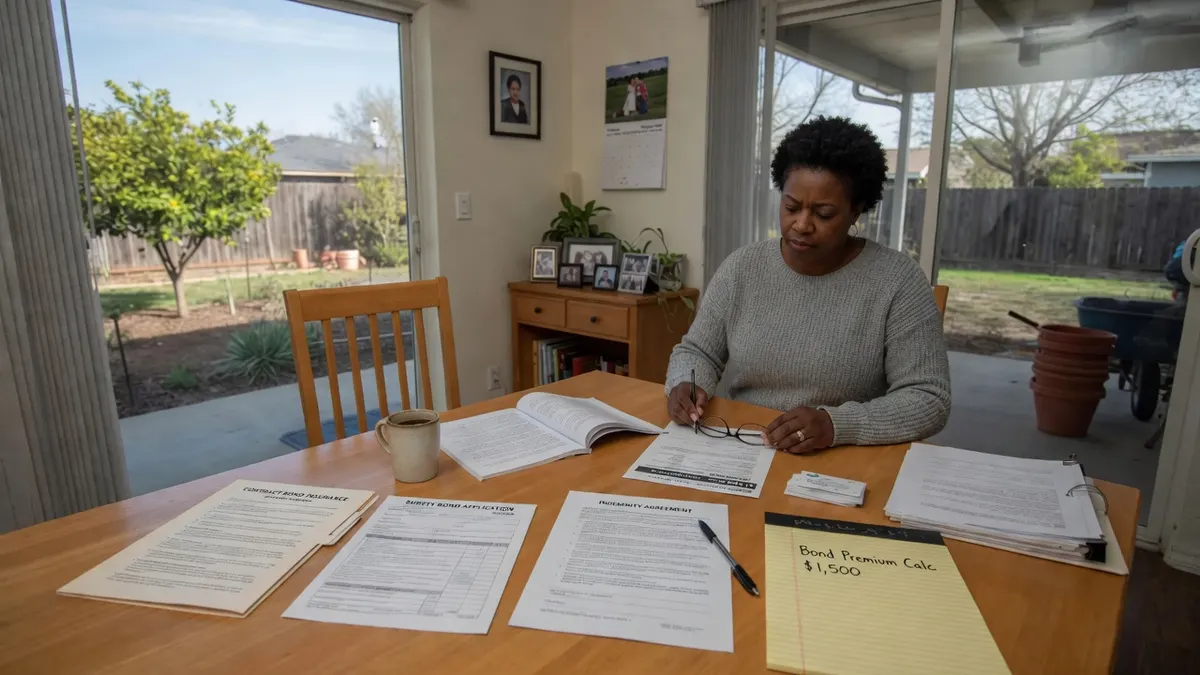
How Contractors Get Bonded in California (Step-by-Step)
Homeowners do not need to become bond experts, but knowing how contractors get bonded helps you read a CSLB license record with more confidence.
A contractor bond is not a badge someone prints on a flyer. A surety company issues it, CSLB records it, and the contractor has to keep it active. If that bond lapses, the license can stop being active. That is why bond status is worth checking before you sign, not after a project goes sideways.
Here is the homeowner-focused version of the bonding process.
Bonding Process at a Glance
| Step | What Contractor Does | What Homeowner Can Learn |
| --- | --- | --- |
| Applies for bond | Gives business and personal information | Bond is tied to a legal entity |
| Underwriting | Surety reviews risk | Claims/credit history can affect cost |
| Bond issued | Surety files with CSLB | Record should show active bond |
| Renewal | Contractor pays to keep it active | Lapses are a warning sign |
| Claim history | Claims can affect future bonding | Repeated issues may show up as discipline |
The key homeowner takeaway: verify the current record, not the marketing claim.
What the Surety Looks At
Surety companies usually review credit, business history, license information, prior claims, and any disciplinary history. Contractors with cleaner records often get easier renewals and lower premiums. Contractors with claims or serious problems may pay more or struggle to stay bonded.
That does not mean a bond proves the contractor is excellent. It means a surety is backing the legally required bond at that moment.
Why Bond Status Can Change
A contractor's bond can lapse because of nonpayment, cancellation, business changes, claims, or failure to renew. When that happens, the CSLB license record can change too.
That is why homeowners should check the CSLB record close to signing and again before a major payment on long projects.
What to Check on the CSLB Record
Look for:
- Active license status
- Active bond
- Bond company name
- Correct business name
- Correct license classification
- Workers' compensation status
- Any disciplinary notes
Then compare that record to your written contract. If the names do not match, ask why before signing.
What Bonding Does Not Tell You
Bonding does not tell you whether the contractor communicates well, prices fairly, protects the jobsite, or manages schedule carefully.
You still need:
- Recent local references
- A written scope
- Permit plan
- Payment schedule
- Insurance proof
- Change-order rules
- Warranty terms
For broader hiring questions, use our contractor interview guide.
Questions to Ask a Contractor
Ask:
- What is your CSLB license number?
- Is the bond active under the same business name as my contract?
- Do you have employees, and is workers' compensation active?
- Can your insurer send proof of general liability coverage?
- Does your license classification cover this scope?
- Have you handled this kind of local project recently?
A professional contractor should not treat these as hostile questions.
The Bottom Line
Contractors get bonded through a surety company, and CSLB records the active bond as part of license compliance. Homeowners do not need to review underwriting files, but they should verify the license and bond record before hiring.
Use the bond check as the start of vetting, then compare scope, references, insurance, permits, and payment terms. Search local general contractors or specific trades through the directory.
Who to Hire for This Project
For the work covered in this guide, these are the contractor types to contact and the CSLB classification to verify before you take quotes:
Questions to Ask Before You Sign
- "Is your CSLB license active and bonded?" Verify it yourself at cslb.ca.gov the license number must appear on their bid.
- "Who pulls the permit, and is it included in the bid?" The contractor should handle any required permits a pro who suggests skipping one is a red flag.
- "Can you itemize labor, materials, and allowances?" Itemized bids are the only way to compare quotes on the same scope.
- "What's the payment schedule?" California caps the down payment at $1,000 or 10%, whichever is less payments should track completed work.
- "Who from this area can I call as a reference?" Ask for a recent local job of similar scope, not just photos.
Sacramento Contractors for This Project
Related Articles
Frequently Asked Questions
How much does it cost for a contractor to get bonded in California? +
The $25,000 CSLB contractor bond typically costs 1% to 5% of the bond amount annually ($250 to $1,250 per year). The exact premium depends primarily on the contractor's personal credit score. Contractors with excellent credit (700+) pay as little as $250/year, while those with poor credit may pay $2,500 or more annually.
How long does it take to get a contractor bond in California? +
Contractors with good credit can often get approved for a bond within minutes through online applications. Standard applications take 1-3 business days. Complex cases involving poor credit, claims history, or disciplinary actions may take 1-2 weeks. Once approved, the surety files the bond electronically with the CSLB.
Can a contractor get bonded with bad credit? +
Yes. Virtually every contractor can obtain a bond, but poor credit significantly increases the annual premium. A contractor with excellent credit might pay 1-2% ($250-$500/year), while one with poor credit may pay 10-15% ($2,500-$3,750/year). Some surety companies specialize in bonds for contractors with credit challenges.
What happens if a contractor's bond expires? +
If a contractor's bond expires or is canceled, the CSLB suspends their license and they cannot legally perform work requiring a license. The contractor must obtain a new bond and pay reinstatement fees to reactivate their license. Homeowners can check bond status at cslb.ca.gov. Never hire a contractor with a lapsed bond.
Does a contractor need a separate bond for each trade license? +
No. One $25,000 surety bond covers all CSLB license classifications held by the same entity. A contractor with both a general building (B) license and a specialty (C) classification needs only one bond. However, contractors organized as LLCs need an additional $100,000 bond regardless of how many classifications they hold.