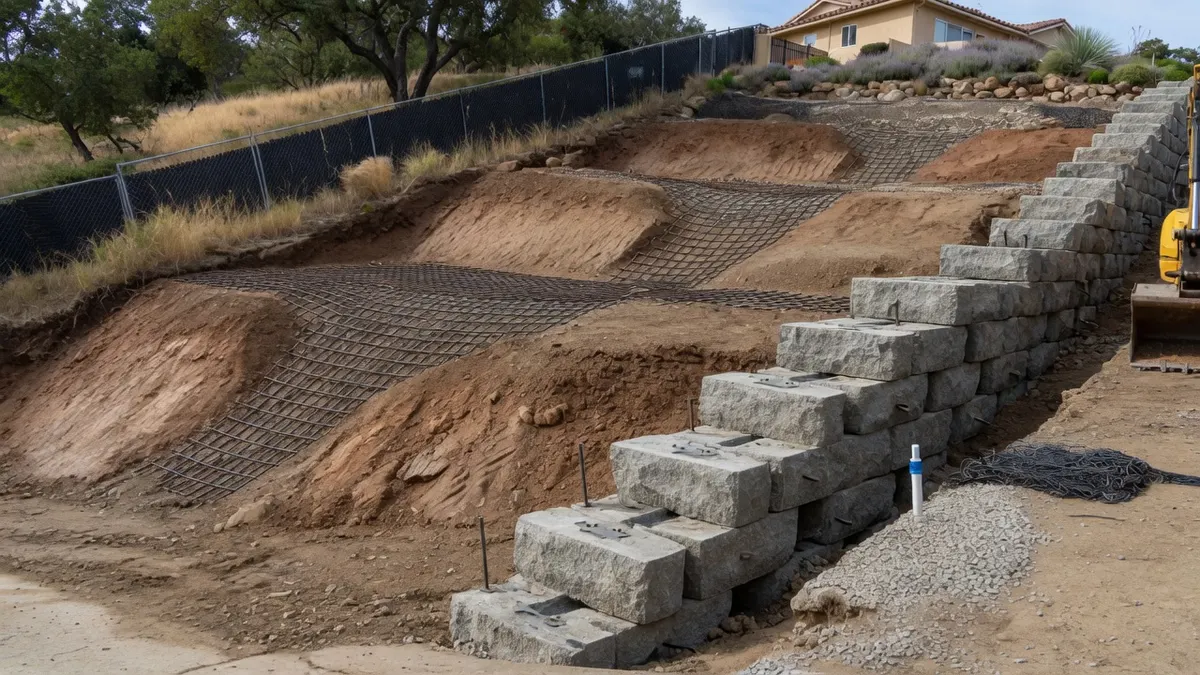
Fair Oaks Retaining Wall Repairs Before They Become Emergencies
A retaining wall rarely fails all at once. It leans a little after a wet February, then a little more, and one spring you notice the top course has crept an inch past the bottom and the flower bed behind it is sinking. In Fair Oaks, where so many properties sit on rolling lots with mature oaks and walls that went up decades ago, that slow creep is the most common warning sign people learn to ignore until a section finally lets go.
The good news is that a wall almost always tells you it's in trouble before it collapses. The trick is reading the signs early, while you still have options that cost thousands instead of tens of thousands.
Reading the wall before it reads you
Walk your wall after the first real rain of the season and look for the small stuff. A wall that bulges in the middle, tilts away from the slope, or shows stair-step cracks through block or mortar is telling you the soil behind it is winning. So is a wall that weeps muddy water from its face or stays damp days after the sky clears.
Pay attention to what's happening around the wall, too. A patio that's pulling away at one corner, a fence post that suddenly leans, soil that puddles uphill instead of draining off, these are all symptoms of the same underlying problem. Many Fair Oaks lots have grade changes that funnel water exactly where you don't want it, and the original builders didn't always plan for that.
Why Fair Oaks dirt and weather gang up on walls
Our soils swell when they're soaked and shrink when they bake, and that yearly cycle is brutal on anything holding back a slope. A wall built in the 1980s might have been perfectly adequate for its time and still be failing now, simply because the drainage behind it was never designed to handle a decade of expansion and contraction.
Here's the part homeowners are surprised to hear: the wall material is rarely the real failure. The hidden culprit is almost always water with nowhere to go. Without gravel backfill and a perforated drain pipe carrying water away, hydrostatic pressure builds behind the wall every rainy season and pushes until something gives. That's why a rebuild that skips the drainage isn't a repair at all, it's a countdown to the next one.
What the numbers actually look like
Across the Sacramento Valley, retaining wall repairs typically land somewhere between roughly $5,000 and $60,000, and that's a wide range for good reason. A short section of garden wall with decent access is at the low end. A tall engineered wall holding back a driveway, with a backhoe that can barely squeeze down the side yard, sits at the high one.
When you compare estimates, the cheapest line item isn't the one to chase. A real bid should spell out engineering, demolition, drainage rock, drain pipe, the wall material itself, equipment access, and putting your landscaping back together afterward. If one quote is dramatically lower, it's usually because it quietly left something out, often the drainage or the engineering. Set aside a contingency too, because older walls tend to hide surprises once you start digging behind them.
Licensed concrete contractors and landscaping crews both work on these projects depending on the wall type, so it's worth getting eyes from more than one trade if your situation is borderline.
Permits, engineering, and the license check you shouldn't skip
In California, retaining walls usually need a permit once they pass about four feet measured from the bottom of the footing, and shorter walls can trigger one too if they're holding back a surcharge, like a driveway or a structure above. Walls near a property line add their own wrinkles. An engineered design isn't bureaucratic busywork here, it's the document that tells the contractor how deep the footing goes and how the drainage gets sized.
Before you sign anything, verify the contractor's CSLB license at the Contractors State License Board. Any job where labor and materials total $1,000 or more legally requires a licensed contractor in California, and a retaining wall blows past that threshold easily. Confirm the license is active, then ask for proof of workers' compensation and liability insurance. A leaning wall is a structural job, and an uninsured crew working a slope is a risk you don't want sitting on your property.
While you're vetting, ask the questions that separate a careful contractor from a fast one. Why did the wall move? How will the new drainage work and where does the water end up? Is engineering required for this height? How does heavy equipment reach the site without tearing up the yard? Someone who answers these clearly before the job starts tends to communicate just as clearly when something unexpected turns up mid-dig.
Timing it so you're not the last call in October
Exterior work books up fast around here. Spring and early summer are peak season for concrete, landscaping, and anything that involves moving dirt, which means the contractor you want may be weeks out. The smarter play is to address a wall in late summer or early fall, before the rains return, so the new drainage is doing its job by the time the wet season arrives. A wall that fails in January is an emergency repair at emergency prices; the same wall handled in September is a planned project.
If you've spotted a lean or a crack this season, start by walking the wall, photographing every problem area from a few angles, and writing down what you've noticed about how water moves through your yard. That short record makes every estimate conversation sharper. From there, line up at least two or three licensed pros, you can build a shortlist through our Fair Oaks contractor guide or the broader Sacramento Valley contractor search, and compare not just the price but the scope. The wall that gets fixed properly, with drainage built in, is the one you stop thinking about for the next twenty years.
Who to Hire for This Project
For the work covered in this guide, these are the contractor types to contact and the CSLB classification to verify before you take quotes:
Questions to Ask Before You Sign
- "Is your CSLB license active and bonded?" Verify it yourself at cslb.ca.gov the license number must appear on their bid.
- "Who pulls the permit, and is it included in the bid?" The contractor should handle any required permits a pro who suggests skipping one is a red flag.
- "Can you itemize labor, materials, and allowances?" Itemized bids are the only way to compare quotes on the same scope.
- "What's the payment schedule?" California caps the down payment at $1,000 or 10%, whichever is less payments should track completed work.
- "Who from this area can I call as a reference?" Ask for a recent local job of similar scope, not just photos.
Sacramento Contractors for This Project
Related Articles
Frequently Asked Questions
How can I tell if my Fair Oaks retaining wall needs repair or can wait? +
Look for leaning or bulging, stair-step cracks through block or mortar, and the wall staying wet or weeping muddy water after the rain stops. Movement that's gotten visibly worse between seasons, or a patio and fence shifting near the wall, means the soil pressure is winning and you shouldn't wait. A wall that's plumb and dry with only minor cosmetic cracking can usually be monitored, but photograph it each year so you can spot creep early.
What does a retaining wall repair typically cost in the Sacramento Valley? +
Most repairs fall roughly between $5,000 and $60,000, depending heavily on wall height, length, material, and how easily equipment can reach the site. A short garden wall with good access sits at the low end, while a tall engineered wall holding back a driveway with tight side-yard access runs much higher. Always budget for drainage and a contingency, since older walls often reveal hidden problems once digging starts.
Do I need a permit to repair a retaining wall in Fair Oaks? +
Generally, walls over about four feet measured from the bottom of the footing require a permit in California, and shorter walls can too if they support a surcharge like a driveway or structure above. Walls near a property line may have additional requirements. Your contractor should confirm the specifics with Sacramento County and handle the permit and inspections, with that responsibility written into the contract.
Should I verify a contractor's license for a retaining wall job? +
Yes. Any project where labor and materials total $1,000 or more legally requires a licensed contractor in California, and a retaining wall easily exceeds that. Check that the CSLB license is active on the Contractors State License Board website, and ask for current proof of workers' compensation and liability insurance before signing. An uninsured crew working a slope is a liability you don't want on your property.
Why does drainage matter so much for a retaining wall? +
In Fair Oaks soils that swell when wet and shrink when dry, water trapped behind a wall builds hydrostatic pressure that pushes until the wall fails. Proper repair includes gravel backfill and a perforated drain pipe that carries water away from the wall. A rebuild that skips drainage isn't really a repair, it just resets the clock until the same failure happens again.
When is the best time of year to repair a retaining wall in Fair Oaks? +
Late summer or early fall is ideal, so the new wall and drainage are in place before the winter rains arrive. Spring and early summer are peak season for concrete and excavation crews, so contractors book up and lead times stretch. Handling the wall as a planned fall project also avoids the emergency pricing that comes with a wall failing in the middle of a January storm.