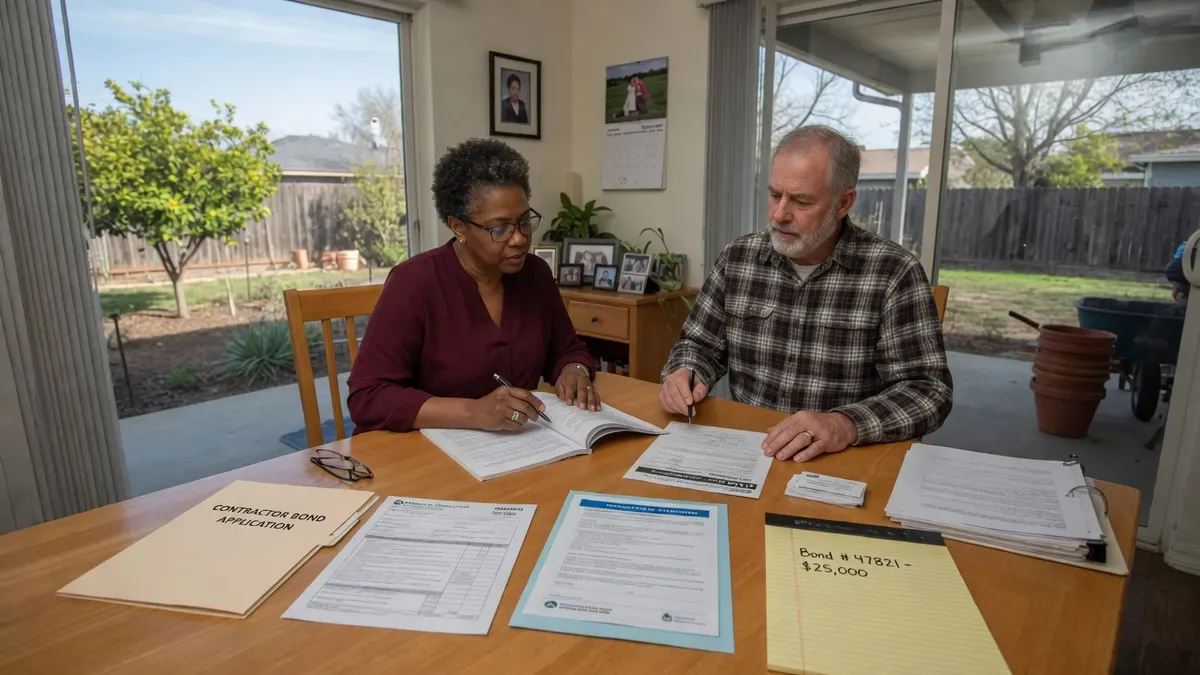
Do All California Contractors Need a Bond? License Bond Requirements Explained
If a person needs a California contractor license for your project, they also need an active contractor bond.
That is the simple homeowner rule. The confusing part is deciding when a license is required in the first place. A Sacramento homeowner hiring someone to patch a small drywall nick is in a different situation than someone hiring for a panel upgrade, water heater, roof repair, fence, bathroom remodel, or ADU.
Use this guide to sort the bond question before you sign.
Bond Requirement Quick Check
| Situation | Bond Usually Required? | Why |
| --- | --- | --- |
| Licensed contractor doing regulated work | Yes | CSLB license requires active bond |
| Work over California's contractor threshold | Yes, if licensed work | License and bond generally go together |
| Small handyman task under threshold | Usually no | May fall outside licensing rules |
| Electrical, plumbing, roofing, HVAC, structural work | Yes | Safety and trade rules matter |
| Owner doing their own work | No contractor bond | Homeowner carries owner-builder risk |
| LLC contractor | Yes, often additional bond | LLCs have extra bond requirements |
When the project touches safety systems, permits, or larger payments, assume you should verify a license and bond.
The License Question Comes First
California generally requires a contractor license for construction work over the state threshold, including labor and materials. The threshold is low enough that many "small" home projects still cross it quickly.
Common examples that usually call for a licensed, bonded contractor include:
- Electrical circuits, panels, EV chargers, or rewiring
- Plumbing lines, water heaters, sewer, and fixture relocation
- Roofing replacement or leak repair
- HVAC equipment, ducts, or mini-splits
- General contracting for remodels, additions, and ADUs
If the worker says, "I do not need a bond," ask whether they are licensed and whether the project legally requires that license.
Handyman Work Is Narrower Than People Think
A handyman can be appropriate for small, low-risk maintenance: hardware, touchups, minor patching, shelves, and simple repairs.
But the handyman label does not make licensed work legal. Splitting a larger job into smaller invoices to avoid licensing is a red flag, not a clever workaround.
Read our contractor vs handyman guide before hiring for anything near the threshold.
Additional Bond Situations
Some contractors may have more than the basic license bond:
- LLC contractors can have additional bond requirements
- Contractors with prior discipline may need a disciplinary bond
- Large private projects may use separate performance or payment bonds
- Home improvement salespeople have their own registration rules
More bond coverage can help, but it does not erase a bad complaint history. Extra bond information should make you ask better questions, not stop vetting.
How to Verify
Before signing:
- Ask for the CSLB license number
- Confirm license status is active
- Confirm the bond is active
- Confirm the business name matches your contract
- Confirm the classification matches the work
- Check workers' compensation status
- Ask for general liability proof separately
Use our license verification walkthrough if you have not done this before.
The Bottom Line
All licensed California contractors need a bond. For homeowners, the practical question is whether your project requires a licensed contractor. If it does, do not hire until the license, bond, classification, insurance, and business name all check out.
Start with the contractor search or browse by city, including Sacramento, Roseville, and Elk Grove.
Who to Hire for This Project
For the work covered in this guide, these are the contractor types to contact and the CSLB classification to verify before you take quotes:
Questions to Ask Before You Sign
- "Is your CSLB license active and bonded?" Verify it yourself at cslb.ca.gov the license number must appear on their bid.
- "Who pulls the permit, and is it included in the bid?" The contractor should handle any required permits a pro who suggests skipping one is a red flag.
- "Can you itemize labor, materials, and allowances?" Itemized bids are the only way to compare quotes on the same scope.
- "What's the payment schedule?" California caps the down payment at $1,000 or 10%, whichever is less payments should track completed work.
- "Who from this area can I call as a reference?" Ask for a recent local job of similar scope, not just photos.
Sacramento Contractors for This Project
Related Articles
Frequently Asked Questions
Do all contractors in California need a bond? +
All contractors who are required to hold a CSLB license must maintain a $25,000 surety bond. A contractor's license is required for any project where total labor and materials cost $1,000 or more. Workers performing jobs under $1,000 (the handyman exception) do not need a license or bond, though some types of work require a license regardless of cost.
Does a handyman need a contractor bond in California? +
A handyman working on projects under $1,000 (total labor and materials) does not need a contractor's license or bond. However, if the project costs $1,000 or more, or involves specialized work like electrical, plumbing, or structural modifications, a contractor's license and bond are required regardless of what the worker calls themselves.
Do LLC contractors need a bigger bond in California? +
Yes. Contractors organized as limited liability companies (LLCs) must carry an additional surety bond or cash deposit of $100,000 on top of the standard $25,000 license bond. This is because the LLC structure limits personal liability, so the additional bond provides extra consumer protection.
What types of contractor bonds exist in California? +
California has several types of contractor bonds: the standard $25,000 license bond (required for all licensed contractors), disciplinary bonds ($25,000-$150,000 for contractors with past violations), qualifying individual bonds ($25,000), LLC bonds ($100,000), and optional performance and payment bonds for large projects. Each serves a different protective purpose.
Can a contractor work without a bond in California? +
A contractor cannot legally perform work requiring a CSLB license without an active $25,000 surety bond. If the bond lapses or is canceled, the contractor's license becomes inactive and they must stop all licensed work until the bond is restored. Hiring an unbonded contractor means you have no bond claim protection if something goes wrong.