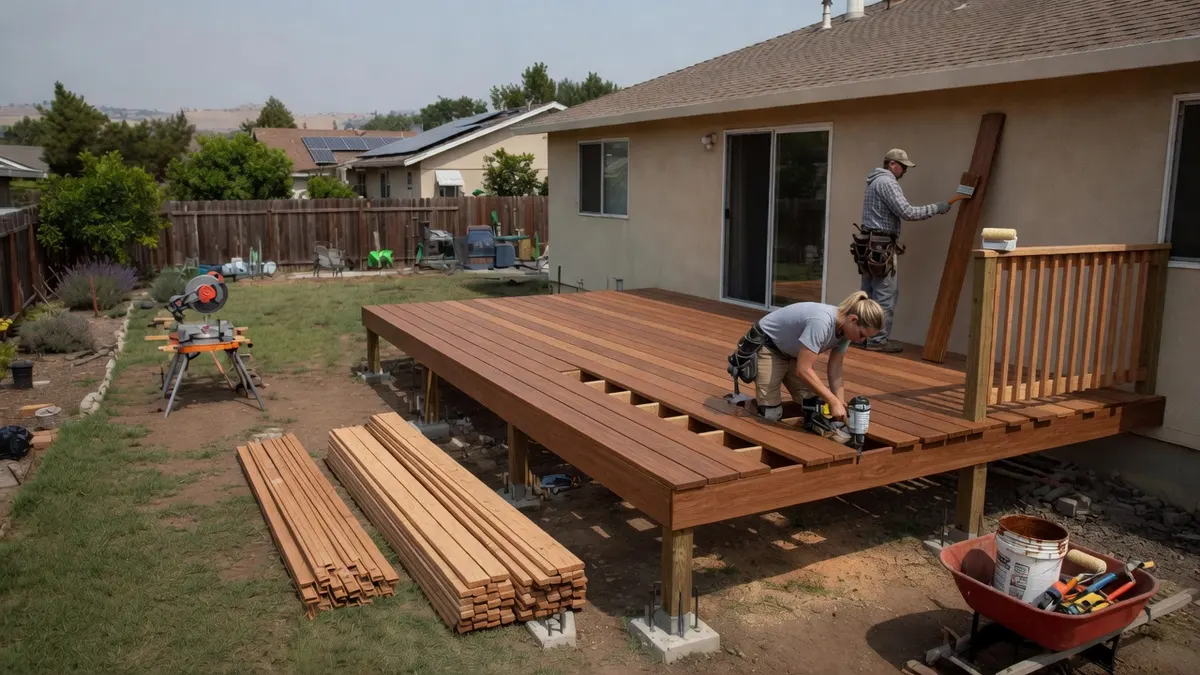
Deck and Patio Construction in Sacramento: Costs, Materials, Permits, and What to Plan For in 2026
Deck and patio construction in Sacramento should start with soil, shade, drainage, height, and how the space connects to the house.
A Fair Oaks homeowner on a sloped lot may need a raised deck with guardrails, stairs, engineering, and careful footings. A Natomas homeowner with a flat backyard may need a concrete or paver patio, shade, and drainage away from the slab. Both are outdoor living projects, but the contractor, permit path, and budget are different.
Use this guide before choosing deck boards or paver colors.
Deck or Patio Planning Chart
| Choice | Best Fit | Ask Before Pricing |
| --- | --- | --- |
| Raised deck | Sloped lots or elevated doors | Are footings, railing, stairs, and permits included? |
| Ground-level deck | Slight transitions and wood feel | How will ventilation and drainage work below? |
| Concrete patio | Durable flat-yard surface | What base prep and control joints are included? |
| Paver patio | Flexible design and repairable sections | How deep is the compacted base? |
| Covered patio | Hot yards and dining areas | Is shade structure permitting included? |
| Outdoor lighting | Safer steps and evening use | Is electrical work separately licensed? |
The right surface depends on grade and use.
Deck, Concrete, or Pavers
Decks work well when the yard drops away from the house or the doorway is above grade. Concrete patios work well for flat, practical dining or seating areas. Pavers add design flexibility and can be easier to repair, but they need real base preparation because Sacramento clay moves.
For deck-specific structure questions, compare Sacramento deck building cost planning.
What Changes Cost
Height, slope, railing, stairs, footings, material, demolition, drainage, shade, electrical, lighting, soil prep, access, and permit requirements all change the estimate. A raised deck and a stamped patio should not be compared by square foot alone.
Ask whether the bid includes demolition, hauling, base prep, footings, drainage, permits, inspection, railing, steps, lighting rough-in, and cleanup.
Sacramento Heat and Shade
An uncovered west-facing deck can be beautiful and still go unused all summer. Plan shade with trees, pergolas, patio covers, umbrellas, or roof-attached structures before finalizing layout.
For shade costs, read patio cover and pergola planning.
Contractor Fit
Use a licensed deck contractor or general contractor for structural deck work. Concrete patios may need a concrete contractor. Larger outdoor living projects may combine landscaping, electrical, concrete, and general contracting.
The Bottom Line
Sacramento deck and patio cost depends on grade, surface type, footings, drainage, shade, permits, and how the space will actually be used. Decide the structure first, then choose finishes.
Start with deck contractors, concrete contractors, compare Fair Oaks and Natomas contractor options, or search deck and patio pros.
Who to Hire for This Project
For the work covered in this guide, these are the contractor types to contact and the CSLB classification to verify before you take quotes:
Questions to Ask Before You Sign
- "Is your CSLB license active and bonded?" Verify it yourself at cslb.ca.gov the license number must appear on their bid.
- "Who pulls the permit, and is it included in the bid?" The contractor should handle any required permits a pro who suggests skipping one is a red flag.
- "Can you itemize labor, materials, and allowances?" Itemized bids are the only way to compare quotes on the same scope.
- "What's the payment schedule?" California caps the down payment at $1,000 or 10%, whichever is less payments should track completed work.
- "Who from this area can I call as a reference?" Ask for a recent local job of similar scope, not just photos.
Sacramento Contractors for This Project
Related Articles
Frequently Asked Questions
How much does it cost to build a deck in Sacramento? +
A pressure-treated pine deck costs $25-$50 per square foot installed. Composite decking (Trex, TimberTech) runs $50-$100 per square foot. Cedar or redwood decks cost $40-$80 per square foot. For a typical 16x20 deck (320 sq ft), expect $8,000-$16,000 for pine, $16,000-$32,000 for composite, and $12,800-$25,600 for cedar or redwood. These prices include framing, railing, stairs, and labor but not permits.
How much does a patio cost in Sacramento? +
A basic concrete patio costs $10-$20 per square foot. Stamped or stained concrete runs $20-$40. Concrete pavers cost $20-$40 per square foot, and natural stone (flagstone) runs $20-$65 depending on installation method. For a 16x20 patio (320 sq ft), expect $3,200-$6,400 for basic concrete or $6,400-$12,800 for pavers.
Do I need a permit to build a deck in Sacramento? +
Yes, in most cases. The City of Sacramento and Sacramento County require permits for any deck more than 30 inches above grade, any attached deck, and any covered structure. Ground-level patios (concrete, pavers) typically don't require permits. Permit fees run $250-$800. Your contractor should handle the entire permit process.
What is the best decking material for Sacramento's climate? +
Composite decking (Trex, TimberTech, Fiberon) is the most popular choice because it requires almost no maintenance and resists Sacramento's UV exposure without staining. Choose light or medium colors because dark composite gets extremely hot in direct sun. For budget projects, pressure-treated pine works but needs staining every 1-2 years.
How hot does composite decking get in Sacramento? +
On a 100-degree day in direct sun, dark composite decking can reach 145-170 degrees at the surface. Medium tones hit 130-150 degrees. Light colors stay around 120-140 degrees. None are comfortable barefoot above 125 degrees. Shade structures, lighter colors, and rugs help manage heat on Sacramento decks.
How long does it take to build a deck or patio in Sacramento? +
A typical deck takes 1-3 weeks to build after permits are approved. Permit approval takes 2-4 weeks. A concrete patio takes 3-5 days plus 7 days for curing. Paver patios take 3-7 days. Total timeline from contract to completion is 4-8 weeks for most projects, depending on permit processing and material availability.