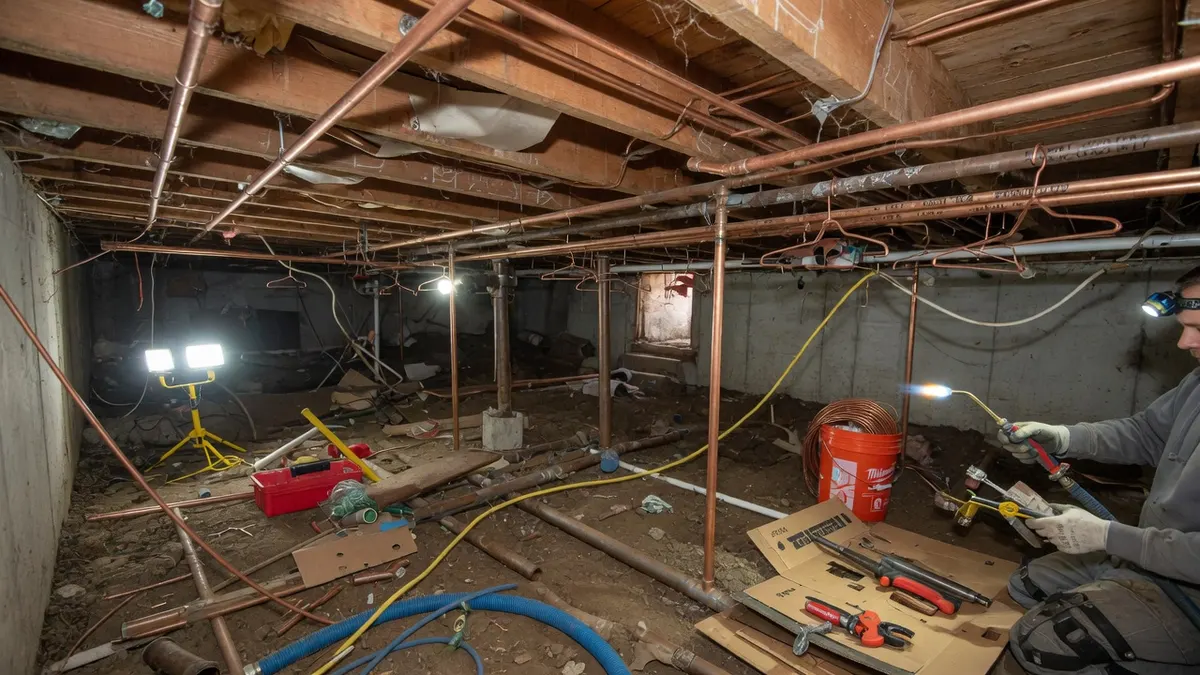
Carmichael Whole-House Repiping: When Repairs Stop Making Sense
There's a specific sound a 1962 Carmichael ranch makes when the galvanized supply lines are giving up: a faint shudder in the wall when you shut off the kitchen faucet, then a drop in shower pressure the moment someone flushes down the hall. If your house was built when Carmichael was still orchards turning into subdivisions, you've probably heard it. The instinct is to fix the latest leak and move on. Sometimes that's the right call. But there's a point where patching the next pinhole costs you more peace of mind than replacing the whole system would.
The day a leak stops being a leak
One drip under the bathroom sink is a Saturday afternoon. The problem is when the drips start clustering. A coupling fails in March, a hot-water line weeps in June, and by fall the pressure in the back bedrooms has quietly gone soft. That pattern usually means the pipe itself, not any single fitting, is the thing wearing out.
Galvanized steel is the usual suspect in this part of the Sacramento Valley. A lot of mid-century Carmichael homes were plumbed with it, and after fifty or sixty years the interior of those pipes scales over with rust and mineral buildup. You can't see it, but you can measure it: the inside diameter shrinks until the water has to fight its way through. Hard Sacramento-area water speeds that along. Once the corrosion is system-wide, chasing leaks one at a time is like patching a roof shingle by shingle during a storm.
Copper, PEX, and what your walls will look like after
The two materials worth discussing are copper and PEX, and they lead to genuinely different jobs. Copper is rigid, long-proven, and tends to cost more in both material and labor because every joint gets soldered. PEX is flexible tubing that can often be routed through existing wall cavities with fewer open holes, which usually means less drywall demolition and a faster install. Neither is automatically "better" for your house, and a contractor who only ever installs one should at least be able to tell you why.
Whatever the pipe, the part homeowners underestimate is the wall repair afterward. A repipe means cutting access points at every fixture and along the runs in between. Patching, texturing to match that 1960s orange-peel finish, and repainting is real work, and it belongs in the estimate from day one. If a bid is silent on drywall and paint, that's not a lower price. It's an unanswered question.
For the broader picture on whom to hire and what local crews charge, our Carmichael contractor guide and the list of licensed plumbing contractors are a good starting point.
What this actually runs in the Sacramento Valley
For a whole-house repipe, a realistic range around here is roughly $8,000 to $24,000, and that spread is wide for honest reasons. A compact two-bath ranch on a slab is a different animal than a four-bath two-story with a crawl space. Copper pushes the number up. The amount of drywall and finish work pushes it up further. Fixture and shutoff-valve upgrades, if you choose to do them while the walls are open, add to it too.
Set aside a contingency, especially in older homes. Once a crew is behind the drywall, they sometimes find a previous repair that never matched code, or framing that complicates a run. A budget with a cushion built in is a budget that won't blow up the first time someone says "well, look at this."
When you compare estimates, read the assumptions before you read the bottom line. A thorough bid names the material, the labor, what's excluded, who patches the walls, who pulls the permit, and what could move the price. Two numbers that look far apart often just describe two different scopes of work.
The license check most people skip
In California, any home-improvement job where labor plus materials totals $1,000 or more must be done by a contractor holding an active CSLB license. (You may still see the old $500 figure floating around online; it's outdated.) A repipe clears that bar without question, so verify the license before you sign anything. It takes two minutes on the Contractors State License Board website, where you can confirm the license is active, in the right classification, and backed by workers' compensation coverage.
Pull that record yourself rather than trusting a number printed on a business card. While you're at it, ask for proof of liability insurance. A reputable Carmichael plumber will hand it over without flinching.
Permits, inspections, and timing the job
A whole-house repipe in unincorporated Sacramento County, which is where Carmichael sits, needs a plumbing permit and an inspection. The contractor typically handles the application and meets the inspector, but the contract should spell out who's responsible so there's no finger-pointing later. The inspection is your backstop. It's the moment a county official confirms the new system was installed to code before the walls close back up, so don't let anyone talk you into skipping it.
On timing: plumbers in the valley book up fast in late spring and summer when everyone's tackling projects at once. If your situation isn't an emergency, the shoulder seasons can mean a quicker spot on the calendar. Either way, confirm material lead times up front, since they can quietly add a week before anyone swings a hammer.
If your repipe is happening alongside a larger remodel, it's worth coordinating with whoever's handling the bathroom remodel so the walls only get opened once.
So before the first estimate, walk the house. Note every spot that's leaked, when the pressure first felt off, and which bathrooms matter most to you. Take photos. Then line up at least three licensed bids through our Sacramento Valley contractor search and compare them on scope, not just price. The goal isn't the cheapest number on the page. It's a clean plan, an honest contingency, and a system you won't think about again for another forty years.
Who to Hire for This Project
For the work covered in this guide, these are the contractor types to contact and the CSLB classification to verify before you take quotes:
Questions to Ask Before You Sign
- "Is your CSLB license active and bonded?" Verify it yourself at cslb.ca.gov the license number must appear on their bid.
- "Who pulls the permit, and is it included in the bid?" The contractor should handle any required permits a pro who suggests skipping one is a red flag.
- "Can you itemize labor, materials, and allowances?" Itemized bids are the only way to compare quotes on the same scope.
- "What's the payment schedule?" California caps the down payment at $1,000 or 10%, whichever is less payments should track completed work.
- "Who from this area can I call as a reference?" Ask for a recent local job of similar scope, not just photos.
Sacramento Contractors for This Project
Related Articles
Frequently Asked Questions
How do I know it's time to repipe my Carmichael home instead of fixing leaks? +
The tipping point is usually a pattern, not a single leak. If you're seeing repeated pinhole leaks, falling water pressure in back rooms, or rusty-looking water from original galvanized lines, the pipe itself is failing system-wide. At that stage, repeated patch repairs tend to cost more over time than a planned whole-house repipe.
What does a whole-house repipe typically cost in the Sacramento Valley? +
A realistic range is roughly $8,000 to $24,000, and the spread is driven by real factors. House size and number of bathrooms, copper versus PEX, crawl space versus slab, and the amount of drywall and paint repair all move the number. Always include wall patching, texture matching, and a contingency for older homes in the budget conversation.
Should I choose copper or PEX for a repipe in Carmichael? +
Both are valid. Copper is rigid, long-proven, and usually costs more because every joint is soldered. PEX is flexible tubing that can often be routed through existing wall cavities with fewer access holes, which can mean less drywall repair and a faster install. A good contractor should explain the tradeoffs rather than pushing only the material they prefer.
Do I need a permit to repipe a house in Carmichael? +
Yes. Carmichael is in unincorporated Sacramento County, and a whole-house repipe requires a plumbing permit and an inspection. The contractor usually handles the application and meets the inspector, but your contract should clearly state who is responsible. The inspection confirms the new system meets code before the walls are closed up, so don't skip it.
How do I verify a Carmichael plumber's license before hiring? +
In California, any project where labor and materials total $1,000 or more must be done by an actively licensed contractor (the older $500 figure is outdated). Look the contractor up on the CSLB website to confirm the license is active, in the correct classification, and carries workers' compensation coverage. Also ask for proof of liability insurance before signing.
Why are galvanized pipes such a common problem in older Carmichael homes? +
Many mid-century Carmichael homes were plumbed with galvanized steel, which corrodes and scales internally over decades. The buildup narrows the pipe's interior, which is why water pressure drops even when no fitting is obviously leaking. Hard Sacramento-area water accelerates the process, so homes from the 1950s and 60s are prime candidates for a full repipe.