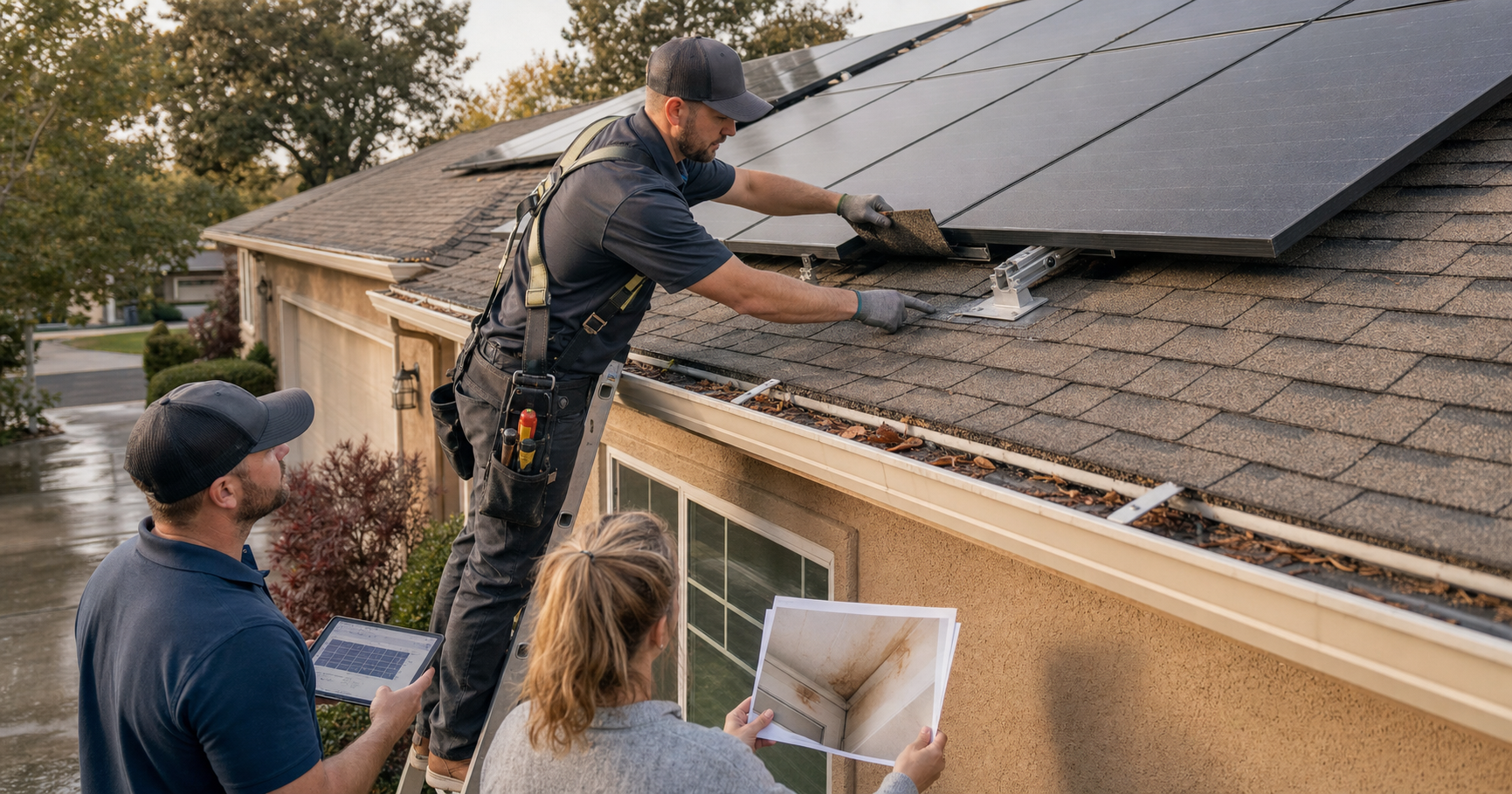
Antelope Roof Leaks Around Solar Panels: Who to Call Before Rain
The ceiling stain shows up in the worst possible place: right below the roof plane with solar panels.
An Antelope homeowner notices a tan ring over the hallway after the first hard rain. The roof is not obviously failing from the street. The solar app says the system is producing. The roofer says the panels may need to come off before anyone can see the decking. The solar company says it only installed the array, not the roof. Suddenly a small leak feels like a handoff problem.
That is why roof leaks near solar panels need a different hiring plan than a normal missing-shingle repair. The source might be a solar mount, flashing boot, underlayment failure, cracked tile, old composition shingles, a nearby vent, a gutter backup, or water traveling from a higher point before it appears inside. The right fix depends on diagnosis, not guesswork.
| Likely issue | What to verify | Best lead | Common cost driver |
|---|---|---|---|
| Leak at solar mount or flashing | Mount type, sealant, flashing, lag location, panel access. | Roofer plus solar contractor | Panel removal and reset |
| Old roof failing under panels | Shingle age, underlayment condition, decking damage, reroof timing. | C-39 roofer | Array detach/reinstall |
| Electrical or conduit penetration | Roof penetration, junction box, conduit route, shutdown procedure. | Solar or electrical contractor | Safe disconnect/reconnect |
| Nearby vent, skylight, or gutter problem | Water path from uphill roof areas, debris, cracked boots, attic staining. | Roofer | Access and matching materials |
Use this chart before comparing bids. A roof-leak estimate near solar panels is not complete until it says who diagnoses the leak, who detaches panels if needed, who repairs the roof, who reconnects equipment, and who documents the work.
Start With The Leak Evidence
Do not start by asking, "Is it the solar?" Start by building a short evidence file. Photograph the ceiling stain with a ruler or tape measure beside it. Photograph the attic stain if you can do that safely from stable access. Take exterior photos from the ground showing the roof plane, panel array, vents, gutters, and nearby trees. Write down when the stain appeared, whether it grows only during wind-driven rain, and whether the leak lines up with a mount, conduit run, vent, or valley.
That simple file changes the first contractor visit. A roofer can compare the indoor stain to the roof slope. A solar contractor can identify which panels or mounts might need access. If the system has production monitoring, save screenshots that show whether the system is operating normally. If the solar installer gave you as-built drawings, permit records, or a workmanship warranty, gather those before anyone climbs on the roof.
Also check the age of the roof. Solar panels can outlast an older composition roof underneath them. If the roof was already near the end of its service life when panels were installed, a leak may be telling you the whole roof plane needs planning rather than one tube of sealant.
Why Antelope Homes Need A Clear Hand-Off
Antelope has many practical suburban homes built from the late 1980s through the 2000s, plus later infill and remodels. Those roofs have lived through hot Sacramento summers, winter rain, wind, tree debris, gutter buildup, satellite dish removals, and sometimes a solar array added long after the original roof was installed.
Solar complicates access. Panels hide shingles or tile, and the leak source may sit under a module that a roofer should not casually move. The solar contractor may know the racking system, but may not be the right trade to evaluate roof underlayment, dry rot, or a broader reroof. The roofer may know how to stop water, but may not own electrical shutdown, panel removal, production testing, or solar warranty paperwork.
That does not mean the project has to become a fight. It means the written scope should name the hand-off. Good contractors can coordinate: solar detach, roof investigation, flashing or reroof work, solar reinstall, final roof photos, system startup, and warranty documentation.
What It Might Cost In 2026
These are planning ranges for Antelope and nearby Sacramento County homes, not quotes:
- Leak inspection with attic check and roof photos: $250 to $900 depending on roof pitch, access, rain timing, and whether water testing is needed.
- Small flashing, boot, vent, or shingle repair away from panel removal: $650 to $3,500 when materials are available and the damaged area is limited.
- Solar panel detach and reset for roof access: $1,500 to $6,500-plus for a small section, and often more for larger arrays, tile roofs, older equipment, battery-tied systems, or difficult access.
- Repair under a solar array: $2,500 to $12,000-plus when panels must come off and the roofer repairs underlayment, decking, flashing, tile, or shingles.
- Reroof before reinstalling solar: $12,000 to $35,000-plus for many composition roofs, with tile, complex rooflines, dry rot, gutters, and array work adding more.
- Interior drywall, paint, insulation, or mold-related repair after the leak is fixed: $750 to $8,000-plus depending on water spread and finish matching.
The key cost question is not just "how much is the roof repair?" It is whether solar equipment has to be detached and reset to make the roof repair real. A low roof bid that excludes panel handling may not be cheaper once the solar company gives its number. A solar bid that resets panels onto a marginal roof may simply put the system back over the next leak.
Which Contractor Should Lead?
If there is visible water intrusion, start with a licensed roofing contractor who can diagnose the roof assembly and water path. The CSLB's C-39 roofing classification covers installing and repairing surfaces that seal, waterproof, and weatherproof structures. That is the lane for roof leak diagnosis, shingles, tile, underlayment, flashing, vents, roof jacks, and many roof-related dry-in questions.
Bring in the solar company or a qualified solar contractor when panels, racking, wiring, conduit, inverters, production monitoring, batteries, or warranties are involved. The CSLB's C-46 solar classification covers installing, modifying, maintaining, and repairing solar energy systems, but it does not turn a solar contractor into a general roof-repair contractor outside work required for the solar system. Electrical work belongs with the right electrical scope; CSLB's C-10 electrical classification includes electrical wires, raceways, conduits, apparatus, and solar photovoltaic cells.
A general contractor can be useful when the leak has already damaged drywall, insulation, framing, paint, cabinets, flooring, or multiple rooms. But for a roof leak near solar panels, the lead still has to coordinate the roof and solar specialists instead of letting each one inspect only their own piece.
Sacramento County Permit And Inspection Questions
Antelope is generally in unincorporated Sacramento County, so homeowners should start with Sacramento County Building Permits and Inspection for current permit handling. The county's FAQ says certain residential permits can be automatically issued online, including residential re-roof with no structural changes, and it lists residential solar using SolarAPP as contractor-use only. The same FAQ includes re-roof, photovoltaic solar systems, electrical panel or circuit work, skylights, siding or stucco, and termite or dry-rot repair among typical permit-required projects.
Sacramento County's SolarAPP guidance says licensed contractors can submit qualifying residential roof-mounted photovoltaic designs for automated review and an auto-issued permit, with eligibility limits. That is most useful for new or qualifying solar work. It does not mean every leak repair under existing panels is automatically simple or permit-free.
Ask these permit questions before signing:
- Is this a roof repair, re-roof, solar detach and reset, electrical repair, structural repair, or interior water-damage repair?
- Does the roof work qualify as a repair, or are we crossing into a re-roof permit?
- If panels come off and go back on, who owns any solar permit, inspection, production test, and utility or monitoring documentation?
- If dry rot, decking, rafters, stucco, skylights, or electrical components are found, who prices and permits that extra scope?
- Who keeps photos of the open roof, repaired flashing, underlayment, fasteners, and panel reinstallation?
Sacramento County also says final sign-off records should be kept for a home project. That is especially important with solar because future buyers, insurers, and warranty teams may ask what happened when panels were removed and reinstalled.
Questions To Ask Before You Sign
Use the first estimate visit to separate diagnosis from repair. A good contractor should be willing to say, "We need to remove two panels before we can price the hidden damage," if that is the honest answer. That is better than pretending every leak can be solved from the ground.
Ask each bidder:
- What evidence points to the leak source?
- Can you inspect the attic and photograph the underside of the roof deck?
- Do any solar panels need to be detached before the roof can be repaired correctly?
- Who shuts down, removes, stores, reinstalls, and tests the solar equipment?
- Will the solar workmanship or equipment warranty be affected?
- Are matching shingles or tiles available?
- Does the bid include underlayment, flashing, fasteners, sealant, decking repair, and debris cleanup?
- What happens if rain arrives while panels are off or the roof is open?
- Will you provide before, during, and after photos?
- Which permits and inspections are included or excluded?
Do not accept "we will seal around it" as the whole plan unless the contractor has actually found a minor surface issue that can be solved that way. Sealant can be part of a repair. It should not be a substitute for diagnosis.
Red Flags Around Solar Roof Leaks
Be cautious if a roofer wants to move panels without explaining solar shutdown, wiring, warranty, or reinstall testing. Be equally cautious if a solar company blames the roof without checking mount flashing, conduit penetrations, and original installation photos.
Other red flags include no attic inspection, no photos, no permit assumption, no plan for rain protection, vague "roof tune-up" language, no mention of matching tile or shingles, and no written hand-off between trades. If the roof is older, be careful with a spot repair that ignores the condition of the whole roof plane under the array. Solar panels make roof access more expensive later, so reroof timing matters.
Also ask about liability and workers' compensation coverage. Roof and solar work puts people on the roof, around electrical equipment, and sometimes near fragile tile. A cheap cash repair is not a bargain if the contractor is uninsured or outside the license scope.
Internal Homework Before You Hire
Start with our Antelope contractor guide, then compare licensed roofing contractors, solar contractors, electrical contractors, general contractors, drywall contractors, and gutter contractors. Use the contractor search when you are ready to build a shortlist.
For related planning, pair this with our roof replacement cost guide, solar panel installation guide, Sacramento reroof permit checklist, ceiling stain and drywall leak-source guide, California permit basics, and license verification checklist.
The Bottom Line
A roof leak near solar panels is not automatically a solar failure, and it is not automatically a roof-only repair. It is a coordination problem until the water path is proven.
Hire the contractor team that can document the leak, protect the home before the next rain, detach panels only when needed, repair the roof assembly correctly, reinstall and test the solar equipment, and leave you with photos, permits, and warranty paperwork. That is the difference between stopping one ceiling stain and setting up the roof for the next storm.
Who to Hire for This Project
For the work covered in this guide, these are the contractor types to contact and the CSLB classification to verify before you take quotes:
Questions to Ask Before You Sign
- "Is your CSLB license active and bonded?" Verify it yourself at cslb.ca.gov the license number must appear on their bid.
- "Who pulls the permit, and is it included in the bid?" The contractor should handle any required permits a pro who suggests skipping one is a red flag.
- "Can you itemize labor, materials, and allowances?" Itemized bids are the only way to compare quotes on the same scope.
- "What's the payment schedule?" California caps the down payment at $1,000 or 10%, whichever is less payments should track completed work.
- "Who from this area can I call as a reference?" Ask for a recent local job of similar scope, not just photos.
Sacramento Contractors for This Project
Related Articles
Frequently Asked Questions
Who should I call first for a roof leak near solar panels in Antelope? +
Start with a licensed roofing contractor for leak diagnosis, especially if water has entered the house. Bring in the solar installer or a qualified solar contractor if panels, mounts, conduit, production equipment, or warranties may need to be touched.
Do solar panels have to be removed to repair a roof leak? +
Sometimes. If the suspected leak is under the array, panels may need to be detached so the roofer can inspect flashing, underlayment, decking, and fasteners. If the leak is from a nearby vent, gutter, valley, or exposed roof area, removal may not be necessary.
How much does it cost to fix a roof leak around solar panels? +
A simple roof leak repair away from panel removal may be about $650 to $3,500. Repairs under panels can run $2,500 to $12,000-plus once detach, reset, access, and hidden damage are included. A full reroof with solar detach and reinstall can be much higher.
Does Sacramento County require a permit for roof work near solar panels? +
It depends on the exact scope. Sacramento County lists re-roof, photovoltaic solar systems, electrical circuits, and many structural or dry-rot repairs as typical permit-required work. Ask whether your project is a minor repair, a re-roof, solar work, electrical work, or a combined permit scope.
Can a roofer remove and reinstall my solar panels? +
Do not assume so. Roofers and solar contractors have different license scopes, warranties, and insurance issues. Some roofing companies coordinate solar detach and reset through a solar partner. The written bid should say who shuts down, removes, stores, reinstalls, tests, and warranties the solar equipment.
What documents should I keep after a solar-area roof leak repair? +
Keep before-and-after photos, permit records, inspection sign-offs if applicable, roof repair invoice, solar detach and reinstall paperwork, system startup or production confirmation, warranty notes, and any attic or interior water-damage repair documentation.