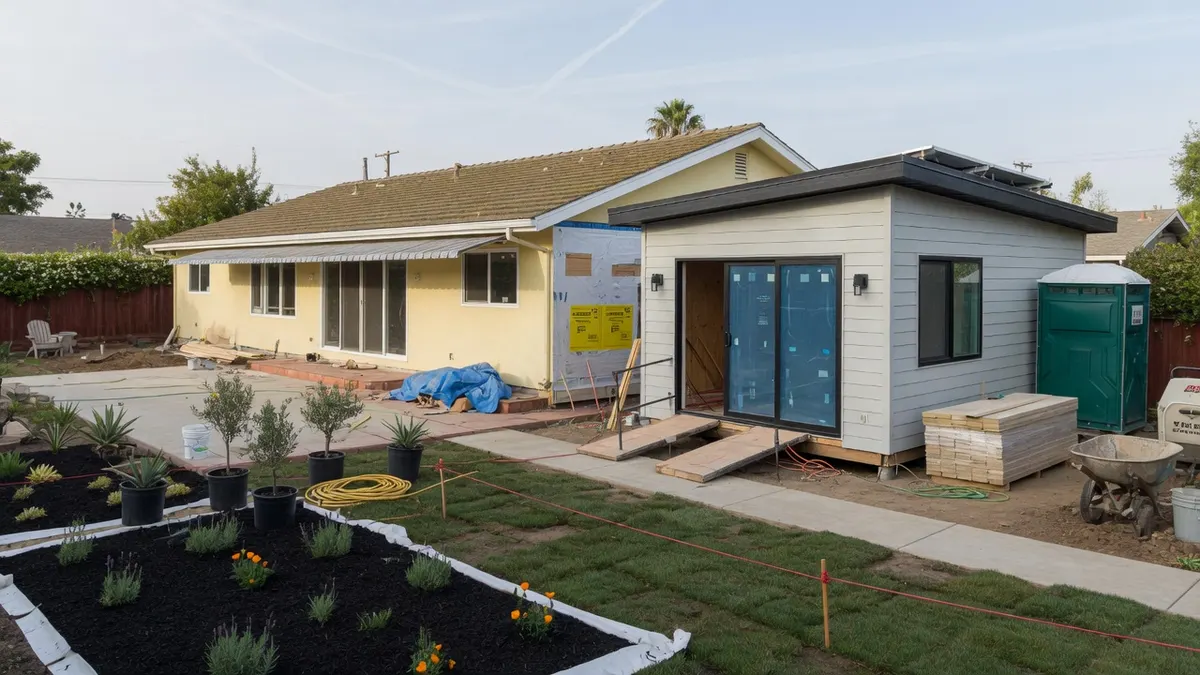
The Complete Guide to Building an ADU (Granny Flat) in Sacramento in 2026
Watch: Quick Homeowner Overview
A short vertical explainer for this guide share it on socials or preview the project before you read.
An ADU can be a smart investment, but it is not a backyard shed with nicer finishes.
A Sacramento homeowner might picture a 600-square-foot cottage for a parent, a rental, or a separate office. The real project includes design, zoning, utilities, drainage, electrical capacity, sewer connection, fire separation, inspections, and a contractor who has actually built small dwellings before. The best ADU projects start with those constraints, not with cabinet colors.
Here is how to think through the job before spending money on plans.
ADU Options at a Glance
| ADU Type | Best Fit | Cost Pressure | Contractor Notes |
| --- | --- | --- | --- |
| Garage conversion | Existing shell, tighter budget | Utility upgrades, insulation, slab, fire separation | Needs careful code review |
| Detached backyard ADU | Privacy, rental income, family housing | Foundation, utilities, site access | Usually a general contractor project |
| Attached ADU | Lot has limited yard space | Structural tie-in, roofline, access | Needs design and framing coordination |
| Junior ADU | Small internal unit | Layout, privacy, shared systems | Good when existing space works |
The cheapest option on paper is not always cheapest on your lot.
Start With the Site, Not the Floor Plan
Before choosing a plan, walk the property with a contractor or designer and answer:
- Where can sewer, water, and electrical connect?
- Is the electrical panel large enough?
- Can equipment and materials reach the backyard?
- Are there protected trees, drainage issues, or easements?
- How close are fences and neighboring structures?
- Where will trash, parking, mail, and access work?
Backyard access is a real Sacramento cost issue. A narrow side yard can change the equipment, labor, and timeline.
Realistic Sacramento ADU Budgets
Costs move with size, utilities, finish level, and site complexity. As a planning range:
- Garage conversion: often lower than new construction, but only if the shell is suitable
- Small detached ADU: commonly a six-figure project once utilities and site work are included
- Larger detached ADU: higher total cost, but sometimes better cost per square foot
- Prefab ADU: can simplify the structure, but foundation, permits, utility trenching, and installation still remain
Ask each contractor to separate hard construction, permit/design fees, utility upgrades, and allowances. If one bid is much lower, find the missing line item before you celebrate.
Permits and Plans Are Part of the Project
ADUs are permit-heavy because they create a legal dwelling unit. Expect drawings, energy compliance, structural details, utility information, inspections, and final approval.
Your contractor should be able to explain:
- Which jurisdiction reviews the project
- Whether pre-approved plans are useful for your lot
- What design professional is involved
- How inspections are sequenced
- Who communicates with the building department
For permit basics, read our California home improvement permit guide.
Who to Hire First
Most ADUs need a licensed general contractor because the work coordinates multiple trades: foundation, framing, roofing, siding, plumbing, electrical, HVAC, insulation, drywall, finishes, and site restoration.
You may also need:
- Designer or architect for plans
- Structural engineer for foundation/framing details
- Plumber for water, sewer, gas, and fixtures
- Electrician for panel capacity and circuits
- HVAC contractor for mini-split or ducted design
- Roofer if the ADU roof ties into the main house
Before signing, verify the contractor license and ask for local ADU references, not just remodel references.
Timeline Homeowners Should Expect
ADUs move in phases:
| Phase | What Happens | Homeowner Risk |
| --- | --- | --- |
| Feasibility | Site, zoning, utilities, budget | Falling in love with an impossible plan |
| Design | Drawings, engineering, selections | Under-scoped plans create change orders |
| Permits | Review and corrections | Schedule depends on jurisdiction and plan quality |
| Construction | Site work through finishes | Hidden utility and access conditions |
| Final | Inspections, punch list, occupancy | Holding final payment without clear standards |
The cleanest projects have decisions made before construction starts: window placement, cabinet layout, appliance specs, flooring, exterior finish, and utility approach.
Questions That Protect Your Budget
Ask:
- Is the electrical panel large enough for the ADU?
- How far is the sewer connection?
- Are trenching, backfill, and landscape repair included?
- Are appliances, cabinets, and fixtures allowances or fixed selections?
- Who pays for plan check corrections?
- What happens if the inspector requires changes?
- How are change orders priced?
- Is the ADU built for long-term rental durability or family use?
Use our hiring checklist before comparing bids.
The Bottom Line
An ADU is a small house, not a small remodel. Sacramento homeowners should start with feasibility, utilities, permits, and contractor experience before choosing finishes.
Hire a licensed general contractor with real ADU work behind them, verify the license, and make the scope specific enough that the bids can be compared fairly. Browse Sacramento contractors or search by trade in the contractor directory.
Who to Hire for This Project
For the work covered in this guide, these are the contractor types to contact and the CSLB classification to verify before you take quotes:
Questions to Ask Before You Sign
- "Is your CSLB license active and bonded?" Verify it yourself at cslb.ca.gov the license number must appear on their bid.
- "Who pulls the permit, and is it included in the bid?" The contractor should handle any required permits a pro who suggests skipping one is a red flag.
- "Can you itemize labor, materials, and allowances?" Itemized bids are the only way to compare quotes on the same scope.
- "What's the payment schedule?" California caps the down payment at $1,000 or 10%, whichever is less payments should track completed work.
- "Who from this area can I call as a reference?" Ask for a recent local job of similar scope, not just photos.
Sacramento Contractors for This Project
Related Articles
Frequently Asked Questions
How much does it cost to build an ADU in Sacramento? +
Expect $80,000-$150,000 for a garage conversion and $150,000-$350,000 for new detached construction. The average cost is $250-$400 per square foot for new construction, varying based on size, finishes, site conditions, and utility connection requirements.
How long does it take to build an ADU in Sacramento? +
Plan for 6-14 months total: 1-3 months for design and planning, 1-2 months for permits, and 4-8 months for construction. Garage conversions are typically faster than new construction.
Do I need to live on the property if I build an ADU? +
For standard ADUs, California law generally does not require owner-occupancy. For Junior ADUs (JADUs), the homeowner must live in either the main house or the JADU.
Can my HOA prevent me from building an ADU? +
No. California law (AB 670 and subsequent legislation) prohibits HOAs from banning ADUs. They can impose reasonable design and architectural standards, but cannot effectively block ADU construction.
Do I need to provide parking for an ADU? +
In most cases, no. California law eliminates parking requirements for ADUs located within a half-mile of public transit, in historic districts, or when on-street parking is available. Most Sacramento ADUs are exempt from additional parking requirements.
Can I sell my ADU separately from my main house? +
Under AB 1033 (effective 2024), cities can allow ADUs to be sold as condominiums, separate from the primary home. Sacramento is evaluating implementation of this provision.
Will building an ADU increase my property taxes? +
Yes, but only on the value of the ADU itself. Your existing home's assessed value won't be reassessed. For a $200,000 ADU, expect roughly $2,000-$2,500 in additional annual property taxes.
What utility connections does my ADU need? +
ADUs need connections to water, sewer (or septic), electricity, and typically gas. The City of Sacramento does not require separate utility meters, but SMUD typically requires a separate electrical meter for ADUs.